
Short answer: Hyperliquid is legit, and it is safe enough for the money you actively trade. It is a self-custodial exchange that cleared $6.15B of perp volume in the 24 hours to November 3, 2026, and no hack of the protocol has ever drained user balances. It is not risk-free, though. Market manipulations have cost its community HLP vault money, five Foundation validators hold almost half the stake, and the web app can block a wallet it flags with no appeal. We rate it 4.1/5: the best on-chain venue for experienced perp traders, but not a place to learn leverage.
Verdict
Use Hyperliquid if you…
- trade BTC, ETH, SOL or HYPE perps and want CEX-grade depth (BTC spread 0.12 bp; in our order-book test on Sep 25 a $100k market buy filled 0.0007% from mid)
- want self-custody and no KYC, and are not in the US or Ontario (the rest of Canada: who can use Hyperliquid in Canada)
- trade size: fees fall with volume, HYPE staking and a referral code, and maker fees reach 0%
- want stock, index or oil perps 24/7 (HIP-3 xyz markets, 0.009% taker in growth mode)
Look elsewhere if you…
- want zero fees on small trades (Lighter's Standard account is 0% / 0%)
- need 50x+ on majors or 1001x-style degen modes (Aster, edgeX)
- need direct fiat deposits, an official iPhone app or a regulated custodian (fiat purchases run only through the third-party Swapped.com on-ramp)
- are new to leverage: there is no live support and a liquidation is final (practise on the testnet first)
- are a US or Ontario resident — the Terms exclude you
Each "look elsewhere" reason has a venue that fits it better; our Hyperliquid alternatives guide matches them one by one, with fees and leverage side by side.
Our scorecard: 4.1 / 5
| Criterion | Score | Weight | Why |
|---|---|---|---|
| Liquidity & execution | 5 / 5 | 25% | Deepest on-chain order books; six-figure BTC/ETH market orders barely move the price |
| Fees | 4 / 5 | 20% | 0.045% / 0.015% base, falling with volume, HYPE staking and a referral code; Lighter is cheaper for small trades |
| Safety & custody | 4 / 5 | 20% | Self-custody and no protocol exploit of user balances; HLP has absorbed manipulation losses |
| Markets & features | 4.5 / 5 | 15% | Crypto perps, spot, HIP-3 stocks/indices/commodities, vaults, staking, outcome markets |
| Decentralization | 3 / 5 | 10% | 27 active validators; Foundation-run nodes hold 47.3% of stake; validators intervened once (JELLY) |
| Ease of use | 3.5 / 5 | 5% | Email login and a clean app, but leverage, cross margin and funding assume trading experience |
| Support | 2 / 5 | 5% | Tickets only (Discord or email form), up to 48 hours; no live chat, no recovery of a stolen key |
How we score: each criterion is judged on data we checked ourselves (public API, official docs and Terms, our own order-book test and app screenshots) against Lighter, Aster, edgeX and the big CEXs. The overall figure is the weighted average. We earn referral fees from Hyperliquid, and the scores and cons are written regardless.
Bottom line: the default choice for on-chain perps. Join with code HOLYGRAIL so the 4% referral discount is on your account from the first trade.
Pros and cons
Pros
- Deepest on-chain liquidity. $4–8B of perp volume a day and $10.5B of open interest (API, November 3, 2026); BTC and ETH books are tight enough for six-figure market orders.
- No gas on trading. Orders, cancels and funding are free of gas; you pay gas only to deposit, and 0.2 USDC plus a tiny HyperEVM gas fee to withdraw USDC to Arbitrum.
- Fully on-chain order book. Every order, cancel, fill and liquidation is in the chain state with one-block finality — no off-chain matching engine.
- No KYC, email login. Sign in with an email and a six-digit code, or any EVM wallet.
- Fees go to the community. Per the docs, fees flow to HLP, the assistance fund and deployers, not to a team treasury. The assistance fund converts its share into HYPE automatically and that HYPE is burned. It spent $11.7M on HYPE in the seven days to October 22, 2026.
- More than crypto. HIP-3 adds S&P 500, Nasdaq-100, oil, gold and single-stock perps that trade 24/7.
Cons
- Base taker fee 0.045% is higher than Lighter's 0% Standard account; you need volume, HYPE or a referral code to bring it down.
- Moderate leverage. 40x BTC and 25x ETH; 144 of 178 markets stop at 3x or 5x (API, September 25, 2026).
- Validator concentration. 35 validators, 27 active; the Hyper Foundation's five hold 47.3% of stake and the top three alone exceed one-third.
- HLP manipulation history. Two 2025 events cost the HLP vault ~$4M (ETH whale) and ~$4.9M (POPCAT); in a third (JELLY) validators delisted the market while HLP held a deeply losing short.
- Wallet flags, ticket-only support. The web app can block an address it considers high-risk, and the Terms make that decision final with no appeal. Support is a Discord ticket or an email form, with no live chat.
- No official iOS app and no direct fiat deposits (fiat purchases go through the third-party Swapped.com on-ramp). The interface comes in English, French, Chinese, Korean and Spanish only.
Hyperliquid at a glance (September 25, 2026)
| Item | Details |
|---|---|
| What it is | Order-book perp + spot DEX on its own layer-1 (HyperBFT consensus, HyperCore + HyperEVM) |
| Perp markets | 178 validator-operated perps + 109 HIP-3 markets on the xyz dex (stocks, indices, commodities) |
| 24h volume | $7.47B perps, $2.39B xyz HIP-3, $181M spot (API, Sep 25, 2026 11:33 UTC) |
| Open interest | $13.41B main perps + $3.94B xyz |
| Max leverage | BTC 40x, ETH 25x, SOL/XRP 20x; 144 of 178 markets are 3x or 5x |
| Base fees | Perps 0.045% taker / 0.015% maker; spot 0.070% / 0.040% |
| KYC | None: log in with an EVM wallet or an email address |
| Restricted | US, Ontario (Canada), sanctioned territories (Terms §1.6) |
| Mobile | Official Android app (Google Play); no official iOS app |
| Referral code | HOLYGRAIL: 4% off fees on your first $25M volume |
Sources: Hyperliquid public API (metaAndAssetCtxs, spotMetaAndAssetCtxs) at 11:33 UTC, docs trading/fees, Terms of Use §1.6, Google Play. Volume swings with the week: rolling 24-hour volume read $8.2B on Saturday, September 19 vs $4.5B on Sunday, September 20.
How Hyperliquid works (and why it is different)
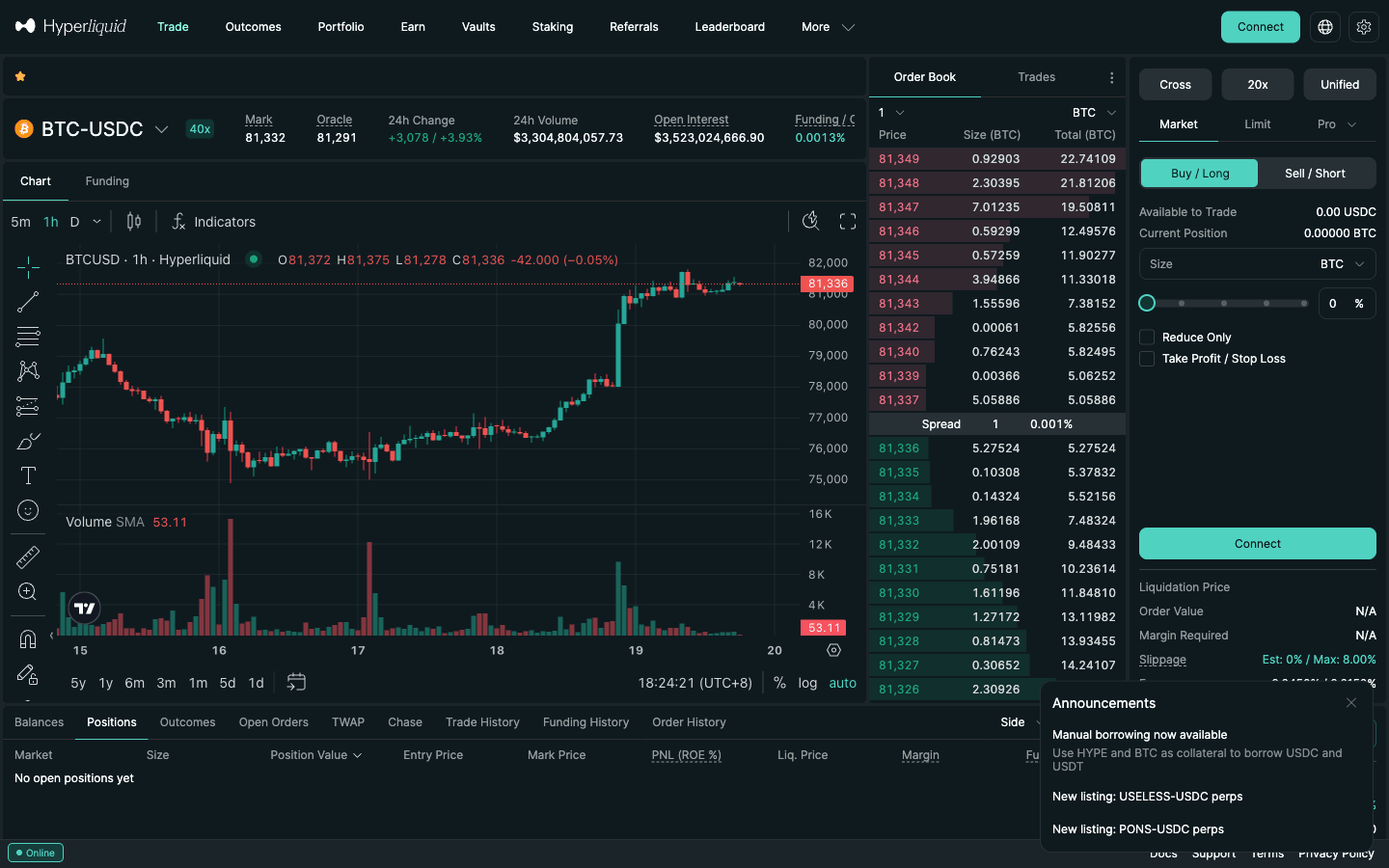
Most DEXs are apps deployed on someone else's chain. Hyperliquid is its own layer-1 blockchain, written for trading. It uses a custom proof-of-stake consensus called HyperBFT, derived from HotStuff, and splits execution into two parts:
- HyperCore holds the perpetual and spot order books, the margin engine, funding and liquidations directly in the chain state. The docs quote a median end-to-end latency of 0.2 seconds (0.9 s at the 99th percentile) for a co-located client and capacity of about 200,000 orders per second.
- HyperEVM is an Ethereum-compatible smart-contract layer that can read and write HyperCore state, which is how lending markets, liquid-staking tokens and new tokenised vaults plug into the exchange.
The practical effect for a trader: the order book behaves like Binance's — limit orders, instant fills, cancels in a fraction of a second — but there is no company balance sheet in the middle. Your USDC sits in your own address on HyperCore, and positions are margined by the protocol's clearinghouse rather than by an exchange operator.
Who is behind it. Hyperliquid Labs, the core contributor, is led by Jeff (@chameleon_jeff on X) and iliensinc, Harvard classmates; the docs describe the team as ex-Airtable, Citadel, Hudson River Trading and Nuro staff who ran crypto market making in 2020 and moved to DeFi in 2022. The docs state that Hyperliquid Labs is self-funded and has not taken any external capital. The web interface at app.hyperliquid.xyz is operated by Hyperliquid Corp. (the party to the Terms of Use), and the Hyper Foundation runs validators, the delegation program and the bug bounty.
HYPE token. HYPE is the chain's native token, used for staking, gas on HyperEVM and fee discounts. The API showed a total supply of 998.9M against a 1B maximum, 298.7M circulating and 411.3M reserved for future emissions on September 25, 2026. The genesis airdrop on November 29, 2024 sent 270.9M HYPE to 94,019 addresses. The assistance fund's system address — the account that receives a share of fees — held 47.5M HYPE; per the fee docs, HYPE in the assistance fund is burned, removing it from circulating and total supply. There is no points program running now; see our HYPE token guide and airdrop facts.
Markets and volume (live data)
Hyperliquid lists 179 validator-operated perpetuals (another 56 older markets are delisted), 349 spot pairs (API, November 3, 2026), and ten builder-deployed HIP-3 perp dexs, of which xyz has 109 markets and nearly all the volume. On September 25, 2026 at 11:33 UTC the API reported $7.47B of perp volume over 24 hours and $13.41B of open interest on the main dex, plus $2.39B of volume and $3.94B of open interest on xyz. BTC alone traded $3.31B, ETH $1.00B, HYPE $574M, ZEC $522M and SOL $318M.
The table below is refreshed every time this site rebuilds (every six hours):
| Market | 24h volume | Open interest | Max lev. | Funding / h |
|---|---|---|---|---|
| BTC | $2.86B | $3.09B | 40x | 0.0013% |
| ETH | $977M | $2.26B | 25x | 0.0013% |
| HYPE | $669M | $1.91B | 10x | 0.0013% |
| ZEC | $598M | $529M | 10x | 0.0013% |
| SOL | $288M | $529M | 20x | -0.0002% |
| NEAR | $136M | $184M | 10x | 0.0013% |
| XRP | $82M | $209M | 20x | 0.0013% |
| XMR | $68M | $151M | 5x | 0.0013% |
Top 8 perps by 24h notional volume, Hyperliquid API, 2026-11-03 12:27:10 UTC. Totals: $6.15B volume, $10.50B open interest. Every market: Hyperliquid market data.
Funding is paid every hour; how the Hyperliquid funding rate is calculated and capped, with 30 days of history, has its own guide. Majors usually sit at the baseline 0.00125% per hour (0.01% per 8 hours); crowded alt longs pay much more, so check the rate before holding overnight — our funding rate guide compares it with Lighter, Aster and the big CEXs. For where Hyperliquid ranks against other venues on volume and open interest, see the perp DEX ranking.
Trading costs in brief
Perps cost 0.045% taker / 0.015% maker at the base tier and spot 0.070% / 0.040%, falling with rolling 14-day volume to 0.024% / 0% above $7B; HYPE staking takes 5–40% off, a referral code a further 4% on your first $25M, and orders, cancels and funding need no gas. The minimum deposit is 5 USDC (smaller deposits are lost) and the minimum order $10; every tier, discount, worked example and the Binance comparison are in our guide to Hyperliquid fees. Hyperliquid's docs describe no funded-account or prop-trading program; third-party prop firms sell "Hyperliquid funded accounts", and what they cost is in funded accounts and prop firms on Hyperliquid.
Hyperliquid Fee Calculator — Your Hyperliquid fee per trade, month and year at your tier, with HYPE staking, the HOLYGRAIL discount and app builder fees. — Open the calculator →Leverage and margin
The docs put the range at 3x to 40x per asset. The live API on September 25, 2026 showed this distribution across the 178 perps:
| Max leverage | Markets | Examples |
|---|---|---|
| 40x | 1 | BTC (20x above $150M notional) |
| 25x | 1 | ETH (15x above $100M notional) |
| 20x | 2 | SOL, XRP |
| 10x | 30 | HYPE, ZEC, NEAR, ONDO, ENA and other large alts |
| 5x | 56 | Mid-caps |
| 3x | 88 | Long-tail and newer listings |
Maintenance margin is half the initial margin at maximum leverage: 1.25% for BTC at 40x, 2.5% for a 20x market, so a position at full leverage is liquidated after roughly that adverse move plus fees. Larger positions move into margin tiers with lower maximum leverage; our list of max leverage by market shows every perp's cap and size tier, read from the API at each build. Positions open in cross margin by default (one collateral pool, unrealized profit can back new positions); switch to isolated margin to ring-fence a speculative trade.
The BTC 40x and ETH 25x caps date from March 12, 2025, when Hyperliquid lowered them after the ETH whale event described in the safety section "to increase maintenance margin requirements for larger positions". Liquidations go to the order book first; if an account falls below two-thirds of its maintenance margin, the HLP liquidator vault takes the position over as a backstop, and auto-deleveraging (closing profitable opposite positions at the previous mark price) is the last resort that keeps the platform free of bad debt. Order types, TP/SL and TWAP are covered in the order types guide; per-asset caps in leverage limits by asset.
HIP-3 markets: stocks, indices and commodities
HIP-3 lets anyone who stakes 500,000 HYPE deploy their own perp dex on HyperCore, with its own oracle, leverage limits and fee share, while reusing Hyperliquid's order book and margin engine. The stake must stay in place for at least 183 days, and validators can slash up to 100% of it for malicious or irregular market operation; slashed HYPE is burned, not paid to traders. Deployers may also halt a market and settle it at the mark price. Every live deployer and market, the fee formula and the risks are in our Hyperliquid HIP-3 guide.
The biggest HIP-3 dex is xyz (trade.xyz): 109 markets and $2.39B of 24h volume on September 25, 2026. Its top markets were the S&P 500 perp ($347.5M, 50x), crude oil ($317.4M, 20x), the XYZ100 Nasdaq-style index ($247.4M, 30x), META ($157.6M) and Brent ($156.5M). Most xyz markets run in growth mode at 0.009% taker / 0.003% maker; gold is excluded from growth mode and pays the standard HIP-3 rate of 0.090% / 0.030%. You trade them on app.hyperliquid.xyz from the same USDC balance, and the HOLYGRAIL discount applies there too.
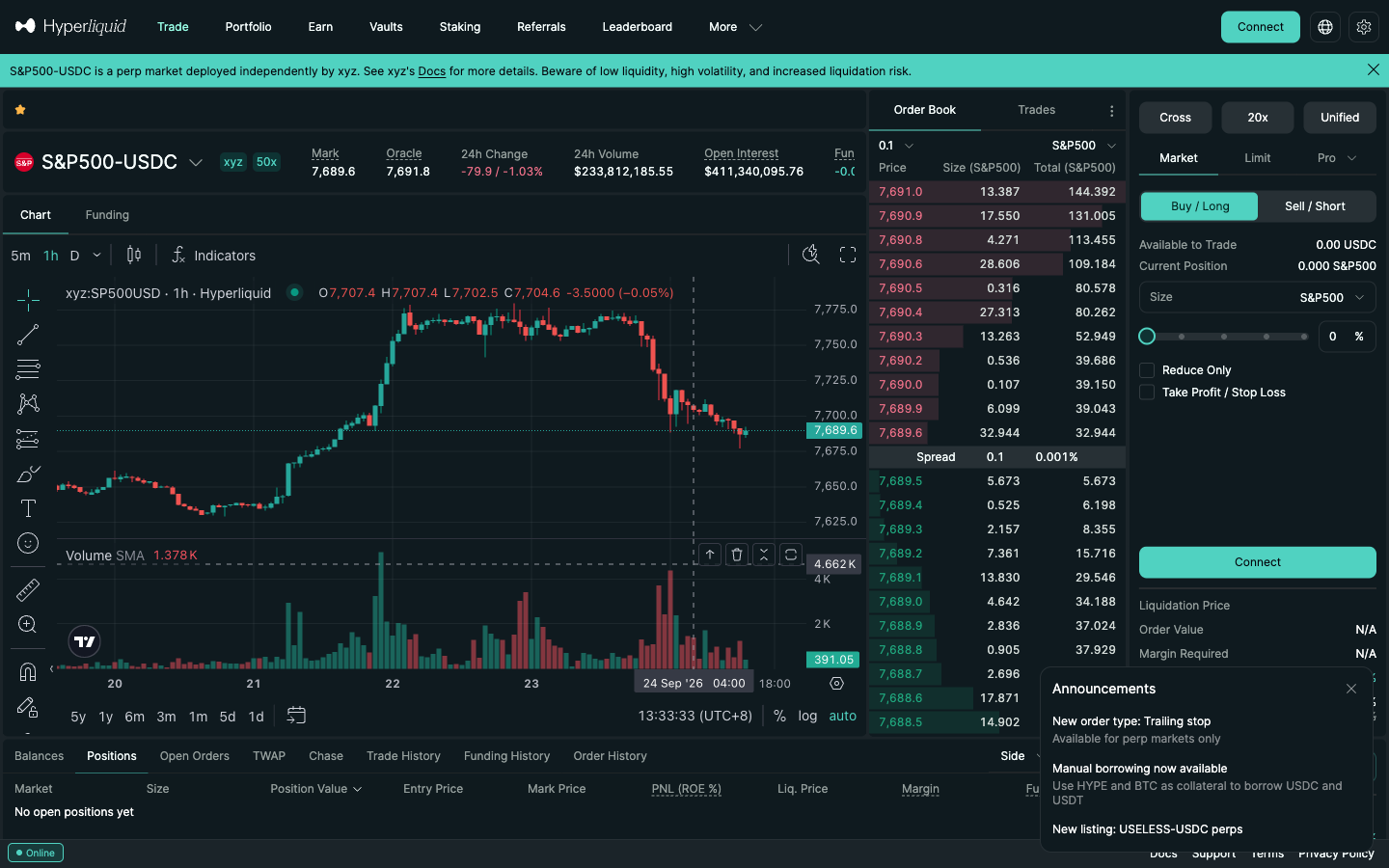
Stock perps trade 24/7, but when the underlying market is closed the xyz oracle falls back to an internal price that can only move within set bounds (for example ±2% with one reset on the S&P 500 perp), so expect jumps when the market reopens. Details and a walk-through: stocks on Hyperliquid (trade.xyz) and Hyperliquid gold; for a stock-perp venue outside Hyperliquid, see our Ondo Perps review and referral code. HIP-4 adds outcome markets (fully collateralised yes/no contracts; the first settles daily at 06:00 UTC to the BTC mark price, with zero fees during testing); the Terms let Hyperliquid block those for "Excluded Persons" in jurisdictions it designates.
Spot trading
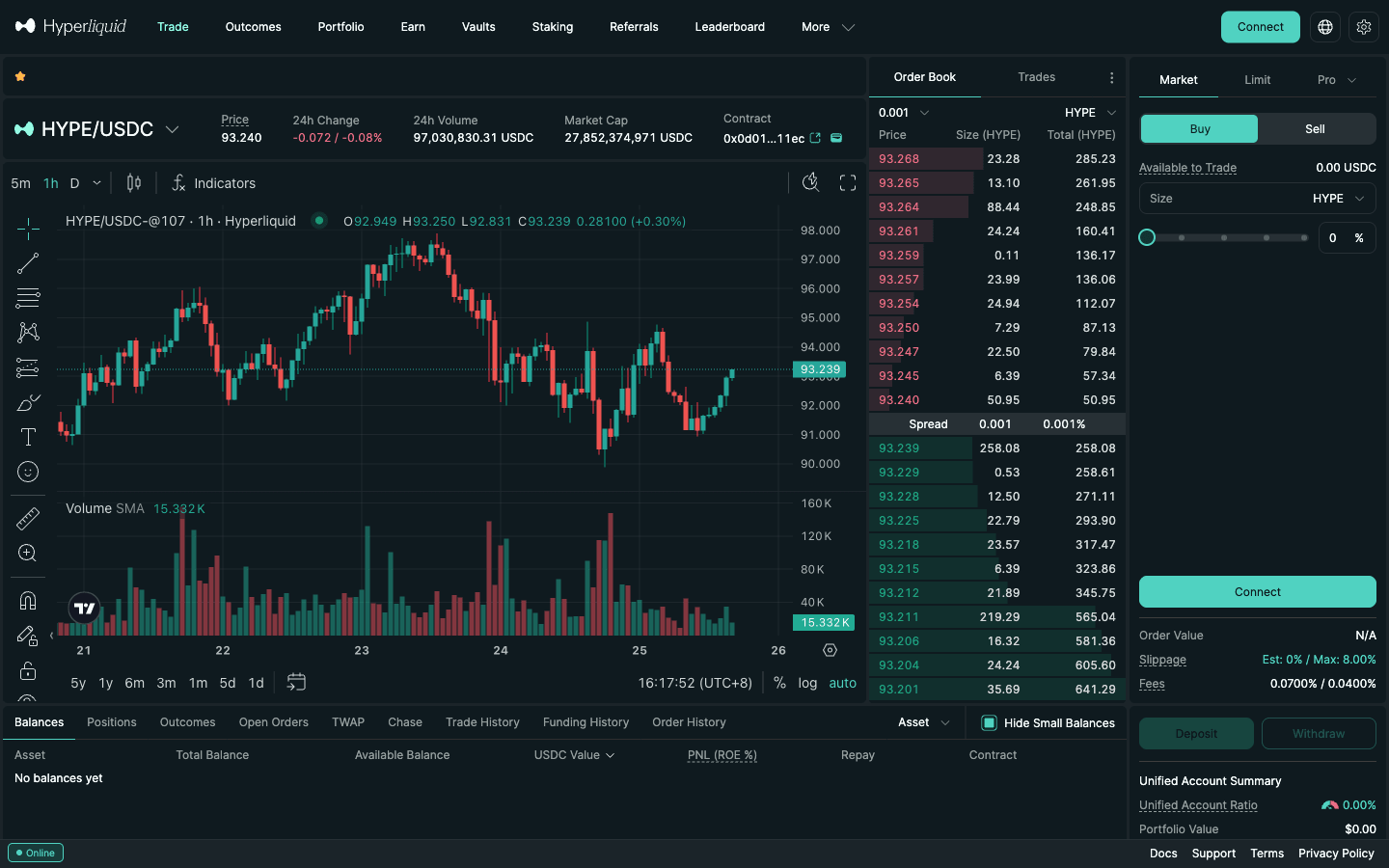
Spot is secondary but real: 330 pairs and $181M of 24h volume on September 25, 2026, against $7.47B on perps. Most pairs are quoted in USDC (313), with a handful in USDT0, USDH and USDe. HYPE/USDC is the main book ($77.0M that day), followed by Unit-bridged BTC, ZEC, ETH and SOL (UBTC, UZEC, UETH, USOL), which are how native coins deposited from their own chains appear on Hyperliquid. Spot fees are higher than perps (0.070% / 0.040% at tier 0) but spot volume counts double toward your fee tier. Spot also doubles as the on-ramp for non-USDC deposits: send BTC, ETH or SOL, then sell for USDC. See the spot trading guide.
Vaults and HLP
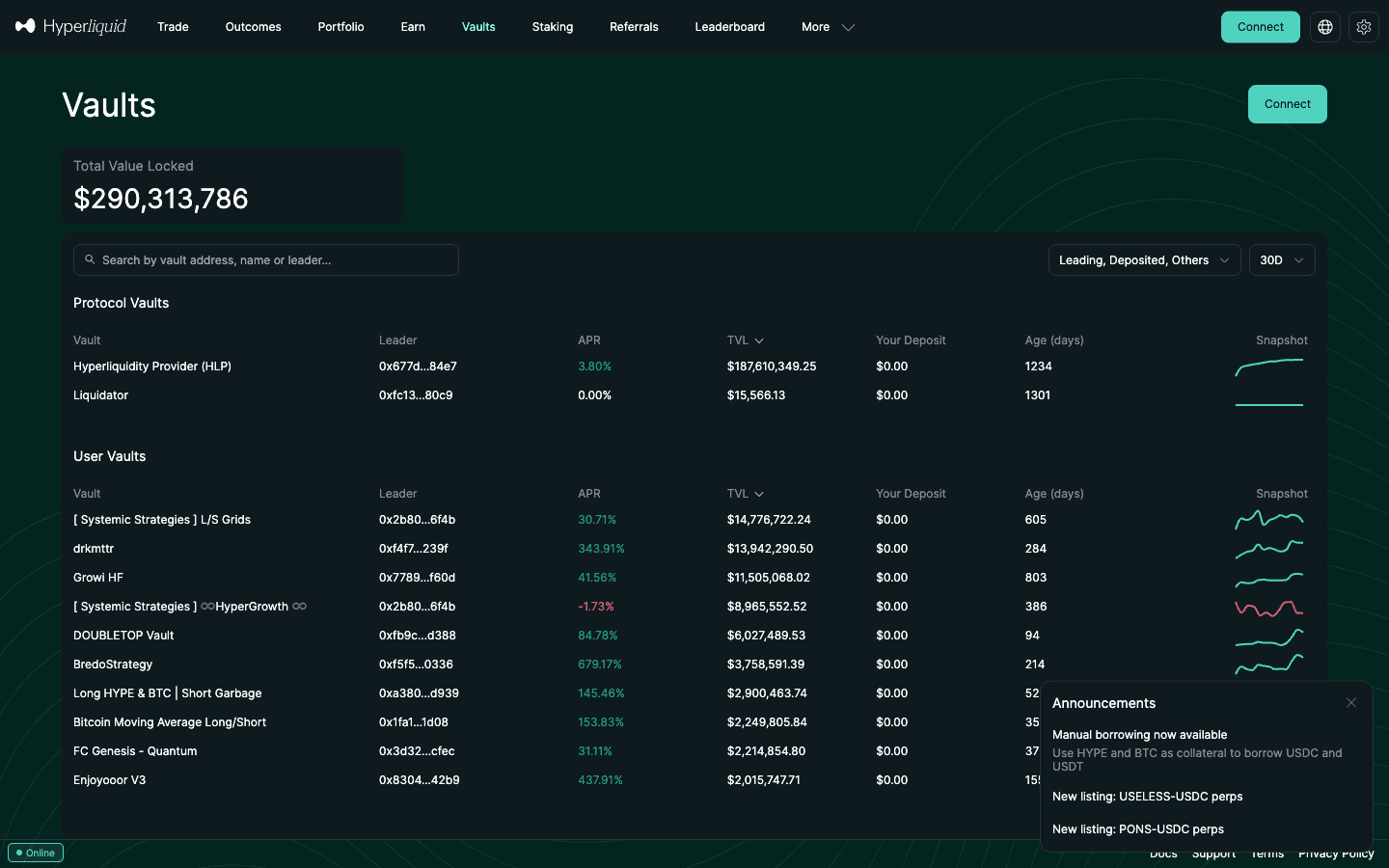
HLP (Hyperliquidity Provider) is the protocol's own, community-owned vault. It runs market-making strategies, performs liquidations, supplies USDC to Earn and receives a share of trading fees. Anyone can deposit USDC. On November 3, 2026 the API showed $150.3M in HLP and an APR of -0.09%; on September 25, 2026 its all-time profit was $138.3M and the past 30 days had made $0.58M. HLP charges no fee or profit share, and a deposit is locked for 4 days from your most recent deposit.
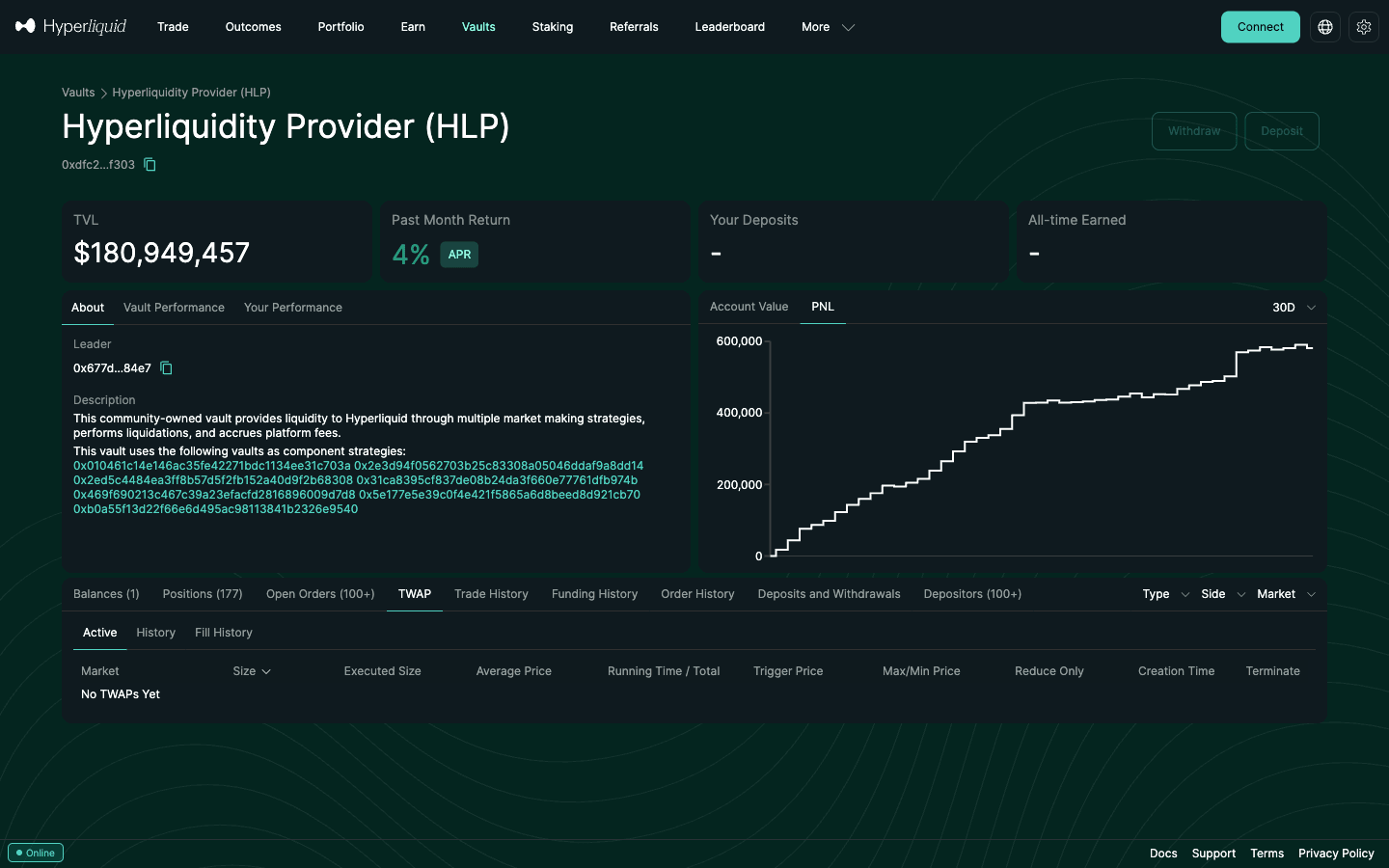
HLP is also where manipulation losses land: when a liquidated account cannot be closed on the book, HLP inherits the position. That is why its history includes the ~$4M ETH whale loss and the JELLY and POPCAT episodes below — and why the app warns that returns are not guaranteed and you can lose some or all of a deposit. User vaults are run by individual traders: the leader keeps 10% of profits, withdrawals unlock 1 day after your last deposit, and past performance says little about the future. The docs now call these HyperCore vaults "legacy" and point new builders to tokenised vaults on HyperEVM, which can also trade spot and HIP-3. More in our vaults and HLP guide and insurance fund explainer.
HYPE staking
Staking happens natively on HyperCore: move HYPE from spot to your staking account and delegate it to one or more validators. On September 25, 2026, 441.0M HYPE was staked across 35 validators (27 active, 6 jailed), with predicted APRs of 2.01–2.23%. The reward rate is inversely proportional to the square root of total stake (about 2.37% at 400M staked) and comes from the future-emissions reserve; rewards accrue every minute, are paid daily and auto-compound.
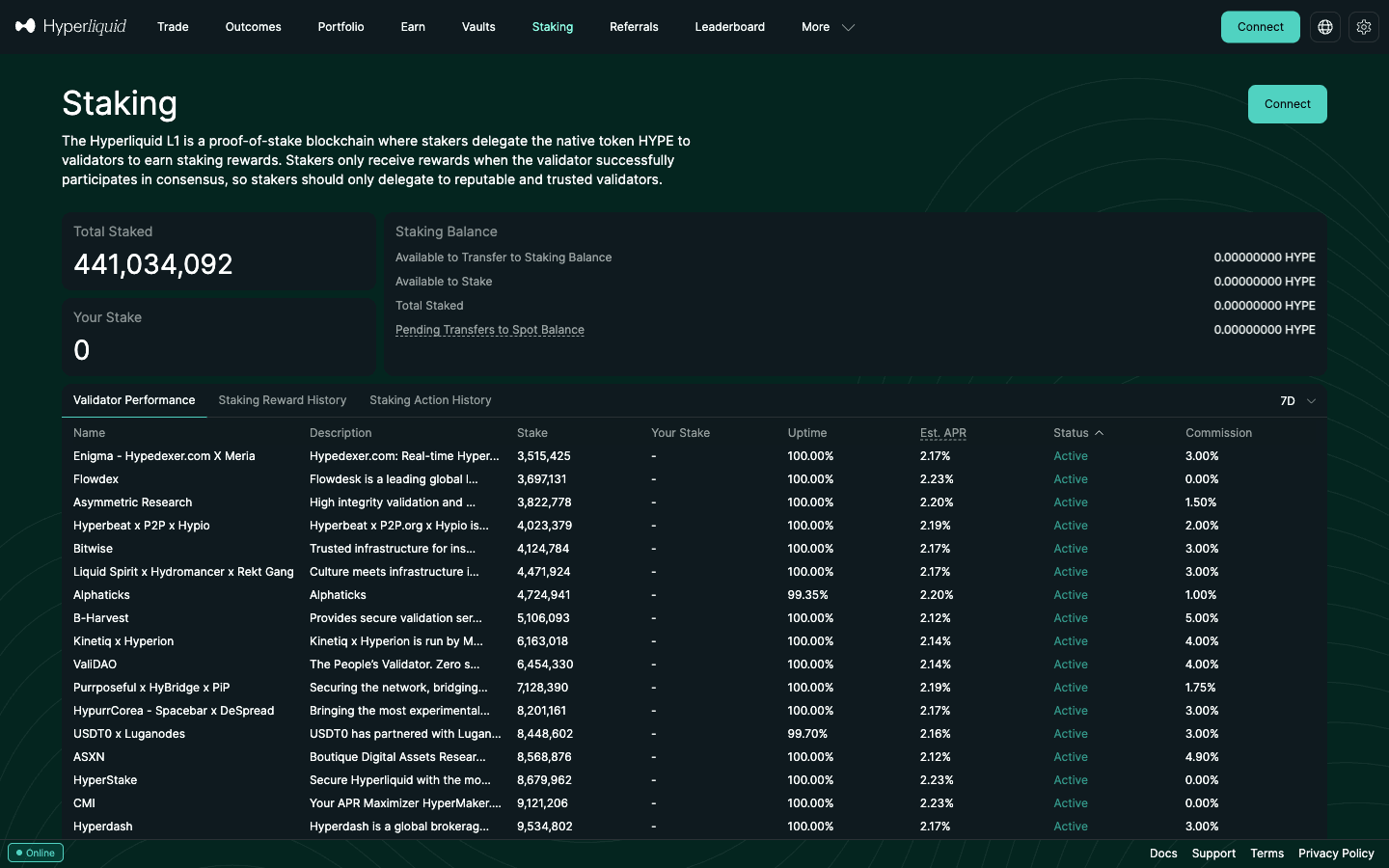
- Lock-ups: 1 day per delegation, then a 7-day unstaking queue to move HYPE back to spot (at most 5 pending withdrawals).
- Slashing: the docs say no automatic slashing is implemented; a jailed validator simply stops earning for its delegators.
- Commission: a validator can only raise its commission if the new rate is 1% or less, which protects delegators from bait-and-switch rates.
- Fee discount: staked HYPE counts toward the 5–40% trading discount above; a separate staking account can be linked to a trading account.
Step-by-step with screenshots: HYPE staking guide.
Is Hyperliquid safe? Security, decentralization and past incidents
Yes, with conditions. Hyperliquid's structure protects you from the failures that sank centralized exchanges: there is no company holding your deposits, and every balance is visible on-chain. The risks that remain are different. Your own key or email login can be stolen. A thin market can be manipulated, with the losses landing on HLP. A small validator set can intervene, and the web app can refuse service to a flagged wallet. Each point is covered below.
Custody. Hyperliquid is non-custodial. Only a signature from your key can move funds, and the official support guide is blunt that unexplained transactions almost always mean the user's key was compromised. That removes exchange-insolvency risk (the FTX failure mode) but puts key security on you: use a hardware wallet paired with Rabby or MetaMask for larger balances, or export the email-login key and store it offline.
Consensus and validator concentration. HyperBFT needs a quorum of more than two-thirds of stake. On September 25, 2026 the five Hyper Foundation validators held 48.0% of the 441.0M staked HYPE; the three largest validators alone held 36.7% — more than one-third, enough in principle to stall consensus by withholding votes — and the eight largest together exceeded two-thirds. The other large operators include Hyperliquid Strategies x Unit (7.6%), Anchorage by Figment (6.2%), Hypurrscanning (5.3%) and Nansen x HypurrCollective (5.0%). This is more concentrated than Ethereum and is the main decentralization critique; the Foundation's delegation program is meant to spread stake over time. A second, less visible point: node operators install signed, pre-built binaries (the public hyperliquid-dex/node repository holds setup files and the signing key, not the node's source), so outsiders cannot review the consensus code the way they can for Ethereum clients.
Bridge and USDC. USDC is now natively minted on Hyperliquid by Circle, and USDC from Arbitrum arrives through Circle's CCTP. The older Arbitrum bridge, audited by Zellic, holds less than 10% of the USDC on HyperCore according to the docs; its contract source (Bridge2.sol) is public, and withdrawals through it are signed by the validator set rather than by a company key. Native BTC, ETH and SOL deposits go through Unit, a separate protocol secured by a 2-of-3 MPC guardian network, and arrive as UBTC, UETH and USOL.
Oracles and delistings. Validators publish oracle prices every 3 seconds as a weighted median of major exchanges' spot prices, and the final oracle is the stake-weighted median across validators. Validators can vote to delist a validator-operated perp; positions then settle to the one-hour time-weighted oracle price.
Bug bounty. The Hyper Foundation pays up to 1M USDC for critical bugs (loss of user funds or broken L1 execution invariants).
Past incidents, labelled by type
Seven events come up whenever people ask whether Hyperliquid is safe. We label each one, because "incident" covers very different things: a market manipulation that cost the HLP vault, an outage, a user whose own key leaked, and a scare with no exploit behind it.
| Date | Event | Type | What happened | Source |
|---|---|---|---|---|
| Dec 23, 2024 | DPRK-linked addresses | Security scare (no exploit) | Researchers flagged addresses linked to North Korea's Lazarus Group trading on Hyperliquid, and deposits flowed out. Hyperliquid Labs said there had been "no DPRK exploit — or any exploit for that matter" and that all user funds were accounted for. | Hyperliquid Labs statement, Dec 23, 2024 |
| Mar 12, 2025 | ETH 50x whale (0xf3f4) | Market: HLP loss | A trader withdrew unrealized profit, lowering margin, and was liquidated; HLP lost ~$4M in 24h. Hyperliquid: "no protocol exploit or hack". Max leverage cut to 40x BTC / 25x ETH. | @HyperliquidX, Mar 12, 2025 |
| Mar 26, 2025 | JELLY perp squeeze | Market + validator intervention | After "suspicious market activity" the validator set voted to delist JELLY perps; users other than flagged addresses were made whole by the Hyper Foundation, with longs refunded as if closed at $0.037555. | @HyperliquidX, Mar 26–27, 2025 |
| Jul 29, 2025 | API outage (14:10–14:47 UTC) | Infrastructure | Traffic overloaded the API servers: orders were delayed and the API returned errors although many orders still landed on-chain. Hyperliquid: "no hack or exploit", blocks were produced as usual. Refunds were automated (about $1.99M in USDC per on-chain data reported by Cointelegraph); anyone owed 10,000 USDC or more had to pass KYB/KYC for the remainder. | Hyperliquid announcements, Jul 30 and Aug 4, 2025 |
| Oct 10, 2025 | ~$21M private-key theft | User-side | An attacker who had one trader's leaked private key drained the account and bridged the funds out. A compromised key, not a protocol breach: the same thing would happen with any self-custody wallet. | PeckShield via CoinDesk, Oct 10, 2025 |
| Oct 10–11, 2025 | Market-wide crash | Market: liquidations + ADL | Record liquidations across crypto. On Hyperliquid, auto-deleveraging closed some profitable positions on the winning side to keep the book solvent, which drew criticism from traders who lost their gains. Hyperliquid reported zero downtime and no bad debt. | Hyperliquid announcements, Oct 11 and 13, 2025; ADL per press reports |
| Nov 12, 2025 | POPCAT manipulation | Market: HLP loss | An attacker spread ~$3M across 19 wallets, built $20M+ of POPCAT longs, pulled a ~$20M buy wall and left HLP ~$4.9M of bad debt. The Arbitrum bridge was paused temporarily. | Halborn post-mortem, Nov 14, 2025 |
None of the seven was a protocol exploit that took user balances. The market incidents share a pattern: a thin market, large leveraged positions, and HLP inheriting the position when liquidations could not clear on the book. In the JELLY case HLP took over a ~$4.1M short that was deep underwater (Halborn put the peak unrealized loss near $12M) until the validator vote settled the market at $0.0095. Traders outside those positions kept their balances; the realized losses fell on HLP, whose depositors share its profit and loss. HLP's all-time profit is still $138.3M. The JELLY response drew criticism because validators intervened in a single market, and Hyperliquid's own post the next day called it "a good reminder to stay humble". Our reading: the exchange is robust for mainstream markets; the tail risks sit in thin alt perps and in HLP.
Phishing. The support guide warns about look-alike domains such as "hyperliguid.xyz" and fake support DMs. Trade only at app.hyperliquid.xyz or a known front-end, bookmark it, and never type a seed phrase into a website. If you log in by email, protect that inbox like a seed phrase: one Trustpilot reviewer lost an account after handing a login code to a fake "support agent" who messaged them on Discord.
Account flags: what the app can block, and what it cannot
Account risk flags appear on most lists of Hyperliquid's risks, and they need some context. Hyperliquid Corp. runs the web app, not the chain. Its Terms say it has "no custody or control over the contents of your wallet and has no ability to retrieve or transfer its contents" (§1.4), and that the app "is not the exclusive means of accessing Hyperliquid" (§1.1). What the company can do is refuse service. It may suspend or terminate your use of any feature "without notice" when it suspects unlawful use or needs to comply with the law (§6.2). Its decisions on who may use the app are "final and binding and not subject to challenge or appeal" (§6.1).
In practice, users on Trustpilot describe wallets marked "high risk" after receiving funds linked to sanctioned entities, followed by a Discord ban and no path to reverse the decision. The safest habit is to fund Hyperliquid from a regulated exchange or a wallet with a clean history, and not to route deposits through mixers or sanctioned services. Do not try to get around a restriction with a VPN or false residency statements, which the Terms prohibit (§3.1.5).
Customer support
Support is ticket-based. You either open a ticket in the "open-ticket" channel of the official Discord or use the Zendesk email form, which cannot receive files or images. The support guide says replies can take up to 48 hours, longer at weekends. No live chat or phone line is listed. Support will never DM you first, and it cannot reverse an on-chain transaction or recover funds taken with a compromised key. Most questions are answered faster by the support guide and our how-to guide. Third-party apps built on Hyperliquid have their own support desks.
What users say: Hyperliquid reviews and reputation
Public opinion splits by audience, so it helps to read each source for what it measures.
- Trustpilot: 2.0 out of 5 from just 15 reviews (86% one-star) on October 22, 2026. The profile is unclaimed, Hyperliquid has never invited reviews, and Trustpilot warns that the company "may be associated with high-risk investments". The complaints repeat: wallets flagged over sanctioned-entity exposure with no appeal, a fake Discord "support agent" stealing an email login code, fees and slippage on small scalps, vault lock-ups, and newly listed coins falling sharply after listing. One review is spam for an unrelated "investment" firm. Treat such offers, and anyone promising to recover lost crypto, as scams.
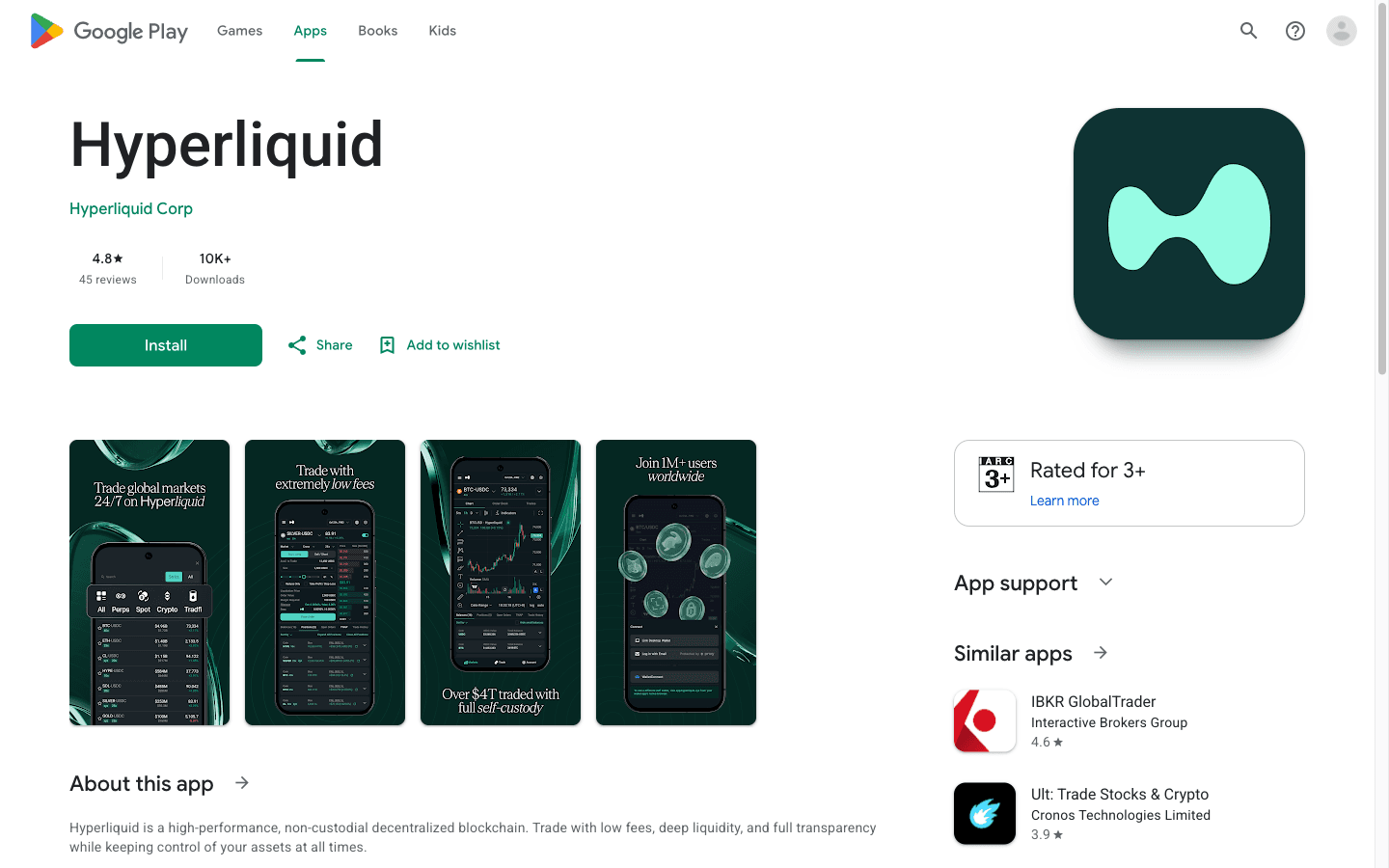
- Google Play: the official Android app was rated 4.8 with 10K+ downloads on September 25, 2026. That is a smaller, self-selected audience of active users.
- Forums: the Reddit and Bitcointalk threads that rank for these searches ("Should I use Hyperliquid?", "Do you trust HyperLiquid?", "Safe to use Hyperliquid in the USA?") keep circling the same three questions: US access, frozen or flagged accounts, and whether the validator set is decentralized enough. The same themes run through this review.
- Institutions: Grayscale Research (May 27, 2026) called Hyperliquid "the breakout success story of the modern digital assets industry", with trading fees of around $800M last year. Bitwise's US spot Hyperliquid ETF (BHYP) began trading on the NYSE on May 15, 2026, and 21Shares lists a staking ETP in Europe and the THYP ETF in the US. None of that changes the risks above, but it does answer "is it legit".
Our take after testing it: the negative reviews are real, and they cluster around compliance flags, phishing and leverage losses, not missing balances. If you fund from a clean source, protect your key or email login, and size positions so a liquidation is survivable, Hyperliquid is the strongest on-chain venue we have used.
KYC, the US ban and where Hyperliquid is based
There is no KYC on app.hyperliquid.xyz — you connect a wallet or log in by email. The Terms of Use (Hyperliquid Corp., last updated June 15, 2026) nevertheless set clear limits:
- §1.6 Restricted Persons: anyone who resides in, is located in or is incorporated in the United States or Ontario, Canada; anyone in a jurisdiction under economic sanctions or export controls; and citizens of those territories wherever they live. Our guide to Hyperliquid restricted countries quotes the clause in full and goes through the US, the UK, Singapore and Japan.
- §1.3: neither the interface nor Hyperliquid is licensed or registered with any regulator in any jurisdiction.
- §1.7–1.8: outcome markets can be blocked for additional "Excluded Persons".
- §1.9: you are responsible for checking that leveraged or derivative trading is legal where you live.
- UK: the app does not allow referral codes for UK users ("Referrals are not allowed in your jurisdiction"), and Hyperliquid's X profile says it is not directed at UK persons.
If you are restricted, do not use it — we do not recommend VPNs or any other way around a venue's geo-rules. "No KYC" also does not mean anonymous: every trade is public on-chain, and fiat on-ramps require ID. Our no-KYC trading guide explains what this means venue by venue; Japanese readers should see our Japanese guide ハイパーリキッドは日本で使える?.
Where is Hyperliquid based?
There is no single headquarters in the CEX sense. The chain is run by its validators. Hyperliquid Labs is the core development team, Hyperliquid Corp. operates the app.hyperliquid.xyz interface, and the Hyper Foundation runs validators, the delegation program and the bug bounty. The Terms of Use are governed by the laws of England and Wales, and disputes go to arbitration at the London Court of International Arbitration (§11.4).
Why is Hyperliquid banned in the US, and could that change?
US persons are Restricted Persons under §1.6. The Terms give no reason, but §1.3 says neither the interface nor Hyperliquid is licensed or registered by any regulator in any jurisdiction, and perpetual futures sit in a regulatory grey zone in the US. Grayscale's May 2026 report describes Hyperliquid as "not yet available to U.S. users due to regulatory ambiguity around perpetual futures and decentralized exchanges". On February 18, 2026 the Hyper Foundation funded the Hyperliquid Policy Center in Washington, D.C. with 1,000,000 HYPE. It is an independent 501(c)(4) led by crypto lawyer Jake Chervinsky that lobbies for rules on DeFi and perps. Headlines about "US approval" describe a possibility. As of September 27, 2026 the Terms still list the US as restricted.
Mobile: official Android app, no iOS app
Hyperliquid Corp publishes an official Android app on Google Play (listing checked September 25, 2026: 10K+ downloads, rated 4.8, last updated September 9, 2026). Check that the publisher reads "Hyperliquid Corp" before installing. There is no official iOS app: an App Store search in the US, Japan, the UK and Singapore on the same day returned only third-party apps. On an iPhone you can:
- open app.hyperliquid.xyz in Safari and log in by email or with a mobile wallet — the full exchange runs in the browser;
- link a desktop wallet: on the phone choose Connect → Link Desktop Wallet, then scan the QR code shown on desktop (docs "Connect mobile via QR code");
- use a third-party front-end app. Based (iOS, Android, web) adds a 0.025% builder fee and Liquid adds 0.05% (referral code JV2EN2CX takes 10% off Liquid's own fee). HOLYGRAIL still saves you 4% there: on-chain fills checked October 1, 2026 show that the referral discount also applies to orders placed through apps with a builder code, taken off Hyperliquid's part of the fee, with the app's builder fee on top. One catch: apps such as Phantom often set their own Hyperliquid referral code on accounts that have none, so enter a code on Hyperliquid before you start using an app. What each app adds per trade is compared in Hyperliquid builder codes.
Every app option, with fees side by side: our Hyperliquid app guide.
How to start trading on Hyperliquid (5 minutes)
Open the referral link
Go to app.hyperliquid.xyz/join/HOLYGRAIL. The page shows "You are invited to Hyperliquid from the referral code: HOLYGRAIL".
Connect — wallet or email
Click Connect. Pick an EVM wallet (Rabby, MetaMask, WalletConnect, Coinbase Wallet) or enter your email and the six-digit code. Wallet users then click Enable Trading and sign a gas-less message. Confirm Join with code when the app offers it.
Deposit
Send USDC on Arbitrum, Ethereum, Base or Polygon to the address shown (minimum 5 USDC), or send native BTC, ETH, SOL, AVAX, ZEC, MON or XPL and sell them for USDC on spot. Many centralized exchanges withdraw directly to Hyperliquid.
Place your first trade
Pick a market, choose long or short, set leverage and size (minimum order $10), and click Place Order. Add a stop-loss in the same ticket.
Withdraw any time
Withdraw sits at the bottom right of the trade page. Arbitrum USDC withdrawals cost 0.2 USDC plus a tiny HyperEVM gas fee.
Full walk-through: how to use Hyperliquid · deposit guide · withdrawal guide · bridge routes · best wallet.
Join with the code before your first trade
Code HOLYGRAIL takes 4% off Hyperliquid's part of every fee on your first $25M, also on orders from apps you connect with the same wallet (checked October 1, 2026). Add it before your account passes $10,000 of volume, because it cannot be changed later. Steps and how to check it: Hyperliquid referral code HOLYGRAIL.
Our referral code: we earn a share of Hyperliquid's fees; your fees go down, not up.
Hyperliquid vs the alternatives
| Item | Hyperliquid | Lighter | Aster | edgeX |
|---|---|---|---|---|
| Base taker / maker | 0.045% / 0.015% | 0% / 0% (Standard) | 0.04% / 0% | 0.045% / 0.040% |
| Max leverage (BTC) | 40x | 50x | 1001x (1001x mode) | 100x |
| Chain | Own L1 (HyperBFT) | zk-rollup | Aster Chain L1 | StarkEx rollup |
| Stock perps | Yes (HIP-3 xyz) | Yes | Yes (RWA perps) | Yes |
| Our code | HOLYGRAIL (4% off) | 718610TD | DTLpLc | HOLYGRAIL |
| Review | this page | Lighter review | Aster review | edgeX review |
Pick Lighter if fee-free small trades matter most, Aster for extreme leverage modes, edgeX for 100x majors and a large US-stock list. For everything else — depth, market count, HIP-3, ecosystem — Hyperliquid is the reference venue. Our best DEX guide ranks them all; new to the idea? Start with what is a DEX. Head-to-heads: vs Lighter, vs Aster, vs Binance, vs Bybit, vs dYdX, vs GMX.
Every Hyperliquid guide on this site
Each guide is written from the official docs and live API data, dated on the page, and kept in sync with this review.
Frequently asked questions
Is Hyperliquid safe?
Mostly yes, with real caveats. Hyperliquid is self-custodial: trades, margin and liquidations settle on its own layer-1, and nobody can move your funds without your key. No code exploit has drained user balances. The real risks are leverage and liquidation, validator concentration (the five Hyper Foundation validators held 47.3% of stake in September 2026), market manipulation that lands on the HLP vault (ETH whale and JELLY in March 2025, POPCAT in November 2025), the web app blocking wallets it flags as high-risk, and phishing. Keep only trading capital on the exchange and store larger sums in a hardware wallet.
Is Hyperliquid legit or a scam?
It is legit and heavily used. On November 3, 2026 the public API showed $6.15B of perp volume in 24 hours across 179 markets and $10.5B of open interest, and Grayscale Research called it "the breakout success story of the modern digital assets industry" in May 2026. According to the official docs, the core team (Hyperliquid Labs) is self-funded and took no external capital. The scams around it are fake sites with look-alike domains and fake "support" DMs. The official trading site is app.hyperliquid.xyz.
Is Hyperliquid good for beginners?
Not as a first exchange. Sign-up is easy (email login, no KYC), but the product assumes you understand leverage, cross margin, funding and liquidation, and there is no live support to walk you through a mistake. If you are new, practise on the Hyperliquid testnet first (its faucet gives mock USDC to addresses that have deposited on mainnet), then use 1–3x leverage and isolated margin, and always set a stop-loss.
Why is Hyperliquid so popular?
It is the first on-chain exchange that feels like a centralized one: a fully on-chain order book with CEX-level depth, no gas on orders, no KYC and self-custody. Its launch story also helped: the team raised no venture capital and airdropped HYPE to 94,019 addresses in November 2024. Per the docs, trading fees go to the community (HLP, the assistance fund and deployers) rather than to a company. The assistance fund turns fees into HYPE automatically, and that HYPE is burned.
How many people use Hyperliquid?
The Hyper Foundation's website showed 2,806,802 users on October 22, 2026. That counts addresses, not verified people, because there is no KYC, so one trader can hold several.
Is Hyperliquid decentralized?
Partly. Every order and liquidation is on-chain and anyone can verify it, but consensus rests on 35 validators (27 active), and the five Hyper Foundation validators held 47.3% of stake in September 2026. The node software ships as signed binaries rather than open source. In March 2025 validators voted to delist the JELLY market mid-squeeze. It is far more transparent than a centralized exchange, but less decentralized than Ethereum.
What happens if Hyperliquid goes down or fails?
Your USDC and positions live in the chain state, not on a company's balance sheet, so an app outage does not touch balances. During the July 29, 2025 API outage the chain kept producing blocks and Hyperliquid refunded affected traders. The October 2025 crash passed with no downtime and no bad debt, according to Hyperliquid. The deeper risks are a validator or bridge failure. Nothing insures them, and the Terms of Use say losses from blockchain or validator failures are yours.
Does Hyperliquid require KYC?
No. You connect an EVM wallet or log in with an email address and a six-digit code; there is no identity verification. That does not make it anonymous: every trade and transfer is public on-chain, and the Terms still bar US and Ontario residents and sanctioned territories.
Why is Hyperliquid banned in the US, and where is it based?
Section 1.6 of the Terms of Use (updated June 15, 2026) lists anyone in the United States or Ontario, Canada, plus sanctioned territories, as Restricted Persons. Section 1.3 says neither the interface nor Hyperliquid is licensed by any regulator. Grayscale puts the US gap down to "regulatory ambiguity around perpetual futures and decentralized exchanges". The web app is run by Hyperliquid Corp., its Terms are governed by English law with arbitration in London, and the Hyper Foundation supports the chain. In February 2026 the Foundation funded the Hyperliquid Policy Center in Washington with 1,000,000 HYPE, but US residents remain restricted today.
Is Hyperliquid better than dYdX or GMX?
For most active traders, yes. It has far deeper order books, more markets (including stock and commodity perps) and gas-free orders. GMX trades against a liquidity pool at oracle prices, which some traders prefer for large orders on thin assets, and dYdX runs its own Cosmos chain with a different fee model. See our head-to-heads: Hyperliquid vs dYdX and Hyperliquid vs GMX.
Is there a Hyperliquid app for iPhone?
Not an official one. Hyperliquid Corp publishes an Android app on Google Play (10K+ downloads, rated 4.8, updated September 9, 2026), but an App Store search on September 25, 2026 returned only third-party apps. iPhone users can trade at app.hyperliquid.xyz in the browser or use a third-party app such as Based or Liquid, which add their own fee.
How much does Hyperliquid cost to trade?
Perpetuals start at 0.045% taker and 0.015% maker and fall with rolling 14-day volume to 0.024% / 0% above $7B; HYPE staking and a referral code lower them further, and orders cost no gas. Every tier, discount and worked example is in our Hyperliquid fees guide. Hyperliquid fees →
Can I add a referral code after I started trading?
Yes, as long as your account has traded no more than $10,000; above that the app refuses any code, and a code can never be changed once set. Steps, the error messages and how to check the code is applied are in our Hyperliquid referral code HOLYGRAIL guide. Hyperliquid referral code HOLYGRAIL →
Ready to trade on Hyperliquid?
Open an account through our link and code HOLYGRAIL is attached for you: 4% off fees on your first $25M in volume, no KYC, withdraw any time.
Disclosure: links on this page use our referral codes. We earn a share of trading fees from referred accounts; it never raises your fees, and the 4% discount is funded by Hyperliquid's referral program, not by us. Perpetual futures are high-risk leveraged products; this review is information, not financial or legal advice.