How to Use Hyperliquid: Sign Up, Deposit and Your First Trade (2026)
Quick start: 3 steps, about 5 minutes
Get a wallet, or use email. MetaMask, Rabby or an email address. No form, no KYC (step 1).
Join with code HOLYGRAIL. Open our join link, click Connect, accept the invite: 4% off fees on your first $25M.
Deposit in the same browser. At least 5 USDC on Arbitrum; wallets also click Enable Trading (free). The link keeps the code until that first deposit (why).
Not for residents of the US or Ontario (who may use it).
Then: pick a market, switch to Isolated and 2–5x, enter a size (from $10), add a stop-loss and click Place Order (first trade, worked example).
Base fees: 0.045% taker / 0.015% maker on perps, 0.070% / 0.040% on spot. We earn a commission when you sign up through our links; it never raises your fees.
— Step 8 now covers spot trading in full: spot vs perps, what you can buy (HYPE, UBTC/UETH/USOL via Unit, HIP-1 tokens), Unit deposit minimums, spot fees, lot sizes and dust, and three spot FAQs (the separate spot guide was merged here).
— ENA deposits to the Ethereum (Unit) address: was accepted, minimum 120 ENA → now no longer accepted (Unit's Ethereum address takes ETH only)
— Rewritten as a sign-up guide: a three-step quick start at the top, and new sections on KYC, connecting MetaMask, logging in and fixing "Enable trading".
1. Hyperliquid explained in 60 seconds
Hyperliquid is a decentralized exchange for perpetual futures (contracts that track a coin's price with no expiry; the basics: what are perpetual futures) and spot that runs on its own layer-1 blockchain. The order book, margin engine, funding and liquidations all live in the chain's state (HyperCore), which is why placing an order is free, fills return in well under a second, and every position on the exchange is publicly visible. You keep custody: your account is a wallet address, and the exchange never holds your keys. As of November 3, 2026 the public API lists 179 perpetual markets and 349 spot pairs, with about $6.2B of perp volume in the past 24 hours. Background and verdict: Hyperliquid review; this page is the hands-on tutorial.
2. What you need before you start
An email address or an EVM wallet. Rabby, MetaMask, Coinbase Wallet, OKX Wallet and anything on WalletConnect work; Phantom works too. Email login needs nothing installed. Our wallet comparison covers the trade-offs.
Collateral. Perps are margined in USDC. The simplest route is USDC on Arbitrum plus a little ETH for gas. You can also send USDC on Ethereum, Base or Polygon (email login), or native BTC, ETH, SOL and several other assets, and sell them for USDC on Hyperliquid.
No crypto yet? Buy USDC on any exchange you already use and withdraw it on the Arbitrum network (or the Hyperliquid network, if the exchange offers it) to your wallet or deposit address. The Deposit window also has a card on-ramp run by an independent provider, Swapped.com, with its own fees and country rules. Every route is compared in the Hyperliquid deposit guide.
About five minutes, once you hold USDC on Arbitrum (buying it first on an exchange takes longer).
A permitted location. The interface terms exclude residents of the United States and Ontario, Canada, and sanctioned jurisdictions (section 15; elsewhere in Canada, see Hyperliquid in Canada outside Ontario).
Does Hyperliquid need KYC?
No. No ID check in the Terms (checked October 15, 2026): there is no identity verification, no documents and no selfie, and no account tier that unlocks with ID. An email address or a self-custody wallet is the account. That does not change who may use it: residents of the United States and Ontario, Canada, and of sanctioned jurisdictions are still excluded, and every trade and position is public on-chain. Background: what no-KYC trading does and does not mean.
3. Step 1: Open a Hyperliquid account (sign up)
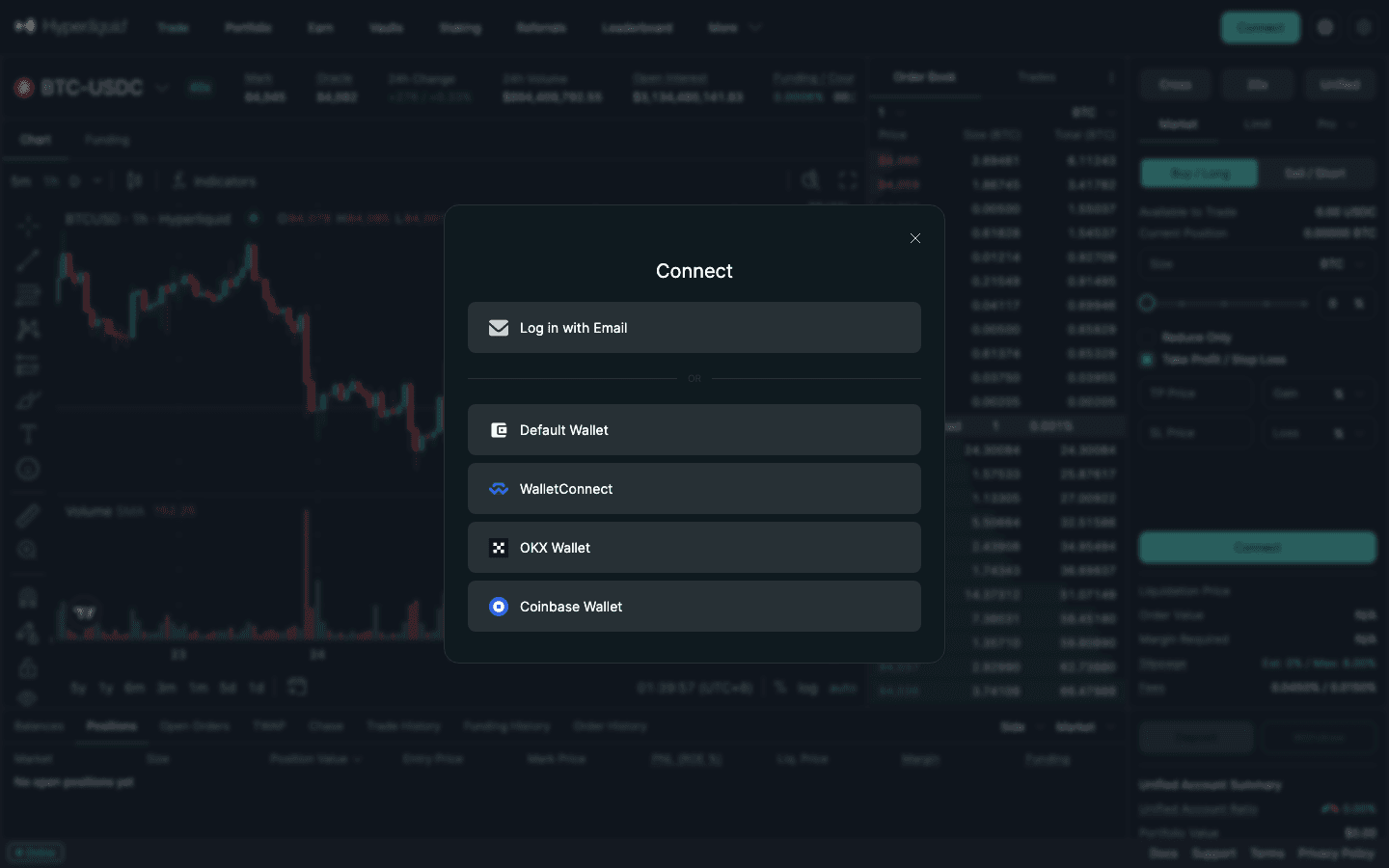
How to open a Hyperliquid account: there is no registration form. Go to app.hyperliquid.xyz (the button at the top of this guide also pre-fills the referral code) and click Connect at the top right. The window offers Log in with Email at the top and, below it, your browser wallet ("Default Wallet"), WalletConnect, OKX Wallet and Coinbase Wallet.
The Connect window on app.hyperliquid.xyz (September 27, 2026; the same options on October 15, 2026): email login at the top, wallets below.
Option A: log in with email
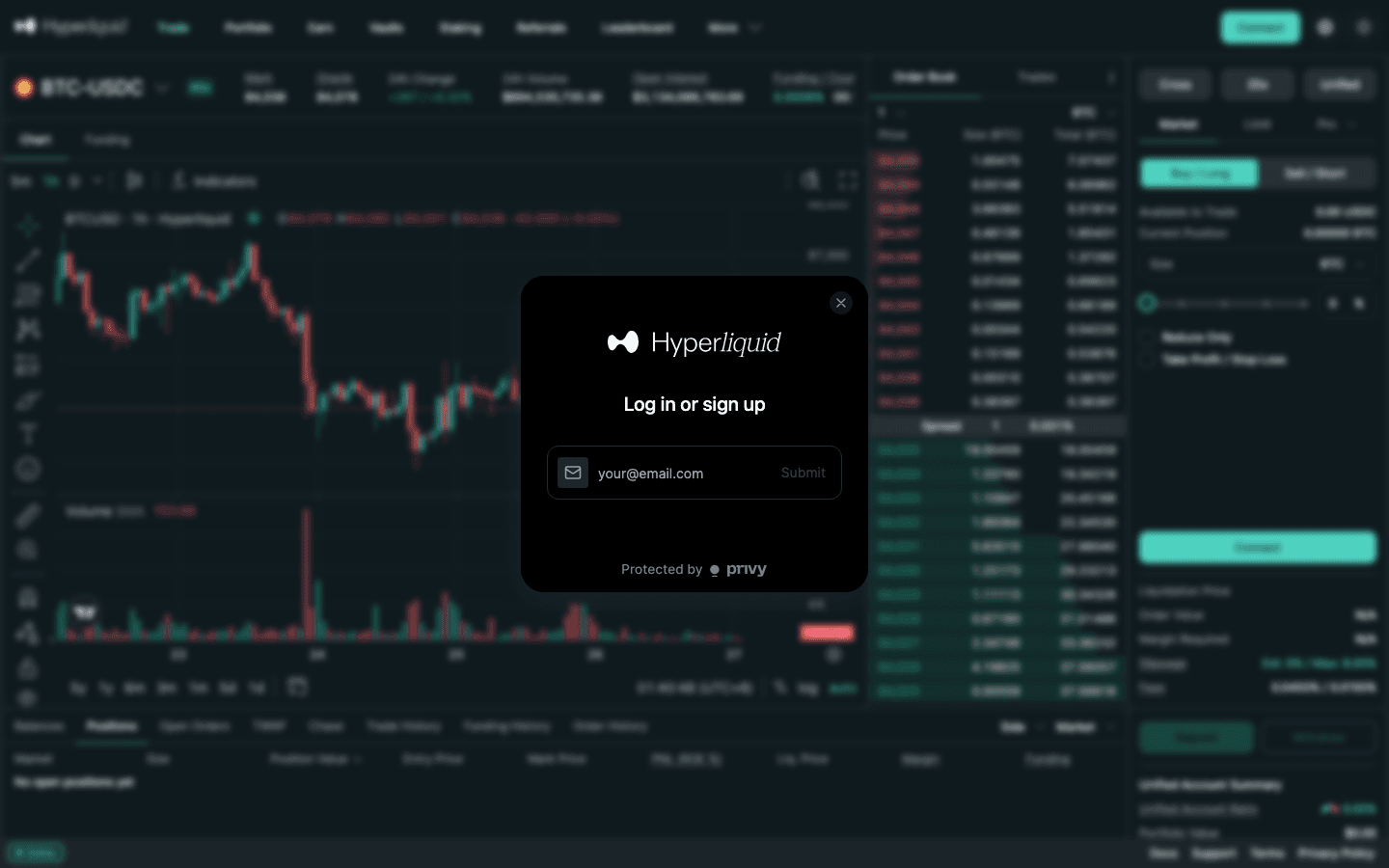
Click Log in with Email, enter your address and press Submit. A 6-digit code arrives within seconds; type it in.
You are logged in. Behind the login Hyperliquid has created an embedded wallet for you (the login window is provided by Privy). It is a real address: you can view it in the top-right menu, and you can later click Export Email Wallet in the settings dropdown to copy its private key into Rabby or MetaMask.
Email login: one field, then a 6-digit code. The same window creates a new account and logs in an existing one (September 27, 2026).
Option B: connect a wallet
Choose your wallet from the list. A pop-up in the extension (or the mobile wallet app) asks to connect to Hyperliquid — approve it.
Your address is now your account. Nothing else is created; the same address on another device shows the same balances.
Which to pick? Email is faster and fine for a first deposit. A hardware-backed wallet is safer for a balance you care about. You can always move funds between the two later, since both are ordinary addresses, but they are two different accounts: the email login creates its own address.
How to connect MetaMask to Hyperliquid
Prepare MetaMask. Install the browser extension, create or import a wallet, and make sure Arbitrum One is in its network list with your USDC and a little ETH for gas on it; that is only needed for the deposit.
Open the join link in the same browser:app.hyperliquid.xyz/join/HOLYGRAIL (type it, or use the button at the top of this guide), then click Connect.
Choose "Default Wallet" (your browser extension) in the Connect window and approve the connection in MetaMask. If you have several wallet extensions installed, the default one may open instead of MetaMask: disable the others for the session, or use WalletConnect.
Click Enable Trading and sign the message in MetaMask (no gas), then deposit (step 4).
On a phone, open the join link in MetaMask's built-in browser, or choose WalletConnect in the Connect window and approve in the MetaMask app. Do not confuse this with the perps tab inside MetaMask itself: that is a separate app built on Hyperliquid with its own all-in fee, listed among the third-party apps in section 12.
Hyperliquid login: how to log back in
Email: Connect → Log in with Email → the same address → the 6-digit code. The same window signs up and logs in, so the same email always opens the same account.
Wallet: Connect → the same wallet and the same address. On a new browser or device the app may ask you to Enable Trading again; it is the same free signature.
"My balance is empty": you probably logged in the other way. An email login and a wallet are separate addresses; log out and use the method you deposited with.
On a phone: the web app logs in the same way; the Android app and the iPhone Home Screen shortcut are covered in the Hyperliquid app guide.
Check the domain. Log in only at app.hyperliquid.xyz (official links); a "login" page reached from an ad or a DM is a phishing risk.
4. Step 2: Enable trading
With a wallet login the order form shows a single button: Enable Trading. Click it and your wallet asks you to sign a message. This is a signature, not a transaction — it costs nothing and moves nothing; it simply authorises the front-end to send orders on behalf of your address. Sign it once and the order form unlocks. Email accounts skip this step entirely.
Enable Trading not working? Fixes
Nothing pops up: unlock the wallet, allow pop-ups for app.hyperliquid.xyz, and click the wallet's toolbar icon: the request may be waiting there.
The wrong wallet opens: several extensions compete for "Default Wallet". Disable the others, reload, and connect again.
Hardware wallet: the signature has to be confirmed on the device; open the Ethereum app on it first.
You rejected the request: click Enable Trading again; nothing was sent or spent.
Network: the network your wallet is on does not matter for the signature; it only matters when you deposit.
Still stuck: check the status page (hyperliquid.statuspage.io) and then open a ticket in the official Discord (official links). Real support never messages you first.
5. Step 3: Enter your referral code (before your first trade)
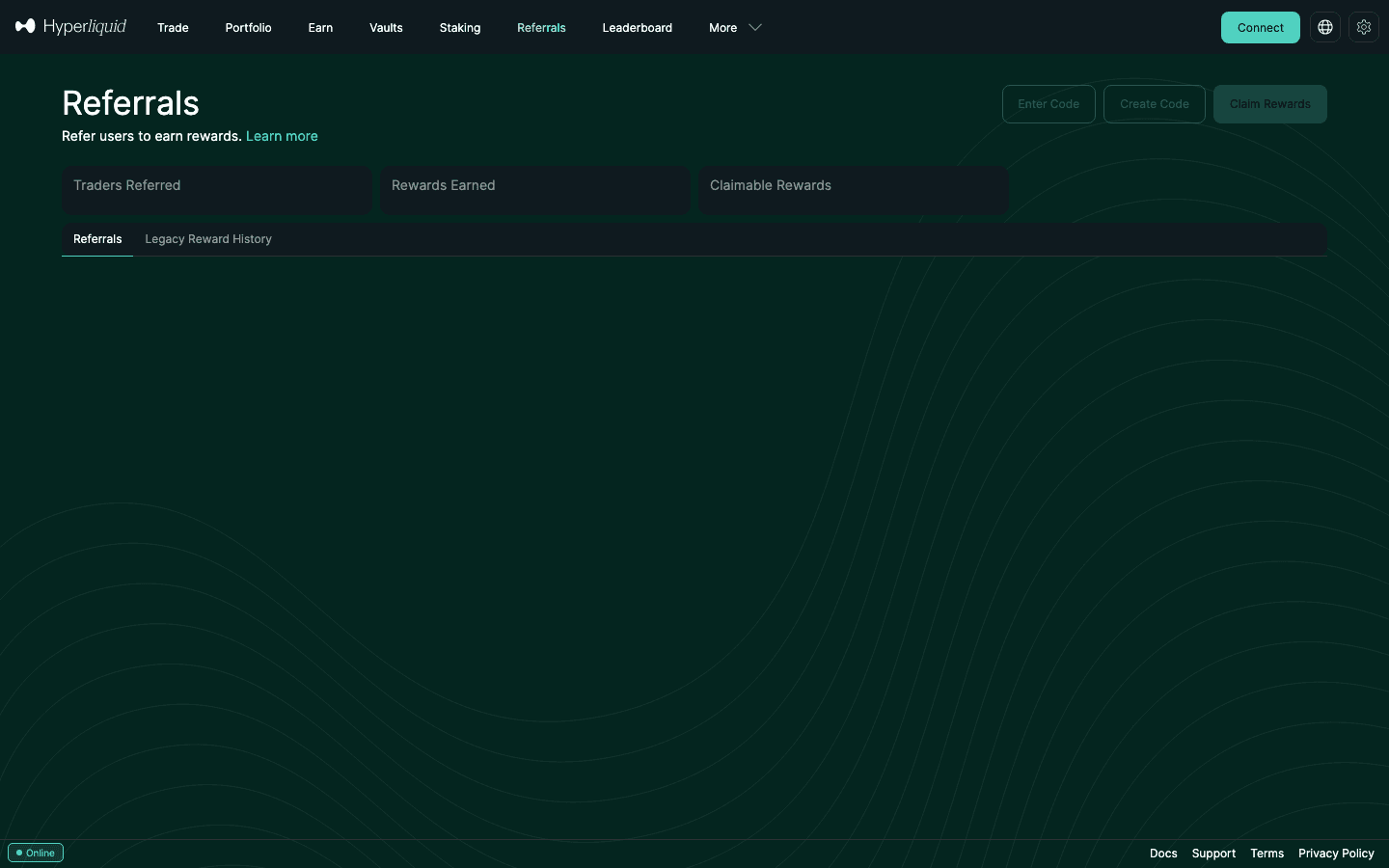
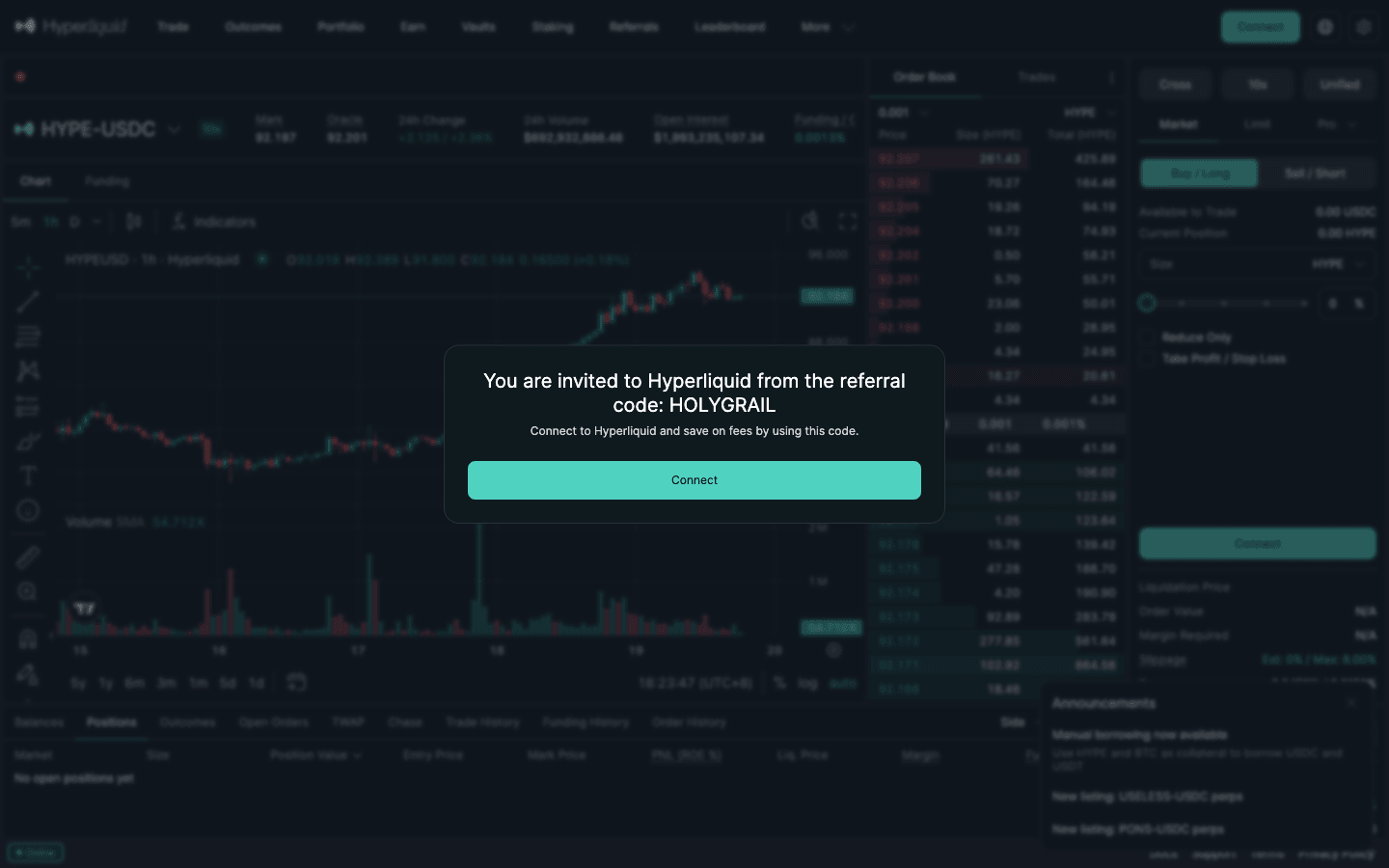
Open the Referrals tab, click Enter Code and type HOLYGRAIL, or arrive through our referral link (the buttons on this page), which shows an invitation prompt you accept with one click. The join link remembers the code and the app submits it once your account is ready to trade, which is right after your first deposit and Enable Trading, so open the link in the browser you will deposit from. Per the official docs, a referral code gives 4% off trading fees on your first $25M of volume. It covers trades placed after the code is set, so enter it before your first order; Hyperliquid stops accepting a code once your account passes $10,000 of volume, and a code cannot be changed once set. It does not apply to vaults or sub-accounts, and costs you nothing. Details and the exact maths: Hyperliquid referral code guide.
The Referrals page. Enter Code (top right) becomes clickable once you are connected (September 27, 2026; unchanged on October 15, 2026).The prompt you see when arriving through a referral link. Accept it before placing your first order.
6. Step 4: Deposit USDC
Click Deposit (bottom right of the trade page). The window shows the supported routes and, for email accounts, a deposit address and QR code:
Route
Notes
Minimum
Arrival
USDC on Arbitrum (Deposit button, wallet login)
Type the amount and confirm in your wallet; the default CCTP route deducts a flat 0.2 USDC Circle fee
5 USDC
About a minute
USDC on Arbitrum / Ethereum / Base / Polygon (email login)
Send from an exchange or wallet to the deposit address shown; arrives as USDC on HyperCore
5 USDC
Minutes (Ethereum gas is a few dollars)
Direct from a CEX
Some exchanges offer Hyperliquid (HyperCore or HyperEVM) as a USDC withdrawal network; funds sent to HyperEVM must be moved to HyperCore in Portfolio
5 USDC
Minutes
Native BTC, ETH, SOL, AVAX, ZEC and others (via Unit)
Credited to your spot balance; sell for USDC before trading perps
0.0003 BTC · 0.007 ETH · 0.12 SOL · 1.5 AVAX (per-asset, see docs)
Chain confirmation time
Card / bank (fiat on-ramp)
Run by an independent provider, Swapped.com; its own payment methods, countries and fees
Set by the provider
Provider-dependent
For a wallet login on Arbitrum you type an amount and confirm the transaction in the wallet; for email login you send USDC from an exchange or another wallet to the address shown. Deposits are free on Hyperliquid's side — you pay the source chain's gas and, on the default Arbitrum route, Circle's 0.2 USDC forwarding fee. Respect the minimums: the official docs state that USDC deposits below 5 USDC are not credited (a wallet account loses them outright; an email account gets sub-5 USDC redirected to its email wallet and loses anything under 1 USDC), and each native asset has its own floor — 0.0003 BTC, 0.007 ETH, 0.12 SOL, 1.5 AVAX — below which the deposit is lost.
Where the money shows up. The order form shows your account mode next to Cross and the leverage button. In the default Unified account (the docs recommend it for most users) there is one USDC balance that pays for perps and spot alike, so nothing needs moving. In Standard mode, perps and spot have separate balances: deposits land in Perps, and you move USDC between the two with the transfer button in the balances panel. Chain-by-chain instructions are in the Hyperliquid deposit guide. Holding USDC on Ethereum, Base or Solana, or ETH instead of USDC? Our guide on how to bridge to Hyperliquid compares the bridges, their fees and the HyperCore vs HyperEVM trap.
7. Step 5: Read the trade page
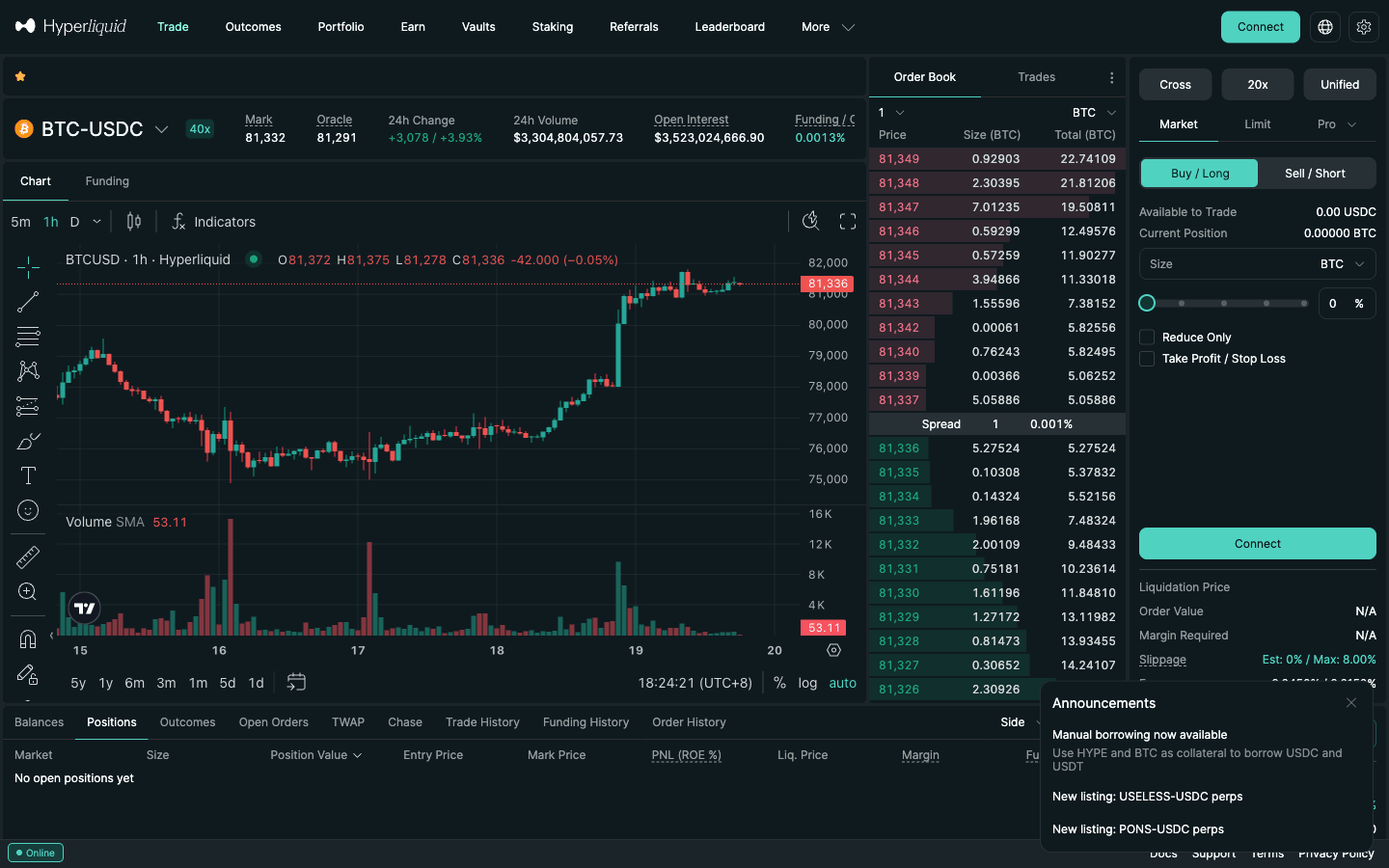
The Trade tab is where everything happens. Reading it top to bottom:
Market header: the pair (for example BTC-USDC), its max leverage badge (40x for BTC), mark price and oracle price, 24h change and volume, open interest, and the current funding rate with a countdown to the next hourly payment.
Chart: a TradingView chart; TP/SL and limit orders can be dragged directly on it.
Order book and trades: bids in green, asks in red, cumulative size per level, and the spread (for BTC typically a single $1 tick).
Order form: margin mode (Cross / Isolated), leverage and account mode buttons (the leverage button sets your own leverage up to the market’s cap: how to change leverage on Hyperliquid), then Market / Limit / Pro tabs, Buy/Long or Sell/Short, size (in the coin, USDC or a percentage of available margin), Reduce Only, and a Take Profit / Stop Loss checkbox. Below it: liquidation price, order value, margin required, slippage and the fee line (0.0450% / 0.0150% at the base tier).
Bottom panel: Balances, Positions, Open Orders, TWAP, Chase, Trade History, Funding History and Order History. Deposit and Withdraw buttons sit at the bottom right.
The BTC-USDC trade page. Order form on the right, book in the middle, positions and history below.
8. Step 6: Place your first perpetual trade (worked example)
A perpetual lets you go long or short a coin with USDC as collateral, without owning the coin. Say you deposit $1,000 USDC and expect BTC, at about $84,000 when the screenshots below were taken (September 27, 2026), to rise.
Haven’t set a referral code yet? Set HOLYGRAIL before your first trade. The discount only covers trades placed after the code is set. Open Referrals → Enter Code and type HOLYGRAIL (step 3): 4% off your fees on your first $25M of volume, accepted only while your account has traded $10,000 or less, and it cannot be changed once set.
Select the market. Click the pair name in the header and choose BTC.
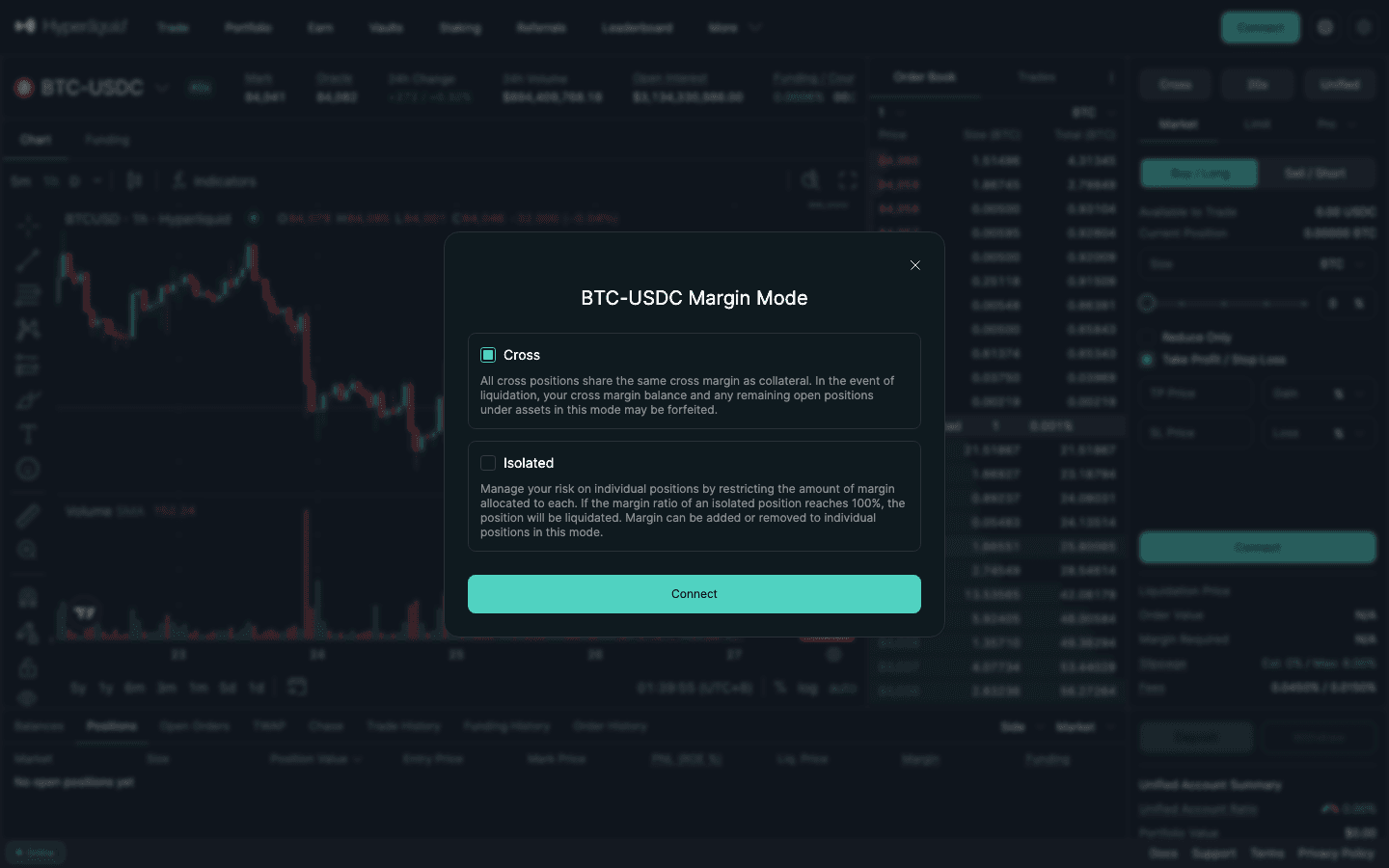
Set margin mode to Isolated. Click Cross above the order form and tick Isolated, so this position can only lose the margin you assign to it.
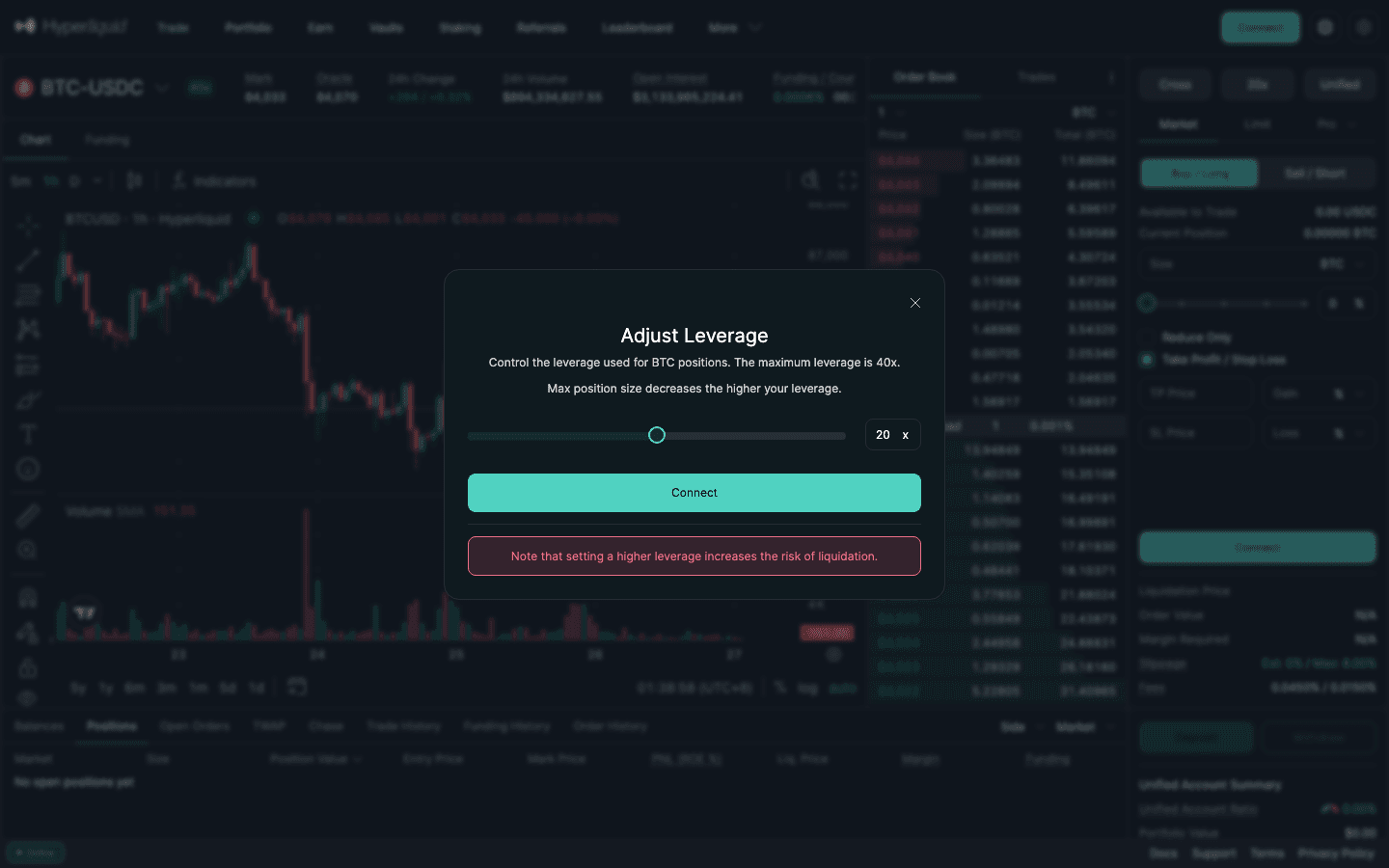
Set leverage. Click the leverage button (it shows the current setting, for example 20x) and drag the slider to 5x. Leverage can be any integer from 1 up to the market's cap (40x on BTC), but the cap is not a suggestion.
Choose the order type. Market for an immediate fill; Limit to name your price and pay the lower maker fee if it rests.
Enter the size. Type 5,000 in USDC (or use the slider). At 5x, margin required = 5,000 ÷ 5 = $1,000 — your whole deposit. A safer first trade uses 2,000–3,000 so there is margin to spare. The smallest order Hyperliquid accepts is $10 of position value (see Hyperliquid minimum order size by pair).
Attach a stop-loss (next section).
Check the ticket — liquidation price, margin required and fee — then click Place Order and Confirm. You can tick "Don't show this again" to skip the confirmation later.
The Margin Mode dialog: tick Isolated for a first trade (September 27, 2026).Adjust Leverage: the dialog states the market's maximum and warns that higher leverage raises liquidation risk (September 27, 2026).
What the numbers mean. A $5,000 market buy costs 0.045% = $2.25 in fees (another $2.25 to close at market; $0.75 if you close with a resting limit). Maintenance margin on Hyperliquid is half the initial margin at max leverage: for BTC (40x) that is 1.25% of notional, so this position is liquidated when its equity falls below about $62.50 — a loss of roughly $937 on the $1,000 of margin, which at 5x is a drop of about 19% to roughly $68,000. An $81,500 stop closes it long before that. Full formulas: liquidation price calculator.
How to set a take-profit and stop-loss on Hyperliquid
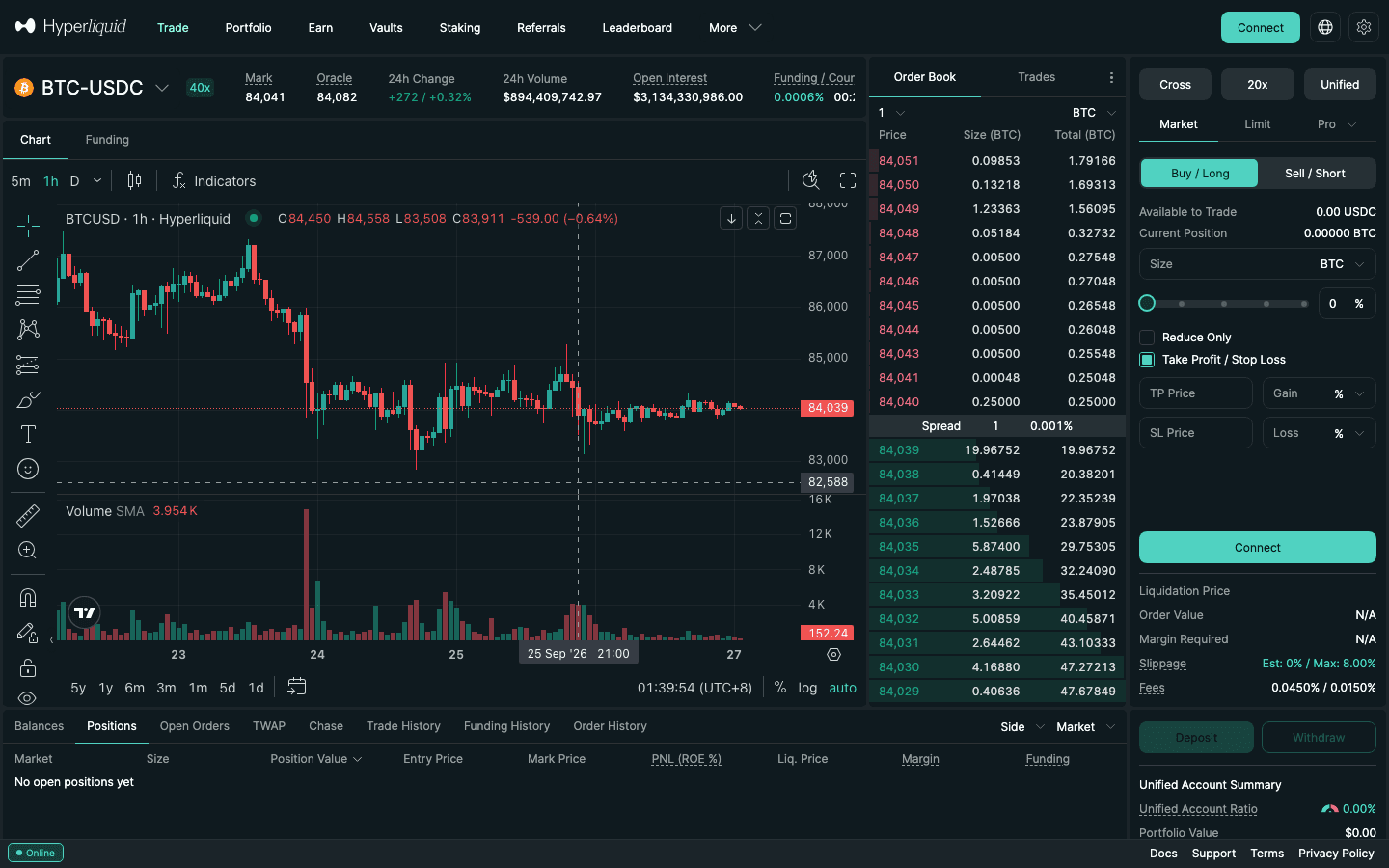
Tick Take Profit / Stop Loss in the order form. Four fields appear: TP Price and Gain %, SL Price and Loss %. Type either the price or the percentage and the other fills in. In the example, a stop at $81,500 and a take-profit at $88,000. Both trigger on the mark price, not the last trade, so a single wick on another venue will not stop you out.
These are market TP/SL orders (10% slippage tolerance) sized to the order they are attached to. They are only placed once that order fills completely: if you cancel a partly filled limit order, its TP/SL is cancelled too, so check the Positions tab after a limit entry. For a limit-price exit or a partial TP/SL, set TP/SL on the open position in the Positions tab, or use a Stop Limit / Take Limit order. The trailing stop tutorial covers stops that follow the price.
TP/SL fields in the order form, with the fee line at the bottom (0.0450% / 0.0150%). Screenshot September 27, 2026.
9. Step 7: Manage and close the position
Positions tab shows size, position value, entry price, mark price, PnL (ROE %), liquidation price, margin and accumulated funding. Click the position to add or remove isolated margin, adjust TP/SL, or close part of it.
Funding is paid or received every hour between longs and shorts; Hyperliquid takes no cut. The interest component is 0.00125% per hour (0.01% per 8 hours). When the perp trades above spot, longs pay shorts. On a $5,000 long at the baseline rate that is $0.0625 an hour — negligible — but on a crowded altcoin rally it can exceed your trading fee many times over. Check the header rate before holding overnight. More in the funding rate guide.
Closing: click Market or Limit next to the position in the table, or place an opposite-side Reduce Only order. Realised PnL is added to your USDC balance at once.
Cross vs isolated later: once you are comfortable, cross margin lets unrealised profit on one position back another. The trade-off is explained in cross vs isolated margin.
10. Step 8: How to buy HYPE on Hyperliquid (spot)
Perps are contracts; if you want to own the HYPE token itself, buy it on the spot market:
Click the pair name in the header, switch the market list to Spot and choose HYPE/USDC (or go straight to app.hyperliquid.xyz/trade/HYPE/USDC).
In a Standard account, move USDC from Perps to Spot first; in the default Unified account your USDC is already available.
Click Buy, enter the amount in HYPE or USDC and place a market or limit order worth at least 10 USDC. Spot fees at the base tier are 0.070% taker / 0.040% maker, and spot volume counts double toward your fee tier.
Your HYPE appears under Balances. From there you can hold it, stake it (below) or send it to another address.
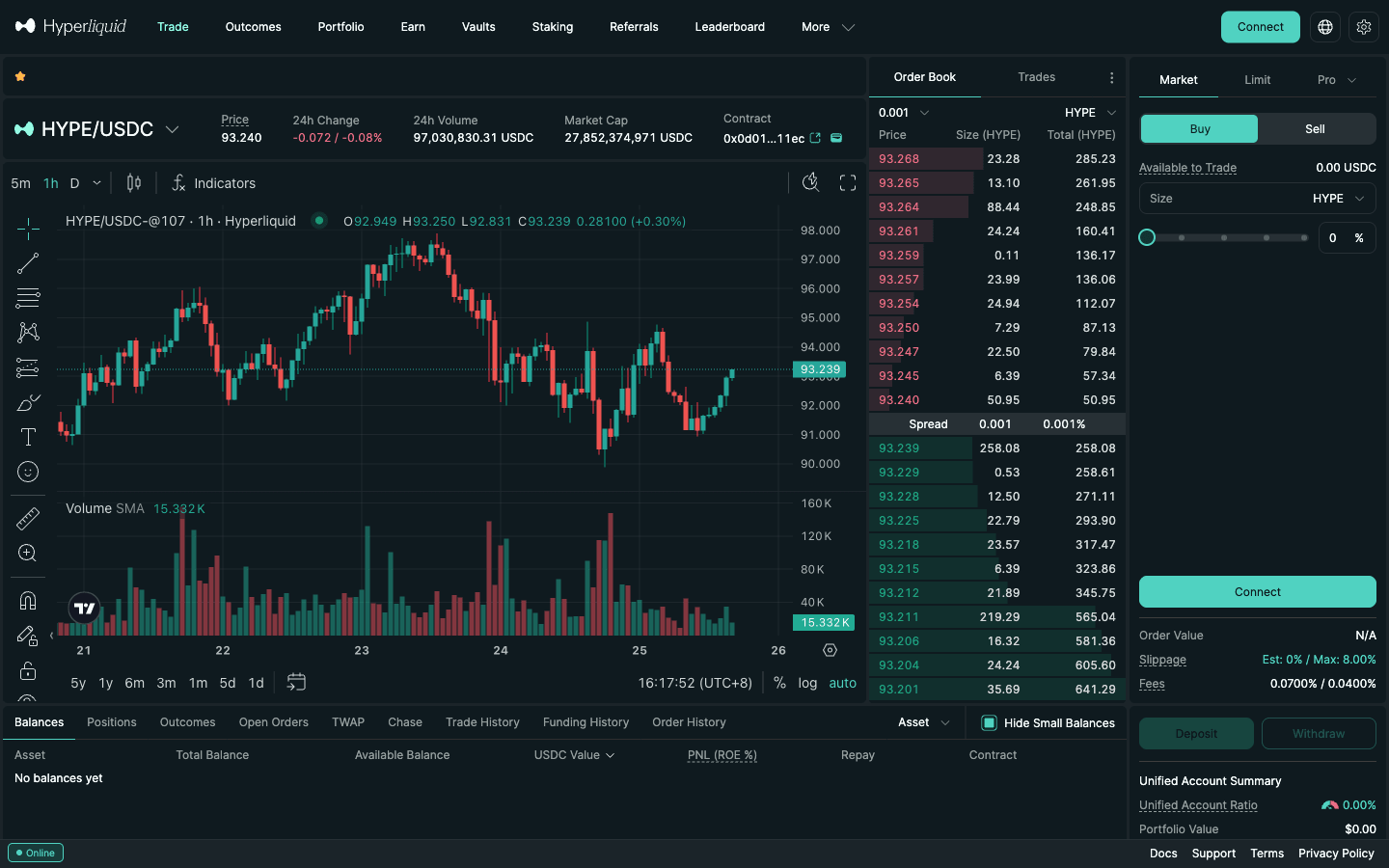
The HYPE/USDC spot market: Buy and Sell instead of Long and Short, and no leverage.
What HYPE is, its supply and where else it trades are covered in the HYPE token guide. If you only want price exposure with leverage, the HYPE perp works like the BTC example above (maximum 10x).
Spot or perps on Hyperliquid?
Spot and perps run on the same HyperCore order-book engine, share one fee tier and sit in the same account; what differs is what you hold.
Spot
Perpetuals
What you hold
The token (HYPE, UBTC…)
A USDC-margined contract
Leverage and shorting
None: you can only sell what you hold
Up to 40x on BTC; long or short
Base fees (taker / maker)
0.070% / 0.040%
0.045% / 0.015%
Funding and liquidation
None on the holding
Funding every hour; liquidation at maintenance margin
Stake, withdraw, use on HyperEVM
Yes
No, only USDC profit and loss
A 1x perp long is not the same as spot: it still pays or receives funding every hour and gives you no token to stake or withdraw. In the default Unified account the USDC you keep for spot buys is also margin for cross perp positions, so if you want a hard wall between a spot stack and leveraged trading, use isolated margin for the perp or keep the spot holdings in a sub-account. The public API listed 349 spot pairs on November 3, 2026.
What you can buy: HYPE, Unit assets and HIP-1 tokens
HYPE: HYPE/USDC is the deepest spot book, and spot HYPE is the only kind you can stake for fee discounts (perp HYPE does not count).
BTC, ETH, SOL and more as U-assets. These coins do not live on Hyperliquid natively. When you pick BTC, ETH or SOL in the deposit window, the address comes from Unit: you send real BTC and receive the same amount of UBTC on HyperCore (ETH becomes UETH, SOL becomes USOL; ZEC, AVAX and a few others work the same way). Unit's Guardians hold the coins with a 2-of-3 MPC scheme, so while they are on Hyperliquid you rely on Unit's custody; withdrawing sends real coins back to the native chain.
HIP-1 tokens: Hyperliquid's own token standard. Listings are permissionless: a deployer wins a Dutch auction paid in HYPE that runs 31 hours and gets a USDC order book at once. Nobody at Hyperliquid vets these tokens, so check the token ID in the market header, not just the ticker, and use limit orders on thin books.
Stablecoins (USDT0, USDH, USDE) trade against USDC; pairs between two quote assets pay 80% lower taker fees.
Deposit (via Unit)
Send on
Minimum
Typical arrival
Credited as
BTC
Bitcoin
0.0003 BTC
about 30 minutes
UBTC
ETH
Ethereum mainnet
0.007 ETH
about 5 minutes
UETH
SOL
Solana
0.12 SOL
about 1 minute
USOL
Source: Unit supported-assets page and Hyperliquid support FAQ. Transactions below the minimum cannot be processed, and an unsupported token or the wrong network can leave the deposit stuck. Your Unit address is permanent and tied to your Hyperliquid address; Unit charges no protocol fee, you pay the chains' network fees.
Spot fees, lot sizes and dust
Spot and perps have separate fee schedules but one tier, set by 14-day weighted volume where weighted volume = perp volume + 2 × spot volume. HYPE staking and a referral code (4% off for your first $25M) cut spot fees the same way as perp fees (full fee tables). Third-party front-ends can add a builder fee of up to 1% on spot; it is collected in the quote asset, so it hits your sells, and the official app charges none. Each token has a lot size set by its deployer: a balance smaller than one lot can't be sold on the book, and balances under one lot worth $1 or less are swept once a day at 00:00 UTC and credited as USDC unless you opt out of spot dusting.
HYPE on Binance instead? Binance opened HYPE spot on September 24, 2026 with a seed tag (a verified account and a risk quiz every 90 days) and charges 0.1% to regular users. Its HYPE withdrawals run on HyperEVM only, so coins land on HyperEVM and need one more Transfer to Core before you can stake or trade them on HyperCore. Buy on Hyperliquid if you plan to stake HYPE or use it as collateral there.
11. Step 9: Withdraw
Click Withdraw at the bottom right of the trade page, choose the asset and destination chain, enter the amount and sign. USDC to Arbitrum carries a flat 0.2 USDC fee plus a tiny HyperEVM gas fee, via Circle CCTP, and should arrive within 5 minutes; other assets pay their native chain's network fee. Open positions' margin cannot be withdrawn, and unrealised profit can only be taken out while the remaining margin stays at or above the initial requirement and 10% of your total notional. Step-by-step: how to withdraw from Hyperliquid.
12. Trading on your phone: does Hyperliquid have an app?
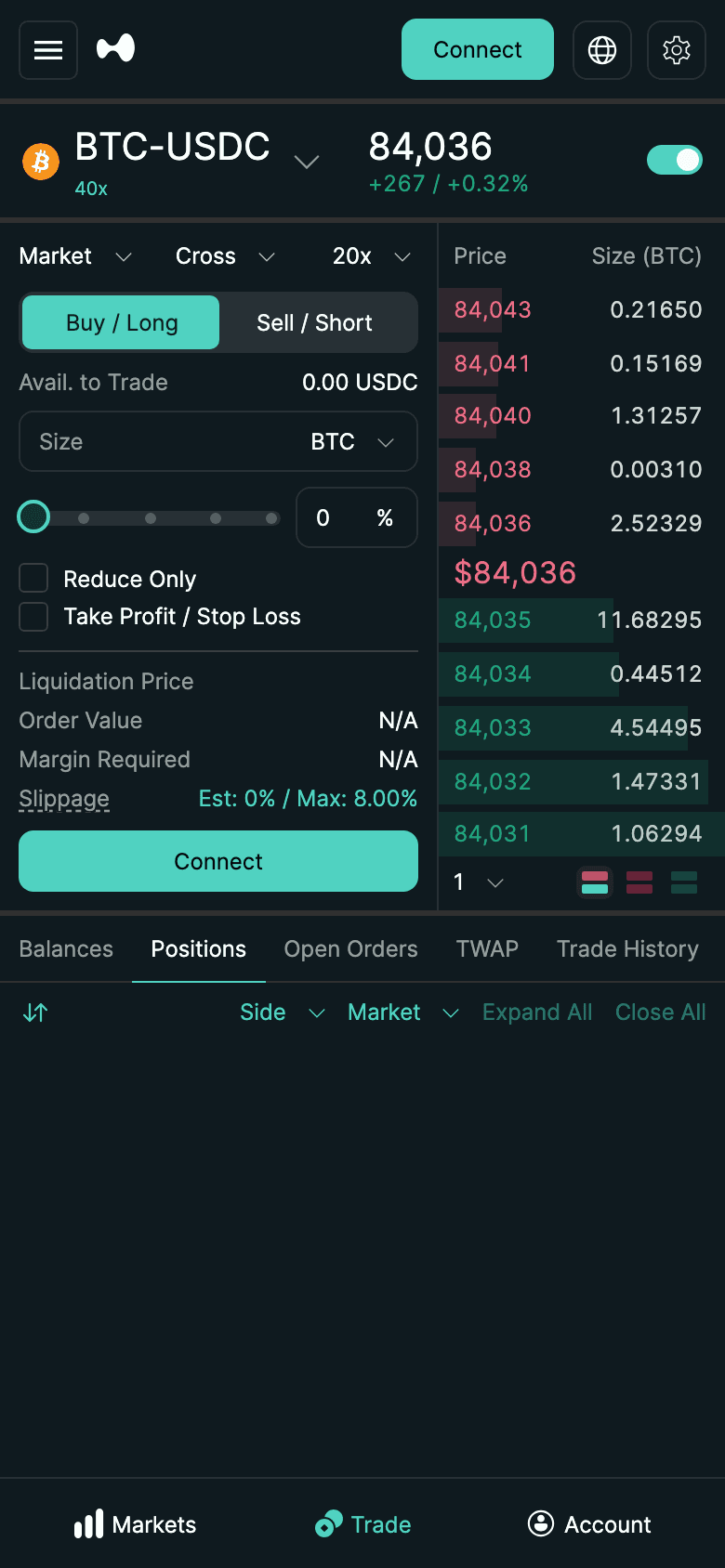
Yes, in two forms. The web app at app.hyperliquid.xyz adapts to a phone screen: Markets, Trade and Account tabs sit at the bottom, and the Trade tab puts the order type, Cross/Isolated, leverage, Buy/Long and Sell/Short and the TP/SL checkbox next to a compact order book. On Android there is also an official app on Google Play published by Hyperliquid Corp. There is no official iOS app; on iPhone, open the web app in Safari and add it to the Home Screen. Setup, login and the Android download are in our Hyperliquid app guide.
The Trade tab of app.hyperliquid.xyz on a 390-pixel-wide phone screen (September 27, 2026).
Third-party apps. Besides the official web app, Hyperliquid's onboarding docs name Dexari, MetaMask and Phantom (checked October 15, 2026); Based and Liquid also trade on Hyperliquid. They are convenient native apps, but they usually add a builder fee on top of Hyperliquid's (on perps: Based +0.025%, Liquid +0.05%, fomo +0.05%; the protocol cap is 0.1%). Your Hyperliquid referral code follows your account into apps you connect with the same wallet, such as Based and Liquid (MetaMask publishes only an all-in rate, so the effect of a code there is not published): the referral discount also applies to orders placed through apps with a builder code (checked against mainnet fills on October 1, 2026), so with HOLYGRAIL set you pay 4% less on Hyperliquid's part of the fee; the builder fee itself is not discounted. The catch: apps such as Phantom often set their own Hyperliquid referral code on accounts that have none, so enter a code on Hyperliquid before you start using an app. A code cannot be added after $10,000 of volume either: join with HOLYGRAIL using the same wallet before you connect any app. fomo is different: it has no wallet connection (Apple, Google or email only) and creates its own wallet and Hyperliquid account for you, so HOLYGRAIL cannot apply there; use fomo's own referral code instead (ours: DailyWiseKite). Some apps also run their own referral program on top: Based, Liquid and fomo (our reviews, with our codes). For the lowest cost, trade in the official web app with a Hyperliquid code.
Trading on your phone? HOLYGRAIL first, then Based
Based is a native Hyperliquid app for iPhone, Android, web and desktop, with the lowest add-on fee among the full Hyperliquid phone apps we compare (+0.025% on perps). To keep Hyperliquid's 4% referral discount inside it, do both steps with one wallet.
Join Hyperliquid with HOLYGRAIL from the wallet you will use on your phone. In the Rabby or MetaMask app, open its browser, go to app.hyperliquid.xyz/join/HOLYGRAIL, connect and confirm the code. That takes 4% off Hyperliquid's part of every fee for your first $25M of volume, and a code can only be added while the account has traded $10,000 or less.
How the HOLYGRAIL code works →
Open Based with that same wallet. Our link opens app.based.one with Based code HOLYGRAIL filled in (Based's own program, separate from Hyperliquid's). Link the wallet from step 1 instead of signing in with email or Google: those make a new wallet, which is a different Hyperliquid account without the discount. In the phone app, choose Connect Mobile to link your existing wallet (Based docs, checked October 19, 2026).
Step 2: open Based →No Connect Mobile option? Based's route from a computer
From a computer: open app.based.one/accounts in a desktop browser, choose Add Hyperliquid account and connect the wallet, then scan the QR code shown on the computer with the phone app via Home → profile picture → Create new wallet → Link to Hyperliquid wallet. Despite the menu name, this links the wallet's existing Hyperliquid account instead of creating a new one; a wallet linked this way can trade, but deposits and withdrawals are done on app.hyperliquid.xyz.
Why this order: apps such as Phantom often set their own Hyperliquid referral code on accounts that have none, so enter a code on Hyperliquid before you start using an app.
What it costs. Based adds a 0.025% builder fee on top of Hyperliquid's fee on perps: 0.0682% taker with HOLYGRAIL (0.0432% Hyperliquid + 0.025% Based), 0.070% without. That is about $0.68 per $1,000 traded, against $0.43 on app.hyperliquid.xyz directly. The 4% only comes off Hyperliquid's part; HOLYGRAIL does not discount Based's builder fee. The cheapest way to trade on a phone is still the official web app (or the official Android app), which has no builder fee: Hyperliquid app guide.
Both are our referral codes: Hyperliquid pays us 10% of the Hyperliquid fees of people who join with HOLYGRAIL, and Based pays us 60% of its builder fee from people who sign up with our Based code. Based documents no discount for you from its code, and it does not raise your fee.
13. Order types you will actually use
Order
What it does
Use it for
Market
Fills now at the best available price (max slippage shown in the ticket, default 8%)
Getting in or out immediately
Limit
Rests on the book at your price or better; pays the lower maker fee if it rests
Most entries and exits
Stop Market / Stop Limit
Activates when the trigger price is crossed
Stop-losses, breakout entries
Take Market / Take Limit
Activates when price reaches a favourable trigger
Taking profit at a level
Trailing Stop
Trigger follows the best mark price by a fixed distance or %
Letting winners run
Scale
Several limit orders spread across a price range
Averaging into a position
TWAP
Splits a large order into sub-orders at least 30 s apart, 5 min to 7 days
Big size without moving the book
Chase
Post-only limit that re-prices to stay at the top of the book
Maker fills without babysitting
Time-in-force options on limit orders are GTC (rests until filled or cancelled), Post Only / ALO (rejected if it would take liquidity — guarantees the maker fee) and IOC (fills what it can, cancels the rest). Deeper dive: Hyperliquid order types.
14. What trading on Hyperliquid costs
Cost
Amount (base tier)
Notes
Perp taker fee
0.045%
0.0432% with a referral code; falls with 14-day volume
Perp maker fee
0.015%
0% above $500M 14-day volume; rebates for large makers
Spot fees
0.070% / 0.040%
Spot volume counts double toward your tier
HIP-3 perps (stocks, commodities)
0.009% taker in growth mode; 0.09% otherwise
Set by each market's deployer; shown in the fee line
Gas on orders
None
Place, cancel, modify, TP/SL, funding, liquidation — all free
Deposit
Source-chain gas (+ 0.2 USDC on the default Arbitrum CCTP route)
Cents on Arbitrum or Base
Withdrawal (USDC → Arbitrum)
0.2 USDC flat plus a tiny HyperEVM gas fee
Deducted from the amount
Funding
Variable, hourly
Peer-to-peer; 0.00125%/h interest component
Staking HYPE cuts fees a further 5–40% depending on tier. Every rate, with tiers and examples, is in Hyperliquid fees explained.
Nothing checks your country when you connect; the rules are in the interface Terms of Use (last updated June 15, 2026; re-read October 15, 2026, unchanged). §1.6 excludes people and entities residing, located or registered in the United States or Ontario, Canada, anyone in a jurisdiction under sanctions or export controls, and citizens of those sanctioned territories. §1.9 makes you responsible for checking that leveraged trading is legal where you live and forbids disguising your location. US residents cannot use Hyperliquid, and we do not cover workarounds. Country-by-country notes (Canada, the UK, Singapore, Japan) are in Hyperliquid restricted countries.
16. Beyond your first trade
Practise on testnet.app.hyperliquid-testnet.xyz is the same app with mock money; its faucet at /drip gives 1,000 mock USDC, but only to addresses that have already deposited on mainnet (email logins get a different testnet address, so export the email wallet first). Walkthrough: Hyperliquid testnet guide. To test a strategy on past prices instead, see how to backtest a Hyperliquid strategy.
Vaults (HLP). The Vaults page lists HLP, the protocol's market-making vault, and user vaults run by traders. HLP deposits unlock 4 days after your latest deposit, user vaults after 1 day; returns can be negative (Hyperliquid vaults).
Staking HYPE. Delegations lock for 1 day, unstaking takes 7 days, and staked HYPE earns validator rewards plus a 5–40% fee discount by tier (Hyperliquid staking).
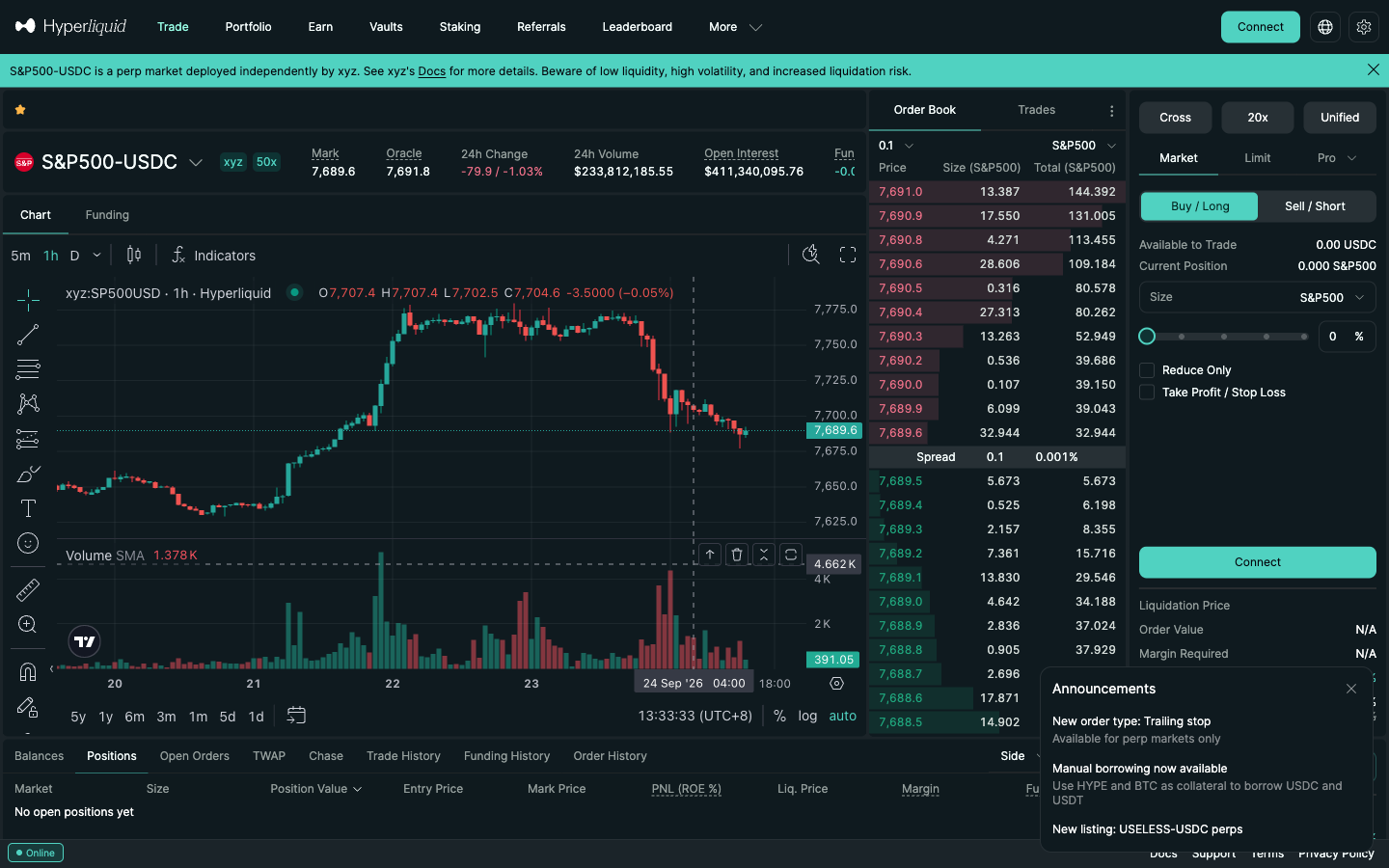
HIP-3 stock, index and commodity perps. Markets deployed by third parties, such as trade.xyz's S&P500-USDC, sit in the same market selector. Fees are set per deployer: 0.009% taker in growth mode at the base tier, typically 0.09% otherwise (trade.xyz stock perps).
A HIP-3 market (S&P500-USDC, deployed by xyz) on the normal Hyperliquid trade page.
17. Eight beginner mistakes to avoid
Trading before entering a referral code. Trades placed before the code is set pay full fees, and once your account passes $10,000 of volume Hyperliquid no longer accepts a code, so you lose 4% off for up to $25M of volume.
Using the max leverage badge as a target. 40x means a 2.5% move wipes your margin. Start at 2–5x.
Cross margin on day one. One bad position can consume collateral you thought belonged to another.
No stop-loss. If a position reaches backstop liquidation, its remaining maintenance margin is not returned to you; a stop-loss you set yourself exits earlier and keeps what is left.
Ignoring funding. Check the rate and countdown in the header before holding through a hot rally.
Depositing an unsupported token. Only send the assets the deposit window lists, on the chains it lists.
Sending less than the minimum. Under 5 USDC (or under the per-asset floor for native deposits, e.g. 0.0003 BTC) is not credited and cannot be recovered. Test with a small but above-minimum amount.
Typing the domain from memory. The trading site is app.hyperliquid.xyz; bookmark it. Lookalikes such as "hyperliguid.xyz" exist, and real support never DMs you first (official links).
Ready? Your first step needs an account
Join with code HOLYGRAIL before your first deposit and trade: 4% off your fees on the first $25M of volume, and it cannot be added after $10,000. Prefer zero taker fees? See Lighter; need more leverage than 40x on BTC? See Aster.
There is no registration form and no KYC. Open app.hyperliquid.xyz (our join link app.hyperliquid.xyz/join/HOLYGRAIL also attaches a referral code), click Connect and either log in with your email (a 6-digit code; Hyperliquid creates an embedded wallet for you) or connect an EVM wallet such as MetaMask or Rabby. Wallets click Enable Trading and sign a gas-free message. Your first USDC deposit (at least 5 USDC) activates the account for trading. The join link remembers the code and the app submits it once your account is ready to trade, which is right after your first deposit and Enable Trading.
How do I log in to Hyperliquid?
Click Connect on app.hyperliquid.xyz and use the same method you signed up with (the same email and its 6-digit code, or the same wallet address). An email login and a wallet are two separate accounts, so an empty balance usually means you logged in the other way. Login details →
How do I connect MetaMask to Hyperliquid?
Open app.hyperliquid.xyz in the browser where MetaMask is installed, click Connect, choose Default Wallet and approve in MetaMask, then click Enable Trading and sign (no gas). On a phone, use MetaMask's built-in browser or WalletConnect. MetaMask steps →
How do I trade on Hyperliquid step by step?
1) Open the join link and log in with email or a wallet (wallets also click Enable Trading). 2) Deposit at least 5 USDC of USDC on Arbitrum. 3) Pick a market, set isolated margin and modest leverage, enter a size, add a stop-loss and click Place Order. Quick start →
Where are the official Hyperliquid docs and Discord?
The docs are at hyperliquid.gitbook.io/hyperliquid-docs (the "Docs" link in the app footer) and the Discord server is discord.gg/hyperliquid. Support only happens in the Discord "open-ticket" channel or through the email form linked from the docs' Support Guide, and replies can take up to 48 hours. Anyone who messages you first claiming to be Hyperliquid support is an impersonator. The network status page is hyperliquid.statuspage.io (checked October 15, 2026). All official links →
Where is Hyperliquid allowed?
The interface Terms of Use (last updated June 15, 2026, §1.6; re-read October 15, 2026) exclude "Restricted Persons": people and companies residing, located or registered in the United States or Ontario, Canada, anyone in a jurisdiction under economic sanctions or export controls, and citizens of those sanctioned territories wherever they live. In Canada only Ontario is named, so the other provinces are not excluded by the Terms, though their own securities rules still apply. Other countries are not named, but §1.9 makes you responsible for checking that leveraged and derivative trading is legal where you live and forbids disguising your location. Restricted countries, incl. Canada →
Can I use Hyperliquid in the US?
No. US residents are Restricted Persons under §1.6 of the interface terms and may not use app.hyperliquid.xyz, and §1.9 forbids using a VPN or any other method to disguise your location. We do not cover workarounds. US traders who want regulated crypto futures have to use a venue licensed in the US.
Do I need KYC to trade on Hyperliquid?
No. No ID check in the Terms: an email address or a self-custody wallet is the account. The interface terms still exclude residents of the United States and Ontario, Canada, and sanctioned jurisdictions, and on-chain activity is public. KYC and who may use it →
Is there a Hyperliquid demo account or funded account?
There is a demo, but no funded account. The demo is the testnet at app.hyperliquid-testnet.xyz: the same interface with mock USDC. Its faucet (1,000 mock USDC at /drip) only works for addresses that have already deposited on mainnet, and email logins get a different address on testnet, so export your email wallet into a wallet extension first. A funded account is different: Hyperliquid's docs describe no funded-account or prop-trading program (checked October 15, 2026). "Get funded to trade Hyperliquid" offers come from separate prop firms with their own fees and rules, so read who runs them before you pay an evaluation fee. Hyperliquid testnet guide → · Hyperliquid funded accounts and prop firms →
Does Hyperliquid have an app?
Yes. The official app is the web app at app.hyperliquid.xyz, which works in any phone browser (Markets, Trade and Account tabs at the bottom), plus an Android app on Google Play published by Hyperliquid Corp. There is no official iOS app; iPhone users add the web app to the Home Screen. Third-party apps such as Based, Dexari, MetaMask and Phantom also trade on Hyperliquid, but they usually add a builder fee (Based +0.025%, Liquid +0.05%, fomo +0.05% on perps). A Hyperliquid referral code follows your account into apps you connect with the same wallet, such as Based and Liquid (MetaMask publishes only an all-in rate): the referral discount also applies to orders placed through apps with a builder code (it comes off Hyperliquid's part of the fee; the app's builder fee is charged in full). But apps such as Phantom often set their own Hyperliquid referral code on accounts that have none, so enter a code on Hyperliquid before you start using an app, and no code can be added after $10,000 of volume. fomo is different: it has no wallet connection (Apple, Google or email only) and creates its own wallet and Hyperliquid account for you, so HOLYGRAIL cannot apply there; use fomo's own referral code instead.
How do I buy HYPE on Hyperliquid?
Deposit USDC, open the Trade page and pick HYPE/USDC in the market selector (the Spot list), choose Buy, enter an amount and place a market or limit order. Spot fees at the base tier are 0.070% taker / 0.040% maker. In the default Unified account the same USDC balance pays for spot and perps; in Standard mode, transfer USDC from Perps to Spot first. The HYPE token itself (supply, staking, where else it trades) is covered in our HYPE token guide. HYPE token guide →
Is BTC on Hyperliquid spot real Bitcoin?
It is UBTC, a 1:1 token issued by Unit when you send real BTC to your Unit deposit address (minimum 0.0003 BTC). Unit's Guardians hold the BTC with a 2-of-3 MPC scheme and release it when you withdraw to a Bitcoin address, so while it is on Hyperliquid you rely on Unit's custody. ETH and SOL work the same way as UETH and USOL. What you can buy on spot →
How do tokens get listed on Hyperliquid spot?
Spot listings are permissionless. A deployer wins a Dutch auction paid in HYPE that runs 31 hours, creates a HIP-1 token and gets a USDC order book at once. Nobody at Hyperliquid vets these tokens, so check the token ID before you buy.
Why can’t I sell a small leftover spot balance?
Each token has a lot size set by its deployer, and spot orders must be worth at least 10 USDC. Balances below one lot and worth $1 or less are swept once a day at 00:00 UTC by spot dusting, which sells the combined dust and credits you USDC; you can opt out in the app. Spot fees, lot sizes and dust →
Why is Enable Trading not working on Hyperliquid?
Enable Trading is a free signature, not a transaction. If nothing happens, unlock the wallet, allow pop-ups for app.hyperliquid.xyz and check the wallet icon for a waiting request; if the wrong extension opens, disable the other wallet extensions and reconnect. All fixes →
What is the minimum to start trading on Hyperliquid?
The official docs set a minimum deposit of 5 USDC on the Arbitrum bridge and the other USDC routes: a wallet-connected account that sends less than 5 USDC loses it, and an email account has sub-5 USDC redirected to its email wallet (under 1 USDC is lost). Native deposits have their own minimums — 0.0003 BTC, 0.007 ETH, 0.12 SOL, 1.5 AVAX — below which funds are lost. The smallest perp order is $10 of position value, so a few dollars of margin at modest leverage is technically enough; start with an amount you can afford to lose entirely while you learn.
Cross or isolated margin for a first trade?
Isolated. Cross margin (the default) shares your cross balance across positions, so a bad trade can drain collateral from good ones. Isolated margin limits the loss on a position to the margin you assigned to it and lets you add or remove margin later. Switch it with the Cross button above the order form before placing the order.
Disclosure: HOLYGRAIL is our referral code; we earn a share of referred accounts' fees. Procedures, fees and margin rules were read from the official Hyperliquid docs, the Terms of Use and the live app (screenshots dated in their captions), and market figures from the public API on the dates above. Leveraged trading can lose more than you expect; nothing here is financial advice.