
Which bridge to use, by where your money is
- USDC on Arbitrum → the Deposit button at app.hyperliquid.xyz (Circle CCTP, flat 0.20 USDC). Want it faster? Relay and Across quoted ~1 s on October 26, 2026.
- On an exchange → withdraw directly on the Hyperliquid network. No bridge needed.
- Ethereum, Base, Polygon, other EVM → Across or Relay, destination “Hyperliquid” (HyperCore).
- Solana → Mayan, deBridge or Relay for USDC. Only SOL and listed tokens go to the Hyperunit address.
- BTC / ETH / SOL coins → Hyperunit (native addresses in the Deposit window). No protocol fee.
- Want HyperEVM, not trading? → pick HyperEVM as the destination in Relay, Across or Stargate (how to bridge to HyperEVM).
- Not sure? → compare quotes on Jumper (LI.FI), then send at least 5 USDC. The click-by-click steps are right below; what each route relies on is in is the Hyperliquid bridge safe?
How to bridge to Hyperliquid, step by step
Bridging to Hyperliquid means moving USDC (or a coin) into your HyperCore account, the balance you trade from. The steps are the same whichever bridge you use. The example below is Relay from Arbitrum; Across works the same way.
- Open Hyperliquid and connect your wallet. Go to app.hyperliquid.xyz, click Connect and pick the wallet that holds your funds (MetaMask, Rabby, Phantom’s EVM address, or email login). Do this first, through a referral link, so the fee discount is on the account before any money arrives: open Hyperliquid with code HOLYGRAIL (4% off your first $25M of volume).
- Check where your money is. Native USDC on Arbitrum One needs no third-party bridge: click Deposit, enter the amount and sign. Circle’s CCTP credits it for a flat 0.20 USDC; our guide shows how to deposit USDC on Arbitrum to Hyperliquid screen by screen. On an exchange, withdraw on the Hyperliquid network instead. Anything else (Ethereum, Base, Polygon, Solana, USDT) goes through steps 3–6.
- Open the bridge and set the route. Open relay.link/bridge/hyperliquid or app.across.to (EVM chains only; from Solana, use Relay) and connect the same wallet. Under Sell or From, pick your chain and token. Under Buy or To, pick USDC on Hyperliquid, not HyperEVM; HyperEVM is the smart-contract side and is not trading margin.
- Enter the amount and read the quote. Send at least 5 USDC (below that, deposits can be lost) and test with a small amount first. Check three lines before you sign: what you receive, the fee and the estimated time.
- Approve and confirm. The first time, your wallet asks for two signatures: a token approval, then the bridge transaction. Keep a little of the source chain’s gas token (ETH on Arbitrum, Ethereum or Base; SOL on Solana).
- Check that it arrived. In Hyperliquid, open Portfolio or the Balances table. USDC from Relay’s Perps route, Across, Mayan’s perps option or the Deposit button sits in Perps and is ready to trade. If it shows under Spot, transfer Spot → Perps. Nothing after a few minutes? Look the transaction up on relay.link/transactions or across.to/transfers before you do anything else, and never send it again.
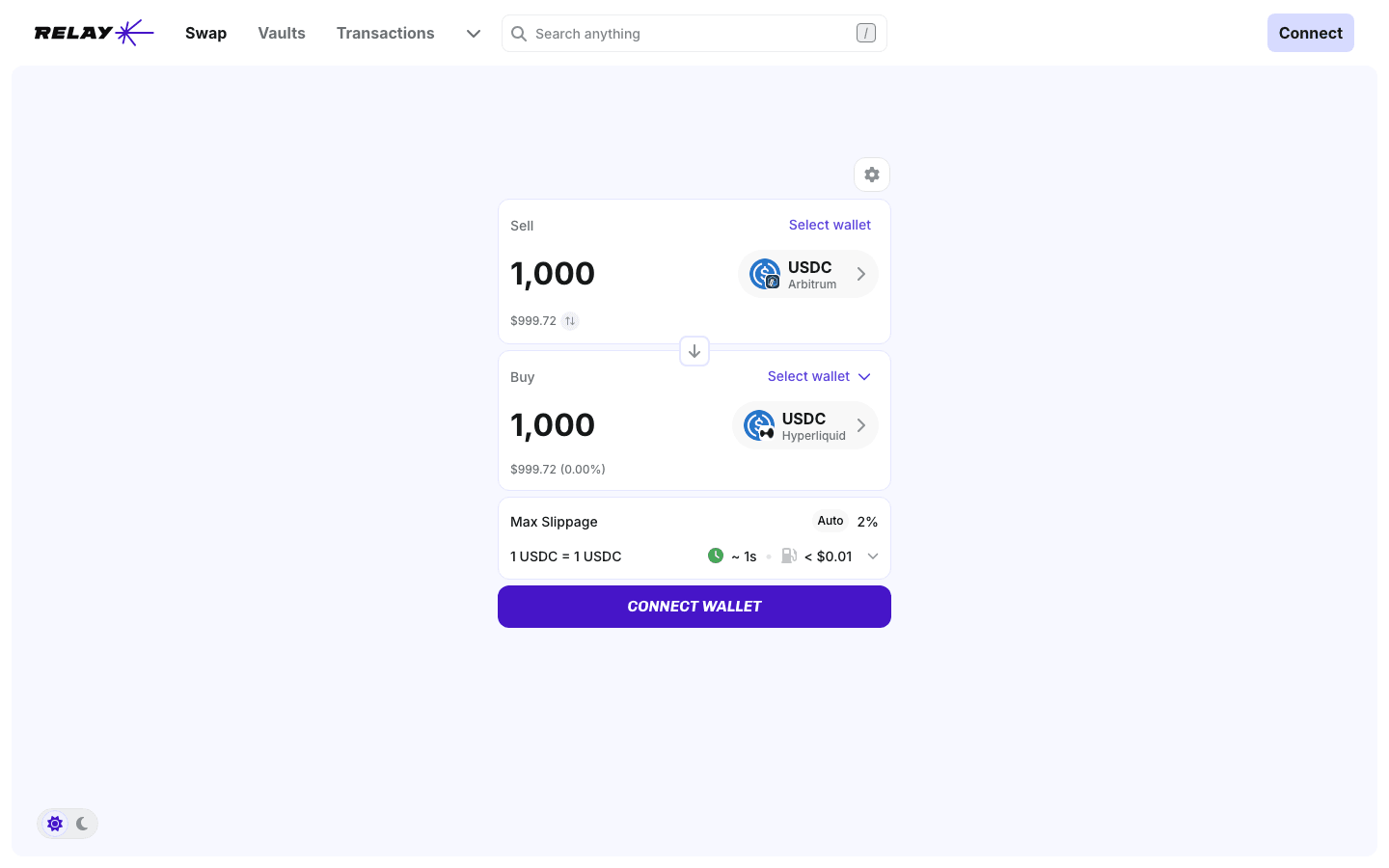
What bridging 1,000 USDC to Hyperliquid cost on October 26, 2026
We asked each bridge’s public quote API for the same transfer, 1,000 USDC into the Hyperliquid Perps balance, within three minutes on October 26, 2026 (02:08–02:11 UTC):
| Route · from | You receive | Cost | Time |
|---|---|---|---|
| Deposit button (CCTP) Arbitrum | 999.80 USDC | 0.20 USDC flat + Arbitrum gas | Minutes |
| Across Arbitrum, Ethereum or Base | 999.89 USDC | 0.108 USDC + source-chain gas | ~1 s |
| Relay Arbitrum | 999.83 USDC | 0.113 USDC relayer fee and a little price impact, + $0.036 gas | ~1 s |
| Relay Ethereum or Base | 999.88 USDC | 0.12 USDC + source-chain gas ($0.008 on Ethereum) | ~1 s |
| Relay Solana | 999.75 USDC | 0.245 USDC + Solana fee | ~1 s |
| Across, USDT0 in (sponsored) Arbitrum | 998.78 USDC | 0.122% deducted in the quote | ~1 s |
Re-quoted October 26, 2026. Sources: Relay quote API; Across Swap API (/swap/approval); Circle’s CCTP fee API for the Deposit button. Times count from the moment the source-chain transaction confirms. These are snapshots: quotes change by the hour, and the quote you see before you sign is the final word. A brand-new Hyperliquid address can also pay a one-time 1 USDC activation fee.
At that moment Across returned the most USDC from Arbitrum (999.89 USDC) and the Deposit button the least (999.80 USDC), and no USDC route cost more than 0.245 USDC per 1,000 USDC. The bridge is a one-off cost of cents. Fees on your trades recur, which is why the referral discount in step 1 matters more than which bridge you pick. New to the venue itself? Our Hyperliquid review covers fees, markets and risks before you fund it.
Best bridge for Hyperliquid by where your money is
Hyperliquid runs on its own layer-1, so "bridging to Hyperliquid" really means getting USDC (or a coin) into your HyperCore account. No single bridge is best for everyone. The best one is the shortest trip from where your funds sit right now:
| Your funds are… | Best bridge | Runner-up | Why |
|---|---|---|---|
| USDC on Arbitrum, in your wallet | Hyperliquid’s own Deposit button | Across (fastest) | Official route; routed through Circle CCTP for a flat 0.20 USDC |
| USDC on a CEX (Binance, OKX, Bybit, Coinbase…) | Withdraw straight to Hyperliquid if listed | Withdraw to Arbitrum One → Deposit | No bridge at all; one withdrawal fee |
| USDC on Ethereum, Base or Polygon | Across or Relay to Hyperliquid (HyperCore) | Email-login deposit address | One transaction, lands as trading margin |
| USDT or USDT0 on Ethereum, Arbitrum or Polygon | Across (sponsored route) | Relay stablecoin swap | Across lists it as sponsored (no bridge fee), yet its October 26, 2026 quote still deducted 0.122% |
| USDC or SOL on Solana | Mayan, deBridge or Relay to Hyperliquid | SOL → Hyperunit address | Never send Solana USDC to the Hyperunit address |
| BTC, ETH, SOL, AVAX, ZEC you want to keep as coins | Hyperunit (the Deposit window’s native addresses) | — | No protocol fee, lands in spot |
| Many small balances on several chains | Jumper (LI.FI) to compare quotes | Relay | Aggregator shows the cheapest route per token |
| USDe, USDT0 or other LayerZero tokens for HyperEVM DeFi | Stargate / LayerZero | deBridge | Lands on HyperEVM, not your trading balance |
Two rules cover most cases. First, fewer hops are better: an exchange that withdraws directly to Hyperliquid beats any bridge on cost and on the number of things that can go wrong. Second, when you do need a bridge, get two quotes (or let Jumper get them). On the same route, the gap between two quotes is often bigger than either fee, and it changes by the hour.
Hyperliquid bridges compared: 10 routes side by side
This table compares the named bridges and routes people actually use: how each one works, where it can start, where the money lands, and what it costs according to each bridge’s own documentation on October 26, 2026. Speeds marked as a claim are the bridge’s own figure.
| Bridge | How it works | From | Lands on | Speed | Fees | Best for |
|---|---|---|---|---|---|---|
| Hyperliquid Deposit (Arbitrum) | Circle CCTP burn-and-mint (legacy Arbitrum bridge deprecated) | Arbitrum (wallet login); + Ethereum, Base, Polygon on email login (via Across) | HyperCore | Minutes | 0.20 USDC flat + Arbitrum gas | USDC already on Arbitrum |
| CEX withdrawal | The exchange sends on the Hyperliquid network | Your exchange account | HyperCore or HyperEVM (check the label) | Minutes | Exchange withdrawal fee | Funds already on an exchange |
| Across | Intent bridge: a relayer fills on HyperEVM, credited to HyperCore | Most EVM chains | HyperCore | ~1 s (Across quote API) | Relayer fee in the quote: 0.108 USDC per 1,000 USDC on October 26, 2026 | Speed from Arbitrum and other EVM chains |
| Relay | Intent bridge with its own solvers | EVM chains, Solana and more | HyperCore Perps USDC (or spot, or HyperEVM) | Seconds | $0.02 + gas; 0.00% platform fee same-token | Cheap same-token USDC moves; withdrawals out |
| deBridge | DLN solver network, no liquidity pools | Solana, EVM chains | Your Hyperliquid account (via native Arbitrum USDC) | Seconds (deBridge claim) | 4 bps protocol + ≈4 bps solver margin + flat native fee | Any Solana or EVM token in one step |
| Mayan | Swift v2 cross-chain swap | Solana, EVM chains | HyperCore USDC (spot or perps) | as little as 6 seconds (Mayan claim) | Quoted per swap | Solana → HyperCore |
| Jumper (LI.FI) | Aggregator: compares Across, Relay, Mayan, CCTP, Unit, Stargate and others | 69 chains in the LI.FI API | HyperCore or HyperEVM (pick “Hyperliquid”) | Depends on route | Underlying bridge fee + any aggregator fee in the quote | Finding the cheapest route |
| Stargate (LayerZero) | LayerZero OFT / pool transfers | 103 chains in LayerZero’s transfer API | HyperEVM (HyperCore also listed) | Depends on route | Quoted per transfer | USDT0, USDe and other OFT assets |
| Hyperunit | Guardian network (2-of-3 MPC) mints native-backed spot tokens | Bitcoin, Ethereum, Solana, Base, Avalanche, Monad, Plasma, Zcash | HyperCore spot (UBTC, UETH, USOL…) | about 1 minute (SOL) to about 30 minutes (BTC) | No protocol fee; source + destination network fees | Depositing coins, not USDC |
| Canonical Arbitrum bridge | Ethereum ↔ Arbitrum rollup bridge | Ethereum | Arbitrum (then Deposit) | 15–30 minutes in, 7 days out | Ethereum gas only | Most conservative L1 → L2 hop |
Sources, all read on October 26, 2026: Hyperliquid docs and info API (usdcRouting); Circle’s CCTP fee API; docs.across.to, Across’s Swap API and its Arbitrum→Hyperliquid guide; docs.relay.link (fees) and Relay’s quote API; docs.debridge.com (fee structure) and deBridge’s Hyperliquid guide; docs.mayan.finance (Hyperliquid); the LI.FI and LayerZero transfer APIs; docs.hyperunit.xyz; Arbitrum docs. Bridge fees are quoted live before you sign, so the quote is the final word.
Each Hyperliquid bridge in detail
Hyperliquid’s own Deposit button (the “native bridge”)
Best for: USDC already on Arbitrum. Fee: 0.20 USDC flat plus Arbitrum gas. Speed: minutes.
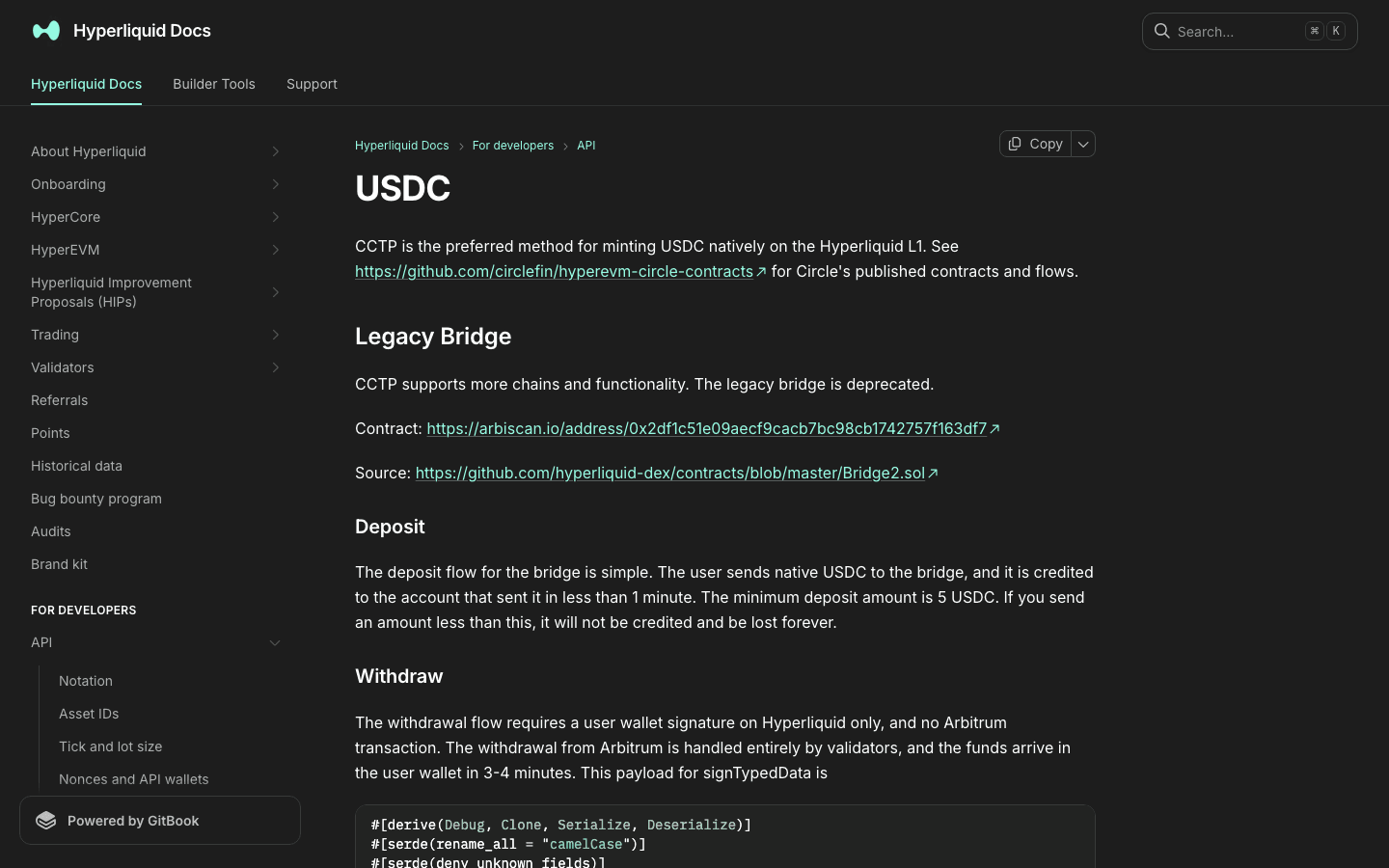
This is the official route. Hyperliquid’s API docs, read on October 26, 2026, put it in two lines: CCTP is "the preferred method for minting USDC natively on the Hyperliquid L1", and under Legacy Bridge, "CCTP supports more chains and functionality. The legacy bridge is deprecated." Hyperliquid’s routing setting named Circle CCTP as the deposit route on October 26, 2026. Circle burns your USDC on Arbitrum, mints it on HyperEVM, and a forwarder credits your HyperCore balance for a flat 0.20 USDC, deducted from the amount (10 USDC arrives as 9.80). You need native USDC on Arbitrum One (contract 0xaf88d065e77c8cC2239327C5EDb3A432268e5831, not USDC.e) and a few cents of ETH for gas. Email-login accounts also get a deposit address that accepts USDC on Arbitrum, Ethereum, Base and Polygon, handled by Across. The click-by-click walk-through with screenshots is in our Hyperliquid deposit guide.
Across
Best for: speed from Arbitrum and other EVM chains. Fee: a relayer fee plus a small destination-gas charge, quoted before you confirm. Speed: ~1 s in Across’s own quote API on October 26, 2026 (about 2 seconds, per its blog).
Across is an intent bridge. You deposit on the source chain, a relayer fronts the funds on HyperEVM, and they are credited to your HyperCore account automatically. If your address has no HyperCore account yet, Across creates one during the transfer. On October 26, 2026 its quote API charged 0.108 USDC on 1,000 USDC from Arbitrum, Ethereum or Base, landing 999.89 USDC in Perps. Its docs list sponsored routes with zero bridge fee, currently USDT/USDT0 into HyperCore USDC from Ethereum, Arbitrum, Monad, Polygon and Unichain; they "change over time". Read the quote anyway: 1,000 USDT (USDT0) from Arbitrum came out as 998.78 USDC the same day, 0.122% less, although USDT0 was priced slightly above USDC in Across’s own token list. Across also runs the email-login deposit flow inside the Hyperliquid app, and you can look up those transfers at across.to/transfers. Link: app.across.to.
Relay
Best for: cheap same-token USDC moves from almost any chain, and withdrawals back out. Fee: $0.02 execution fee plus destination gas, and a 0.00% platform fee on same-token bridges (0.01% on stablecoin swaps). Speed: seconds.
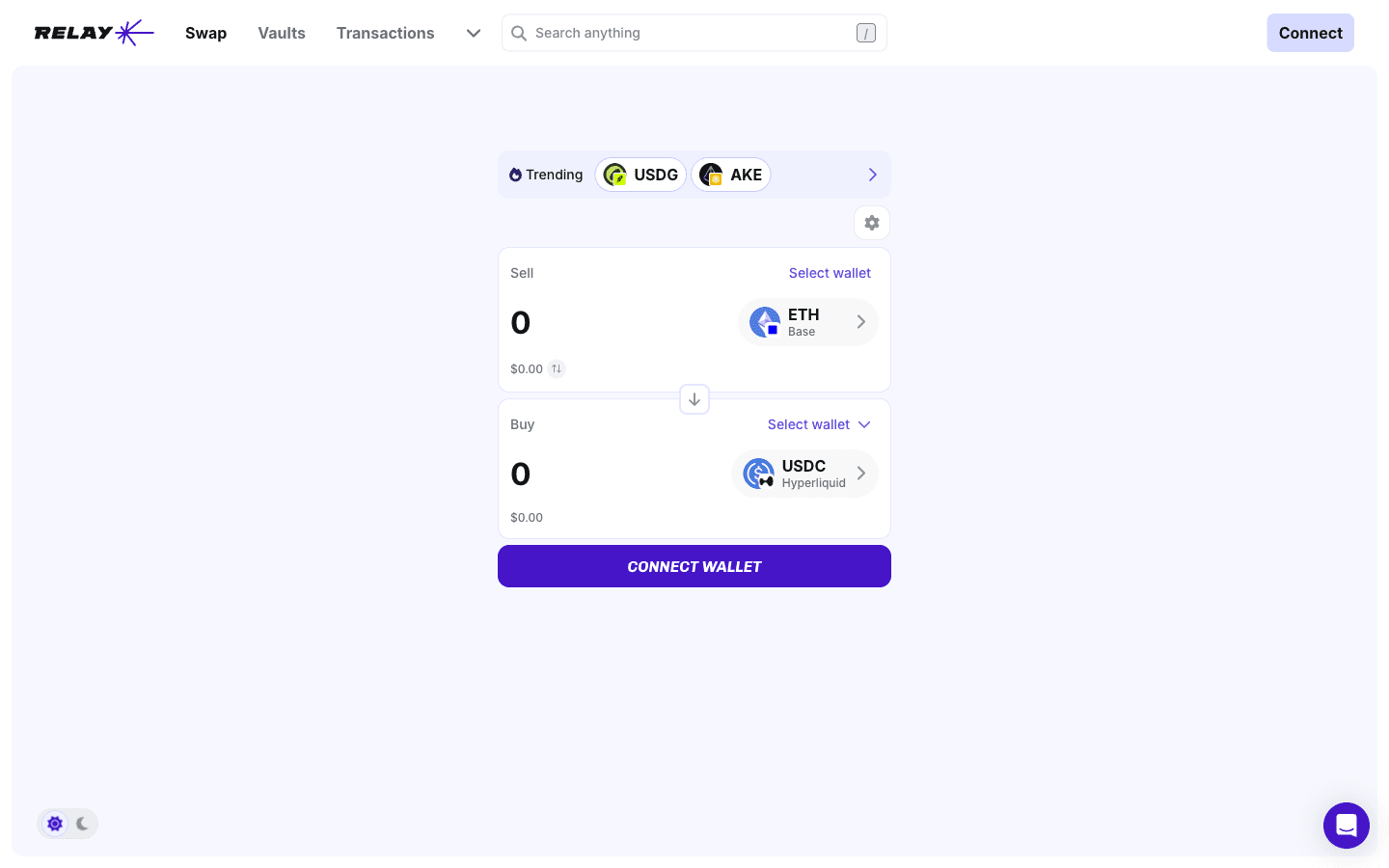
On October 26, 2026, Relay quoted a 0.113 USDC relayer fee from Arbitrum (1,000 USDC in, 999.83 USDC out, $0.036 of gas), 0.12 USDC from Ethereum or Base and 0.245 USDC from Solana, each ~1 s. On October 15, 2026 the same Arbitrum quote had carried no relayer fee at all, which is why we re-quote rather than repeat a number. Relay’s docs list Hyperliquid (HyperCore) as a destination for Perps USDC directly, plus spot USDC, USDH and other spot tokens, and HyperEVM as a separate chain. It also supports withdrawals from Hyperliquid to any Relay chain. One pass-through cost to know: a brand-new HyperCore address pays a one-time 1 USDC activation fee on its first incoming transfer. That is Hyperliquid’s rule, not Relay’s, and any route that creates the account can pass it on. Link: relay.link/bridge/hyperliquid.
deBridge
Best for: any token from Solana or an EVM chain in one step. Fee: 4 bps protocol fee plus a solver margin of about 4 bps, plus a small flat fee in the source chain’s gas token. Speed: seconds, per deBridge.
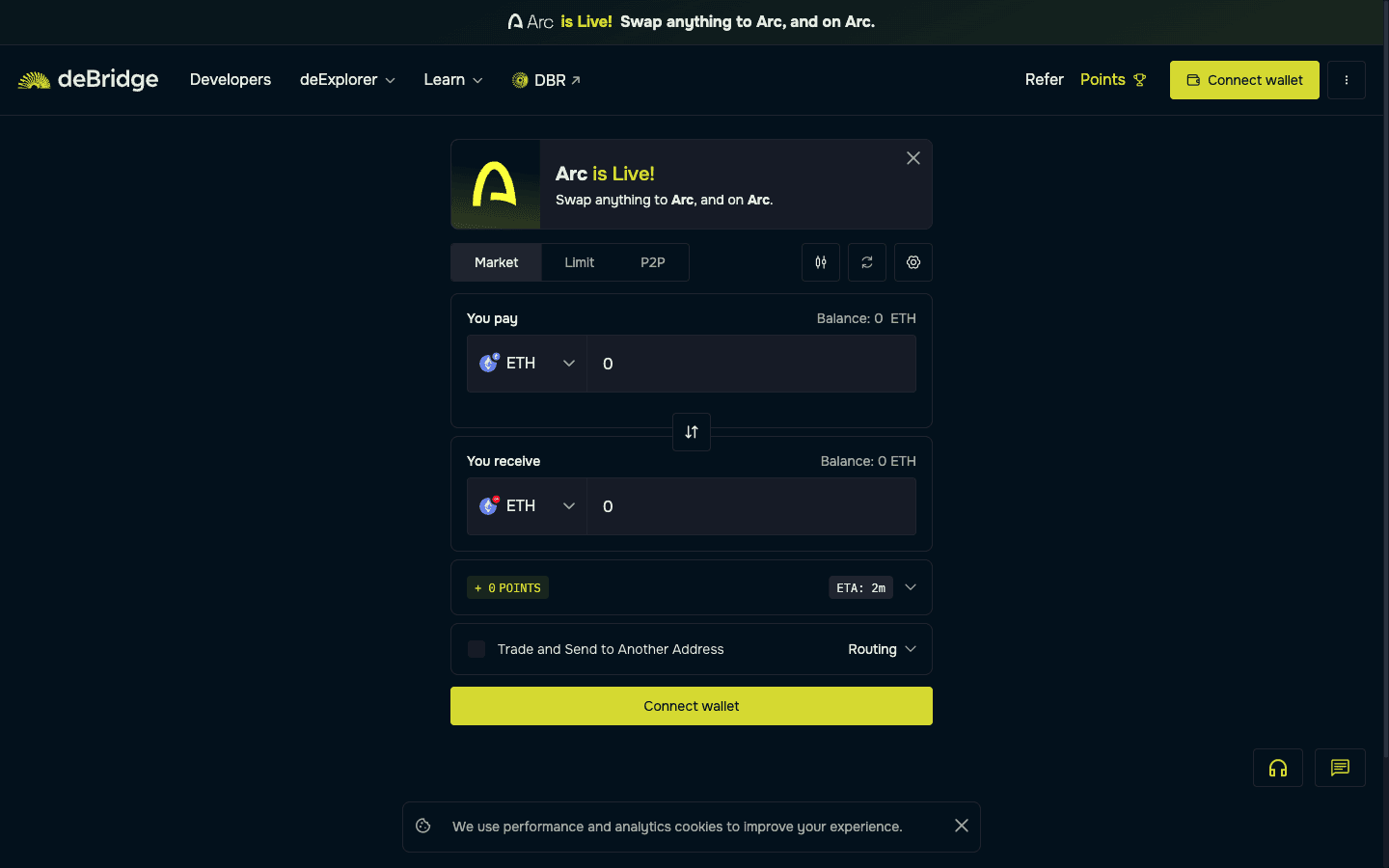
deBridge runs a solver network with no liquidity pools. Pick “Hyperliquid” as the destination and, per deBridge, it delivers native Arbitrum USDC into your Hyperliquid account. It is one of the few routes that takes USDC or SOL on Solana and lands in your trading account in a single transaction. deBridge also supports HyperEVM (chain 999) as a separate destination. Link: app.debridge.finance.
Mayan
Best for: Solana → HyperCore. Fee: quoted per swap. Speed: as little as 6 seconds, per Mayan.
Mayan’s Swift v2 swaps from any supported token on Solana or an EVM chain into USDC on HyperCore. You choose the spot or the perps balance, so the money can arrive as trading margin directly. Only USDC is supported on the HyperCore side, and Mayan also handles withdrawals from HyperCore back to EVM chains. Link: swap.mayan.finance.
Jumper (LI.FI)
Best for: comparing routes when you are not sure which bridge is cheapest. Fee: the underlying bridge’s fee plus any aggregator fee, all shown in the quote. Speed: depends on the route it picks.
Jumper is the consumer app on top of the LI.FI API. On October 26, 2026, LI.FI listed 69 chains, including Hyperliquid (HyperCore) and HyperEVM as two separate destinations. Its bridge list includes Across, Relay, Mayan, CCTP, Unit, Stargate, Eco and Hyperliquid’s native bridge. That makes it a good price checker, but select “Hyperliquid” and not “HyperEVM” if you want to trade. Link: jumper.exchange.
Stargate (LayerZero)
Best for: LayerZero tokens such as USDT0 and USDe, and HyperEVM DeFi. Fee: quoted per transfer. Speed: depends on the route.
Hyperliquid’s docs list Stargate for bridging to HyperEVM, including a direct USDe route, and the USDT0 app for USDT0. LayerZero’s transfer API listed 103 chains on October 26, 2026, with HyperEVM and HyperCore as separate entries. Use it when the asset you hold is a LayerZero token or when you want to use HyperEVM apps. If you land on HyperEVM, the HyperCore vs HyperEVM section explains how to get the funds into your trading balance. Link: stargate.finance.
Canonical Arbitrum bridge
Best for: a conservative Ethereum → Arbitrum hop before the Deposit button. Fee: Ethereum gas. Speed: 15–30 minutes in, at least 7 days back to Ethereum (Arbitrum docs).
This is not Hyperliquid’s bridge. It is Arbitrum’s rollup bridge, and it only gets you as far as Arbitrum One. It is slower than any intent bridge but relies only on Arbitrum itself. Fine for a one-way trip. Link: bridge.arbitrum.io.
Others: Eco, Symbiosis, Squid, Synapse, Router Nitro
Eco (Eco Portal / Eco Routes) is a stablecoin-routing service. It ranks itself first in its own “best way to bridge to Hyperliquid” guide, and it is also one of the bridges LI.FI routes through, so you can compare it without trusting either list. Symbiosis and Squid route to HyperEVM. Synapse and Router Nitro appear on Hyperliquid’s own list of bridges for getting USDC onto Arbitrum. All of them work. None beats the routes above on a like-for-like quote unless the quote says so, so treat them as extra quotes.
Hyperunit bridge: BTC, ETH, SOL and other coins
When the Hyperliquid Deposit window shows a Bitcoin, Ethereum or Solana address, that address comes from Hyperunit (Unit). Unit calls itself "the asset tokenization layer on Hyperliquid". It lets you deposit supported coins from your wallet or exchange straight to Hyperliquid, trade them on the spot order book, and withdraw them to their native chains. It is the right bridge when you want to arrive with coins rather than USDC.
How the Hyperunit bridge works
- Permanent deposit address. In the Deposit window (or at app.hyperunit.xyz), pick the asset. Unit’s Guardian network generates a unique address that is permanently tied to your Hyperliquid address, and you can verify it by the Guardians’ signatures.
- Guardians and MPC. Independent operators (Unit, Hyperliquid and Infinite Field at launch) each run the protocol and their own chain indexers. They sign with a 2-of-3 multi-party threshold scheme, so no single Guardian can move funds.
- Unit tokens. Once the source transaction is final (for Bitcoin, 2 confirmations), the same amount is credited to your spot balance as a HIP-1 token: UBTC, UETH, USOL and so on. To trade perps, sell it for USDC (0.070% spot taker at the base tier) and move the USDC to Perps.
- Fees. Unit says it "does not collect revenue from deposits or withdrawals". You pay only the network fees of the source and destination transactions, and the Deposit window shows the live estimate. Unit’s fee API estimated, on October 26, 2026: about 0.000024 BTC and 31 minutes for a Bitcoin deposit, 0.00054 ETH and 3 minutes for Ethereum, 0.0128 SOL and 1 minute for Solana.
- Withdrawals. Choose Withdraw, pick the coin and paste a native-chain address. After the Hyperliquid transaction finalizes (about 10 seconds, per Unit), the Guardians broadcast the transfer on the native chain.
- Compliance. Unit screens addresses against sanctions lists, and its app geoblocks restricted regions. It is not a mixer, and its explorer is public.
Supported assets and minimums
| Asset | Network | Minimum | Typical arrival |
|---|---|---|---|
| BTC | Bitcoin | 0.0003 | about 30 minutes |
| ETH | Ethereum | 0.007 | about 5 minutes |
| SOL | Solana | 0.12 | about 1 minute |
| BONK · PUMP · FARTCOIN | Solana (SPL) | 1,800,000 · 5,500 · 55 | about 1 minute |
| SPX · 2Z · ANSEM | Solana (SPL) | 32 · 150 · 60 | about 1 minute |
| AVAX | Avalanche | 1.5 | See the Deposit window |
| MON · XPL | Monad · Plasma | 450 · 60 | See the Deposit window |
| ZEC | Zcash | 0.07 | See the Deposit window |
| VIRTUAL | Base | 25 | See the Deposit window |
Minimums: docs.hyperunit.xyz supported assets and the Hyperliquid support FAQ (ANSEM), read October 26, 2026. Below the minimum, a deposit is not processed and the support FAQ says the funds are lost. Arrival times are from the Hyperliquid support FAQ. The Deposit window shows the live estimate.
The revert tool
If a deposit fails, Unit’s Revert UI (app.hyperunit.xyz/revert) can return some mistakes to a wallet you control. Examples: USDC, USDT or wrapped SOL sent to the Solana address, or USDC, USDT or WETH sent to the Ethereum address. A revert has to wait for a set number of source-chain confirmations (about 3 days for Ethereum and Solana, per Unit), costs a small fee, and is not guaranteed. Unsupported tokens outside the revert list, or the right coin sent on the wrong chain, generally cannot be recovered; ETH sent on Arbitrum to the Ethereum address is the one listed exception.
HyperCore vs HyperEVM: where your funds land, and how to bridge to HyperEVM
Hyperliquid is one chain with two parts that share the same state and consensus. HyperCore holds the order books, your Perps and Spot balances and your margin. HyperEVM (chain ID 999) is an Ethereum-compatible smart-contract layer for DeFi apps. USDC on HyperEVM is an ERC-20 in your wallet. It is not trading margin until you move it. How the two sides differ and how to move tokens between them: what is HyperEVM.
- Land on HyperCore if you want to trade perps or spot: the Deposit button, CEX withdrawals on the Hyperliquid network, Across, Relay (Perps USDC), Mayan (perps or spot) and deBridge’s Hyperliquid route.
- Land on HyperEVM if you want HyperEVM lending, LP or other apps: Relay, Across, Stargate, Symbiosis, deBridge or LI.FI with “HyperEVM” selected, or CCTP to HyperEVM (no HyperCore forwarding fee).
How to bridge to HyperEVM from Ethereum or Arbitrum
Bridge to HyperEVM when you want HyperEVM apps: lending, liquidity pools, HYPE staking protocols. Hyperliquid’s own docs list Stargate, deBridge, Gas.zip, Jumper and, per asset, the USDT0 app, Garden (BTC) and Mintify (ETH). Relay and Across also deliver native USDC there. Which route fits depends on the token you hold:
| You hold… | Route to HyperEVM | What arrives |
|---|---|---|
| USDC on Ethereum, Arbitrum, Base | Relay or Across, destination “HyperEVM”; or CCTP | Native USDC |
| USDT or USDT0 | USDT0 app (usdt0.to) or Stargate | USDT0 |
| USDe | Stargate’s direct USDe route | USDe |
| ETH or another token, nothing on HyperEVM yet | Gas.zip for a little HYPE, then deBridge or Jumper for the rest | HYPE for gas, then the swapped token |
On October 26, 2026, moving 1,000 USDC from Ethereum to HyperEVM cost 0.122 USDC on Relay (~2 s) and 0.104 USDC on Across, in each bridge’s own quote API. The steps:
- Add the network to your wallet: chain ID 999, RPC
https://rpc.hyperliquid.xyz/evm(or one click on chainlist.org/chain/999). - In the bridge, choose your source chain and token, then HyperEVM as the destination. This is the one case where you do not pick “Hyperliquid”.
- Read the quote, approve and confirm. Relay and Across fill in seconds; check the arrival in your wallet on HyperEVM or on hyperevmscan.io.
- Get a little HYPE for gas, because every HyperEVM transaction pays in HYPE. Bridge some with Gas.zip, or buy HYPE on Hyperliquid Spot and use Transfer to/from EVM.
- To trade with the funds later, move them to HyperCore with the steps below.
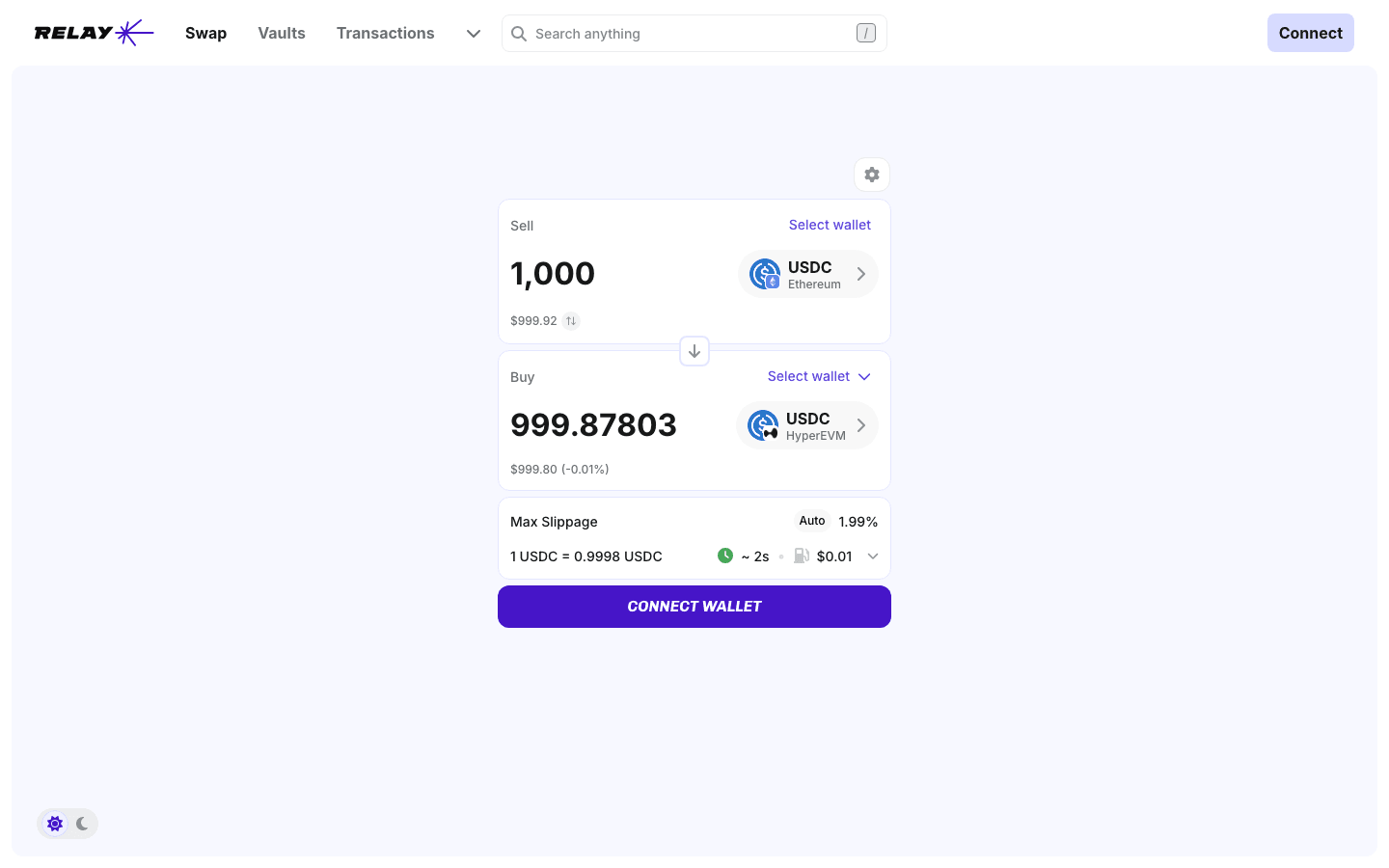
How to move funds from HyperEVM to HyperCore (and back)
- Add HyperEVM to your wallet (chain ID 999, RPC
https://rpc.hyperliquid.xyz/evm) so you can see the balance. - Keep a little HYPE on HyperEVM for gas. If you have none, buy HYPE on Spot and move it to the EVM first.
- In the Hyperliquid app, open the Balances table and click Transfer to/from EVM (or EVM ↔ Core Transfer on the Portfolio page). Choose the token and direction.
- The token arrives in Spot on HyperCore. For USDC, then transfer Spot → Perps to use it as margin.
Do not do this by hand-sending tokens to a system address unless you know the exact address for that token. Hyperliquid’s docs warn that 0x2222…2222 works only for HYPE; other assets sent there are lost. The app button does it for you. If you pressed Transfer to/from EVM by accident, your funds are not lost. They are on HyperEVM, and the same button brings them back.
Is the Hyperliquid bridge safe?
There is no single “Hyperliquid bridge” to judge, and no route is risk-free. What you rely on depends on the route you pick. The table sums up who has to act correctly for your money to arrive, from each protocol’s own documents and, for Hyperliquid’s legacy contract, from the contract itself, read on October 26, 2026. We have not audited any of these contracts.
| Route | What you rely on | Built-in safeguard | Main risk |
|---|---|---|---|
| Deposit button (Circle CCTP) | Circle, the issuer of USDC: its contracts burn the USDC on Arbitrum and mint native USDC on Hyperliquid’s HyperEVM, then it is credited to HyperCore | No pool and no wrapped token in between; USDC is Circle’s own token on both sides | You depend on Circle’s contracts and attestations |
| Legacy Arbitrum bridge (Bridge2) | Hyperliquid validators’ bridge keys: 4 keys of equal weight on October 26, 2026, 3 of which must sign a withdrawal | A 200-second dispute period, 2 locker votes freeze the contract, unlocking needs the validators’ cold-wallet keys; public code, audited by Zellic | A small signer set guards $376.6M of USDC |
| Across | Relayers front your funds; Across settles them later through bundles checked by UMA’s optimistic oracle | Anyone can dispute a bundle during a challenge period; Across says one honest watcher is enough | Smart-contract and oracle risk of Across |
| Relay, deBridge, Mayan | The bridge’s own solvers or relayers and its contracts | You see the quote before you sign; the funds move in one transaction | Smart-contract and solver risk of that bridge |
| Hyperunit (BTC, ETH, SOL…) | Unit’s Guardians (Unit, Hyperliquid and Infinite Field at launch) signing with a 2-of-3 MPC threshold | No single Guardian can move funds; key shares sit in secure enclaves, per Unit’s docs | With 2-of-3, two Guardian key holders can sign |
Sources read October 26, 2026: Hyperliquid docs (hypercore/usdc, for-developers/api/usdc), Bridge2.sol on Hyperliquid’s GitHub and the contract’s state over Arbitrum’s public RPC, Circle’s CCTP guide for Arbitrum → HyperCore, Across’s security-model page, Unit’s architecture page.
Hyperliquid’s legacy Arbitrum bridge (Bridge2), read on-chain
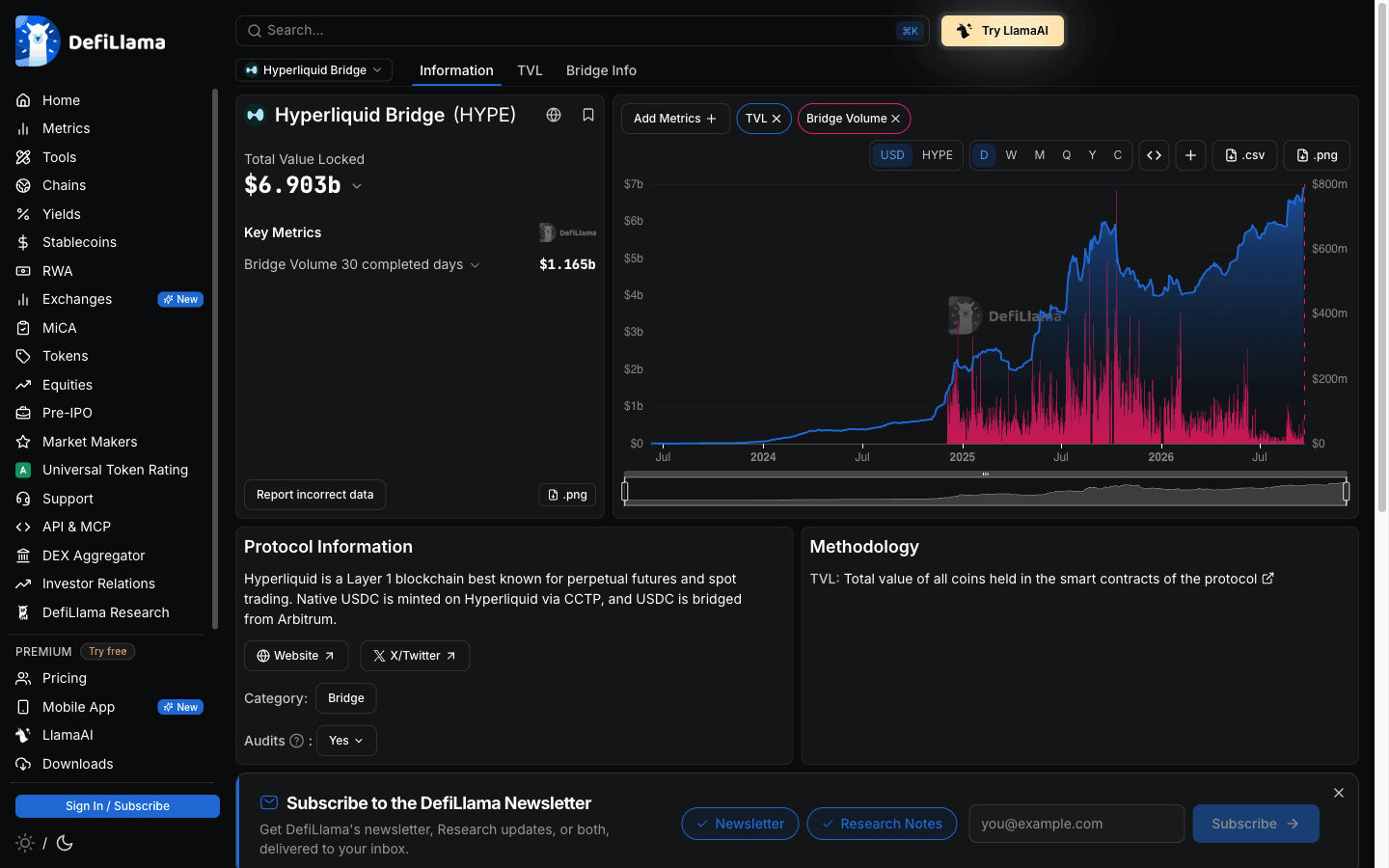
Hyperliquid’s own bridge contract lives on Arbitrum at 0x2df1c51e09aecf9cacb7bc98cb1742757f163df7; the docs link it and publish its source as Bridge2.sol. On October 26, 2026 the API docs said: “CCTP supports more chains and functionality. The legacy bridge is deprecated.” Deprecated does not mean empty or switched off. On October 26, 2026 the contract still held $376.6M of USDC and was not paused. Hyperliquid’s docs add that it holds less than 10% of the USDC on HyperCore (DefiLlama, read the same day, counted $6.24B on the Hyperliquid L1 side) and that the bridge was audited by Zellic.
How it protects withdrawals, from the contract’s own code and state:
- Signatures. Hyperliquid validators sign each withdrawal on the L1, and the contract accepts a batch only when the signers hold more than two thirds of its validator power. On October 26, 2026 the contract’s signer set had 4 keys of equal weight (validator-set epoch 7 in the contract), so 3 of them had to sign.
- Dispute period. A signed withdrawal waits 200 seconds before it can be finalized. During that window any approved locker can vote to lock the bridge, and 2 votes pause it.
- Cold keys to unlock. Once paused, only a quorum of the validators’ cold-wallet signatures can unlock it and install a new validator set.
- Deposits. When the bridge is used for a deposit, validators watch the contract’s Deposit events and credit the same USDC on Hyperliquid. Deposits below 5 USDC are lost, per the docs.
Why it still matters to you: Hyperliquid switches USDC withdrawals between Circle CCTP and this contract. On November 3, 2026 they ran through Circle CCTP (0.2 USDC plus a tiny HyperEVM gas fee in HYPE); on the legacy Arbitrum bridge they cost 1 USDC with no gas fee, and this is the contract that pays them out. The Withdraw window shows which route applies before you sign; the full comparison is in our Hyperliquid withdrawal guide.
Three checks before any bridge transfer
- Open the bridge from a bookmark, not from an ad, a reply or a DM. No bridge or Hyperliquid support account asks you to send funds to an address in a message.
- Read the destination line before you sign: “Hyperliquid” or “HyperCore” for trading, “HyperEVM” only if you want HyperEVM apps.
- Send a test first, a little more than the 5 USDC minimum, and wait for it to arrive before you send the rest. More ways to lose funds are in mistakes that lose funds.
How to bridge USDC from Solana to Hyperliquid
Solana is where most money gets lost, because the Deposit window shows one Solana address and it is the wrong one for USDC.
- USDC on Solana → a bridge. Hyperliquid’s support docs say it plainly: "Depositing USDC on Solana will fail and not be credited." Use Mayan, deBridge or Relay with Hyperliquid as the destination, or a CCTP transfer (Circle charged a forwarding fee of about 0.24 USDC to HyperCore from Solana on October 26, 2026, plus a 1 bps fast-transfer fee if you choose fast mode). Relay quoted 0.245 USDC on 1,000 USDC the same day, ~1 s once the Solana transaction confirms.
- SOL and listed Solana tokens → the Hyperunit address. It accepts SOL, 2Z, ANSEM, BONK, FARTCOIN, PUMP and SPX only, with minimums (for example 0.12 SOL). The coins arrive in about 1 minute into your spot balance.
- Phantom users: Phantom is one of the interfaces Hyperliquid lists for onboarding. The rule is the same inside any wallet: a USDC transfer to Hyperliquid must go through a bridge route, not the Solana deposit address.
How to deposit from an exchange, Ethereum, Base or Polygon
From a centralized exchange. Hyperliquid’s docs note that "many CEXs and bridges support withdrawals on Hyperliquid, either via HyperCore or HyperEVM". If your exchange lists the Hyperliquid network for USDC, withdraw to the address in your Deposit window. Check whether the network label means HyperCore or HyperEVM, because a HyperEVM withdrawal lands outside your trading balance. If the exchange does not list Hyperliquid, withdraw USDC on Arbitrum One (not Arbitrum Nova) to your own wallet and use the Deposit button. We do not quote per-exchange withdrawal fees because they change often. Read the fee on the withdrawal screen.
From Ethereum, Base or Polygon. You have three good options. Bridge straight to HyperCore with Across or Relay. Log in to Hyperliquid by email and send USDC to the multi-chain deposit address (Arbitrum, Ethereum, Base or Polygon, handled by Across). Or use CCTP. On Ethereum mainnet, gas is the biggest cost, often more than any bridge fee, so move a meaningful amount in one go instead of several small ones. The email-address flow has two safety valves. Wrong tokens are redirected to your email wallet within about 10 minutes, and so are deposits below 5 USDC. Deposits below 1 USDC are lost.
Card or bank. The Deposit window also links a fiat on-ramp run by Swapped.com, an independent provider. Its fees and support are Swapped’s, not Hyperliquid’s.
Hyperliquid bridge fees by source chain
| Starting chain | Cheapest sensible route | What you pay | Typical time |
|---|---|---|---|
| Arbitrum | Deposit button (CCTP) | 0.20 USDC + a few cents of ETH gas | Minutes |
| Ethereum mainnet | Across / Relay to HyperCore, or CCTP | Ethereum gas (the biggest cost) + bridge fee (Relay 0.12 USDC, Across 0.108 USDC per 1,000 USDC on October 26, 2026); CCTP ≈0.24 USDC, plus Circle’s 1 bps fast-transfer fee if you pick fast mode | Seconds to minutes |
| Base, Polygon, Optimism | Across or Relay; email-login address (Base/Polygon) | Cents of gas + the quoted bridge fee | Seconds |
| Solana (USDC) | Mayan, deBridge or Relay; CCTP | Solana fee + quoted bridge fee (Relay 0.245 USDC per 1,000 USDC on October 26, 2026); CCTP ≈0.24 USDC (+ 1 bps in fast mode) | Seconds |
| Solana (SOL) | Hyperunit address | Solana network fees, then 0.070% spot taker to sell for USDC | about 1 minute |
| Bitcoin | Hyperunit address | Bitcoin network fees | about 30 minutes |
| Centralized exchange | Direct withdrawal on the Hyperliquid network | Exchange withdrawal fee only | Minutes |
CCTP fees: Circle’s fee API for transfers to HyperCore, read October 26, 2026 (Arbitrum is a flat fee; other chains vary slightly with HyperEVM gas). Bridge fees: each bridge’s docs and quote API. Every route to a brand-new Hyperliquid address may add the one-time 1 USDC account-activation fee. Hyperliquid itself charges nothing to deposit.
Worked example: you hold 500 USDC on Arbitrum. Through the Deposit button, 499.80 USDC arrives on HyperCore, plus a few cents of ETH for gas. Through an intent bridge, you pay the quoted relayer fee instead, in exchange for a faster fill. Either way the bridge is a one-off cost. Trading fees recur: opening and closing a single $10,000 position at the base taker rate costs $9.00, many times the Deposit fee. For active traders the fee tier and the referral discount matter more than which bridge they used.
So before the first deposit lands, open Hyperliquid with code HOLYGRAIL (how the referral code works): the 4% discount covers your first $25M of volume, whichever bridge brought the money in.
Mistakes that lose funds
- USDC on Solana to the Solana deposit address. Not credited. Try Unit’s revert tool (USDC, USDT, WSOL only).
- Wrong network or token. Arbitrum Nova, BNB Chain or Optimism USDC, or USDC.e / USDT / DAI into the Deposit button, are not credited. Wrong coins sent to Hyperunit addresses may be unrecoverable.
- USDC to a Hyperunit coin address. The Ethereum address takes only ETH, and the Base address takes only VIRTUAL. ENA is no longer accepted: the support FAQ still lists it, but Unit’s supported-assets page shows only ETH for Ethereum and its address API rejects ENA (checked October 22, 2026). USDC sent to either is not credited (Ethereum USDC is on the revert list; Base USDC is not). Stablecoins go through the Deposit button, the email-login USDC address or a bridge.
- Deposits under the minimum. Under 5 USDC is lost on the wallet route. Hyperunit coins have their own minimums (Hyperunit minimums).
- Landing on HyperEVM when you wanted to trade. Not lost. Use Transfer to/from EVM (HyperCore vs HyperEVM).
- Fake sites and "support" DMs. Bookmark app.hyperliquid.xyz and each bridge’s official URL. Hyperliquid never asks you to send funds to an address in a message.
- Resending while a transfer is pending. Check the source-chain explorer or the bridge’s transfer history first. A second send doubles the problem.
Test once with a little more than the minimum (for example 6 USDC), then send the rest. Deposit problems and fixes are covered step by step in the deposit guide.
How to bridge out of Hyperliquid
To bridge back out, click Withdraw at the bottom right of the trade page, not Send, which only moves funds between Hyperliquid addresses. Hyperliquid’s USDC withdrawal goes to Arbitrum through Circle CCTP (its routing setting on November 3, 2026) for 0.2 USDC plus a tiny HyperEVM gas fee in HYPE, and the app says it arrives within 5 minutes. You sign once and need no ETH on Arbitrum. Hyperliquid switches USDC withdrawals between Circle CCTP and the legacy Arbitrum bridge; on the legacy Arbitrum bridge the fee is 1 USDC with no gas fee, and the Withdraw window shows which applies before you sign. Coins go back to their native chains through Hyperunit, paying network fees only. To land USDC on another chain in one step, Relay, Across and Mayan all support withdrawals from HyperCore; Across notes that refunds on that route land on HyperEVM. Screens, fees and the CEX route are in our guide on how to withdraw from Hyperliquid to Arbitrum, an exchange or another chain.
After you arrive: fees and referral
However your funds arrived, the fee schedule is the same: 0.045% taker / 0.015% maker on perps at the base tier. It falls with 14-day volume and with HYPE staking; the full breakdown is in Hyperliquid fees explained. Trading, cancelling and funding cost no gas. Join through a referral link before your first trade and you pay 4% less on your first $25M of volume. Ours is HOLYGRAIL. New to the interface? Start with how to trade on Hyperliquid or rehearse on the testnet, whose faucet unlocks after a real deposit from your address. For how Hyperliquid compares with other venues, see our Hyperliquid review.
Hyperliquid bridge FAQ
What is the Hyperliquid bridge?
It is how USDC and coins get from another chain into a Hyperliquid account. USDC on Arbitrum goes through the Deposit button in the Hyperliquid app, which uses Circle CCTP for a flat 0.20 USDC; Hyperliquid’s original Arbitrum bridge contract, Bridge2, is deprecated in its docs but still exists. From other chains, third-party bridges such as Relay, Across, Mayan or deBridge deliver USDC to the trading balance, and BTC, ETH or SOL arrive through Hyperunit.
How do I bridge to Hyperliquid?
Open Hyperliquid and connect the wallet that holds your funds. If you have native USDC on Arbitrum, click Deposit, enter at least 5 USDC and sign; Circle CCTP credits your trading balance for a flat 0.20 USDC. From another EVM chain, open Relay or Across; from Solana, Relay, Mayan or deBridge (Across has no Solana route to HyperCore). Pick your source chain and token, choose Hyperliquid (not HyperEVM) as the destination, read the quote, approve and confirm. The USDC lands in your Perps balance, usually within seconds. Send a small test first, and never resend while a transfer is still pending.
What is the best bridge for Hyperliquid?
It depends on where your funds are. From Arbitrum, the Hyperliquid Deposit button is the official route (Circle CCTP, a flat 0.20 USDC fee). From a centralized exchange, withdraw straight to Hyperliquid and skip bridges. From Ethereum, Base or other EVM chains, Across or Relay deliver USDC straight to your HyperCore trading balance in seconds. From Solana, use Mayan, deBridge or Relay. For BTC, ETH or SOL you want to keep as coins, use Hyperunit, the native-asset deposit addresses in the Deposit window.
What is the fastest bridge to Hyperliquid?
The intent bridges. On October 26, 2026, Across’s and Relay’s own quote APIs both estimated ~1 s from Arbitrum to HyperCore after the source transaction confirms (Across’s blog says about 2 seconds). Mayan says its HyperCore deposits credit in as little as 6 seconds, and deBridge also settles in seconds. The official Deposit button usually credits within minutes. The slowest routes are the canonical Arbitrum bridge from Ethereum (15–30 minutes) and Bitcoin through Hyperunit (about 30 minutes).
What is the cheapest way to bridge to Hyperliquid?
A centralized exchange that withdraws directly on the Hyperliquid network is usually cheapest, because there is no bridge fee at all. From your own wallet, Arbitrum USDC through the Deposit button costs a flat 0.20 USDC plus a few cents of gas. In the October 26, 2026 quotes for 1,000 USDC from Arbitrum, Across returned the most (999.89 USDC) and the Deposit button the least (999.80 USDC), so the gap was cents. Relay charges no platform fee on same-token bridges. Across lists USDT and USDT0 into HyperCore USDC as sponsored routes with no bridge fee, but its quote still deducted 0.122%. When you start on Ethereum mainnet, gas is usually the biggest cost.
Is the Hyperliquid bridge safe?
It depends on the route, and none is risk-free. The Deposit button uses Circle CCTP, so you rely on Circle, the issuer of USDC, to burn and mint it. Hyperliquid’s own legacy Arbitrum contract, Bridge2, is deprecated in the docs but still held $376.6M of USDC on October 26, 2026; its signer set was 4 keys, 3 of which must sign each withdrawal, followed by a 200-second window in which lockers can freeze it. Third-party bridges add their own contract and relayer risk, and Hyperunit relies on a 2-of-3 Guardian signing set. Use official URLs, send a small test first, and never send funds to an address from a DM.
Is the Hyperliquid Arbitrum bridge deprecated?
Yes. Hyperliquid’s API documentation says: “CCTP supports more chains and functionality. The legacy bridge is deprecated.” (read October 26, 2026) and calls CCTP the preferred way to mint USDC on the Hyperliquid L1. Arbitrum deposits from the app go through Circle CCTP (Hyperliquid’s routing setting named Circle CCTP as the deposit route on October 26, 2026). The contract still exists at 0x2df1…3df7 on Arbitrum, and Hyperliquid switches USDC withdrawals between the two routes: on November 3, 2026 they went through Circle CCTP.
How do I bridge from Hyperliquid?
Click Withdraw in the Hyperliquid app, not Send. USDC goes to Arbitrum through Circle CCTP (the route Hyperliquid used on November 3, 2026) for 0.2 USDC plus a tiny HyperEVM gas fee in HYPE and should arrive within 5 minutes; when Hyperliquid switches to the legacy Arbitrum bridge, it is 1 USDC with no gas fee. Coins such as BTC, ETH and SOL go back to their native chains through Hyperunit, paying only network fees. To land USDC on another chain in one step, Relay, Across and Mayan support withdrawals out of HyperCore. Our withdrawal guide covers each step.
How do I deposit to Hyperliquid from Ethereum?
Bridge USDC from Ethereum straight to HyperCore with Relay or Across: one transaction, and the money arrives as trading margin. On October 26, 2026, Relay quoted 0.12 USDC on 1,000 USDC plus $0.008 of Ethereum gas, and Across 0.108 USDC. Email-login accounts can also send Ethereum USDC to their deposit address. CCTP works too, at about 0.24 USDC to HyperCore. Ethereum gas changes by the minute, so move one meaningful amount rather than several small ones.
How do I bridge to HyperEVM?
Pick HyperEVM (chain 999) as the destination, not Hyperliquid. Relay, Across, deBridge, Stargate, Jumper and Gas.zip all deliver there from Ethereum or Arbitrum; on October 26, 2026, Relay quoted 0.122 USDC and Across 0.104 USDC for 1,000 USDC. Keep a little HYPE on HyperEVM for gas. To trade the funds, move them to HyperCore with Transfer to/from EVM in the Hyperliquid app.
Can I bridge directly to HyperCore without going through HyperEVM?
Yes. The Deposit button, CEX withdrawals on the Hyperliquid network, Across, Relay, Mayan and deBridge’s Hyperliquid route all credit your HyperCore balance, which is your trading margin. Some routes, such as Stargate and several aggregator paths, land on HyperEVM instead. Funds there are not lost: move them with Transfer to/from EVM on the Balances table, which needs a little HYPE for gas.
What is Hyperunit and how does the Hyperunit bridge work?
Hyperunit (Unit) is the asset-tokenization layer behind Hyperliquid’s native deposit addresses. A network of Guardians (Unit, Hyperliquid and Infinite Field at launch) generates a permanent deposit address for your Hyperliquid account and signs with a 2-of-3 MPC threshold. When your BTC, ETH, SOL or other supported coin is confirmed, the same amount is credited to your spot balance as a Unit token (UBTC, UETH, USOL). Unit takes no protocol fee; you pay the network fees. Below the minimum (for example 0.0003 BTC or 0.12 SOL) nothing is processed.
Is Hyperliquid on Arbitrum?
No. Hyperliquid runs on its own layer-1 (HyperCore for the order book and clearinghouse, HyperEVM for smart contracts). Arbitrum is the most common on-ramp. USDC is now natively minted on the Hyperliquid L1 through Circle CCTP, and the legacy Arbitrum bridge contract holds less than 10% of the USDC supply on HyperCore, per Hyperliquid’s docs.
What is the minimum deposit to Hyperliquid?
5 USDC for USDC. Wallet-connected deposits below 5 USDC are lost. On the email-login address, deposits below 5 USDC are redirected to your email wallet, and deposits below 1 USDC are lost. Coins deposited through Hyperunit have their own minimums, for example 0.12 SOL.
How do I bridge USDC from Solana to Hyperliquid?
Use Mayan, deBridge or Relay with Hyperliquid as the destination, or a CCTP-based transfer. All of them deliver USDC to your Hyperliquid account. On October 26, 2026, Relay quoted 0.245 USDC on 1,000 USDC from Solana, in ~1 s. Do not send USDC to the Solana deposit address shown in the Hyperliquid app. That address belongs to Hyperunit and accepts only SOL and a short list of Solana tokens. If you already did, try Unit’s revert tool at app.hyperunit.xyz/revert.
Before your first bridge: open Hyperliquid with HOLYGRAIL
Whichever route brings your USDC in, code HOLYGRAIL takes 4% off your trading fees for your first $25M of volume. Set it before the deposit lands.
Disclosure: HOLYGRAIL is our referral code; we earn a share of referred accounts’ fees. We have no affiliate relationship with any bridge named here. Deposit rules, minimums and fees come from Hyperliquid’s, Circle’s, Unit’s and Arbitrum’s documentation and from each bridge’s own docs and APIs, read on October 26, 2026; the legacy bridge’s state was read from the contract on Arbitrum the same day. Speeds marked as a claim are the bridge’s own figures. TVL figures are DefiLlama snapshots from that date.