DEX means decentralized exchange: a crypto exchange that runs on smart contracts or its own blockchain instead of a company, so you trade straight from your own wallet and keep custody of your funds.
DEX vs CEX
DEX
CEX
Funds
your wallet
the exchange
Sign-up
wallet only
account + ID
Money
crypto only
crypto + bank
Two kinds: swap DEXs (AMMs like Uniswap) and perp DEXs (order books like Hyperliquid).
Your first perp trade needs a Hyperliquid account: join with HOLYGRAIL first for 4% off fees on your first $25M.
A code can only be added while the account is under $10,000 of volume. We earn a commission when you sign up through our links; it never raises your fees. Comparing venues first? See our DEX picks.
— New answer box at the top: a one-sentence definition of DEX, three differences from a CEX and the two kinds of DEX (swap AMMs and perp order books). New FAQs on whether DEXs are legal and on funds sent by mistake; the KYC answer now covers privacy.
1. What does DEX mean in crypto?
“DEX” is short for decentralized exchange. It does the same job as Binance or Coinbase — you swap one crypto asset for another, or trade futures on it — but no company sits in the middle holding customer money. The rules of the exchange are code: smart contracts on a public blockchain (Uniswap on Ethereum, Base, Arbitrum and dozens of other chains) or a blockchain built only for trading (Hyperliquid’s HyperCore, dYdX Chain).
Your wallet address is your account, which is why most DEXs ask for no email, password or ID, and your funds stay in your wallet or in a contract only your signature can move. The flip side: every trade, balance and liquidation is public on-chain. “DEX crypto”, “DEX exchange” and “decentralized exchange” all mean the same thing; Samsung DeX, a desktop mode for Galaxy phones, is unrelated.
2. How does a DEX work? AMM, order book, hybrid, aggregator
Every exchange has to answer one question: at what price does a buyer meet a seller? DEXs answer it in four ways.
Design
How the price is set
Examples
Best for
AMM (liquidity pools)
A formula prices trades against a pool of two tokens that anyone can fund
Uniswap, PancakeSwap, Aerodrome, Raydium, Curve
Token swaps, long-tail tokens
On-chain order book
Bids and asks are matched by the chain itself, like a CEX order book
Orders match on an operator’s server; deposits, withdrawals and settlement are on-chain
Pacifica, Polymarket Perps
Perps with CEX-like speed
Aggregator
Splits your swap across many DEXs to find the best price
Jupiter, 1inch, CoW Swap, 0x/Matcha
Getting the best swap rate
Automated market makers (AMMs): Uniswap and friends
An AMM replaces the order book with a liquidity pool — a smart contract holding two tokens, for example ETH and USDC. Anyone can deposit both tokens and become a liquidity provider (LP). When you swap, you trade against the pool, and a formula moves the price. Uniswap’s original design keeps the product of the two balances constant (x × y = k): buy ETH out of the pool and there is less ETH left, so the next ETH costs more. The bigger your trade relative to the pool, the more the price moves against you — that is price impact.
LPs earn the swap fee. According to Uniswap’s developer documentation (checked October 15, 2026), every Uniswap v2 pool charges 0.30%; v3 introduced standard tiers of 0.05%, 0.30% or 1% (governance can enable others); and v4 lets each pool creator set any fee and attach custom logic (“hooks”). Stable pairs use low tiers, volatile long-tail tokens high ones. The catch for LPs is impermanent loss: if prices move, the pool automatically sells the winner and buys the loser, which can outweigh the fees earned.
Not every AMM uses the same curve. The three designs you will meet:
Constant-product (x × y = k): Uniswap v2 and most meme-coin pools. Liquidity is spread across every possible price, so it is simple and always available but thin around the current price.
Concentrated liquidity: Uniswap v3 and v4 (and forks such as PancakeSwap v3 and Orca Whirlpools) let each LP choose a price range. The same capital gives much deeper liquidity near the market price, but an LP whose range the price leaves stops earning fees until they re-position.
Stableswap: Curve’s curve stays almost flat near 1:1, so swapping between assets that should trade at the same price (USDC and USDT, or ETH and a staked-ETH token) moves the price very little.
AMMs are why a new token can be tradable minutes after it launches: nobody needs to list it, someone just creates a pool. That openness is also why AMMs are full of scam tokens (more in Risks).
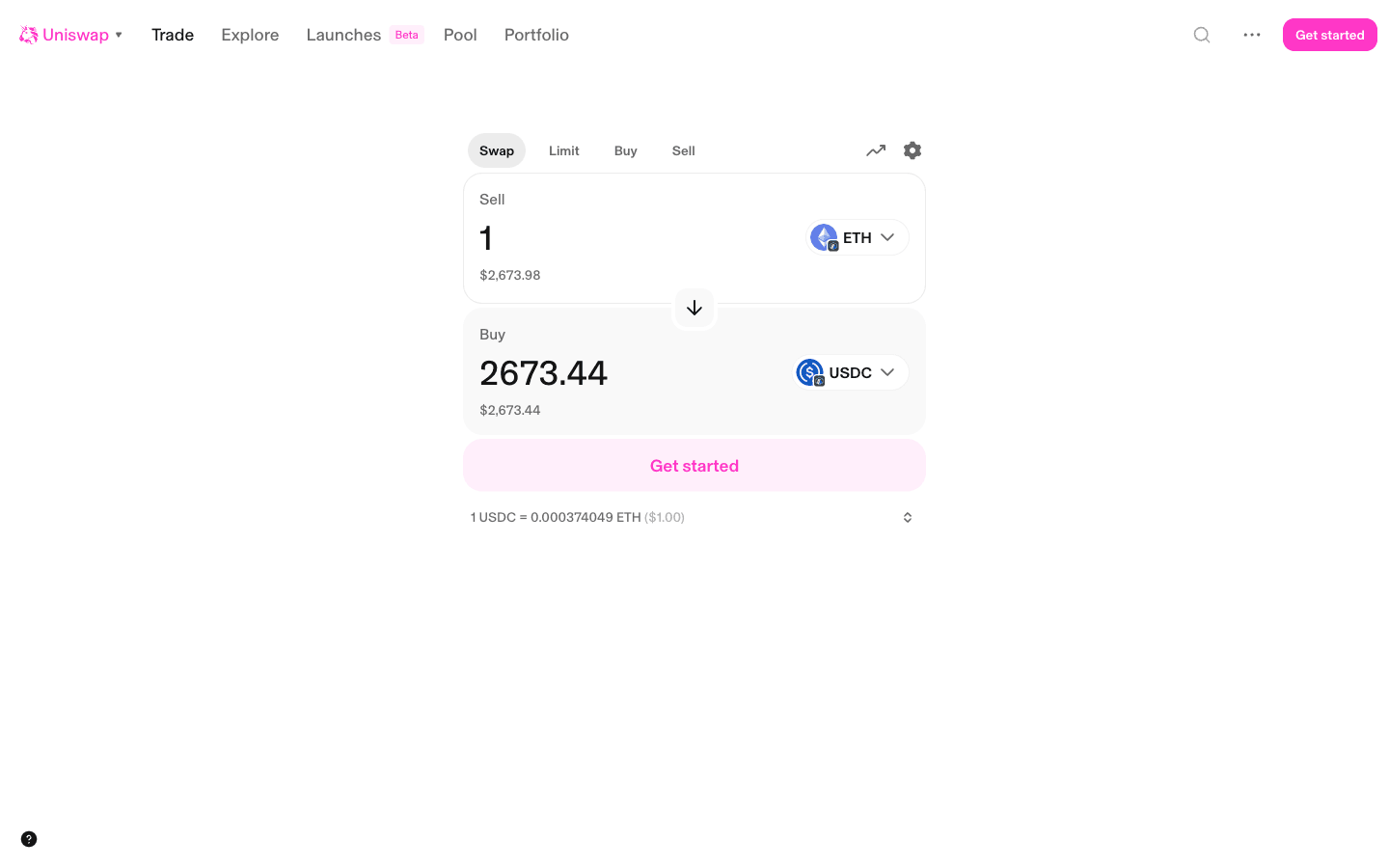
An AMM swap: Uniswap on Arbitrum, September 25, 2026. You trade against a liquidity pool — pick two tokens, check the quote, connect a wallet and sign.
On-chain order books: Hyperliquid and Lighter
An order-book DEX works like a centralized exchange screen: buyers post bids, sellers post asks, and a matching engine fills them by price and time. You can place limit orders, stop-losses and take-profits, and professional market makers quote tight spreads. For years this was impractical on-chain because every order would cost gas and wait for a block. Two designs solved it:
Hyperliquid built its own layer-1 blockchain, HyperCore, where the order book, margin and liquidations are part of the chain’s state. Placing and cancelling orders costs no gas. As of November 3, 2026 its public API lists 179 perpetual markets, with $6.15B of perp volume over the previous 24 hours and about $10.5B of open interest. It also runs a spot order book (about $199M of 24-hour volume on DefiLlama on September 25, 2026).
Lighter is a zk-rollup on Ethereum: orders are matched off the main chain, and zero-knowledge proofs let anyone verify that matching and liquidations followed the rules. Its default Standard account charges 0% maker and 0% taker (Lighter docs, October 19, 2026).
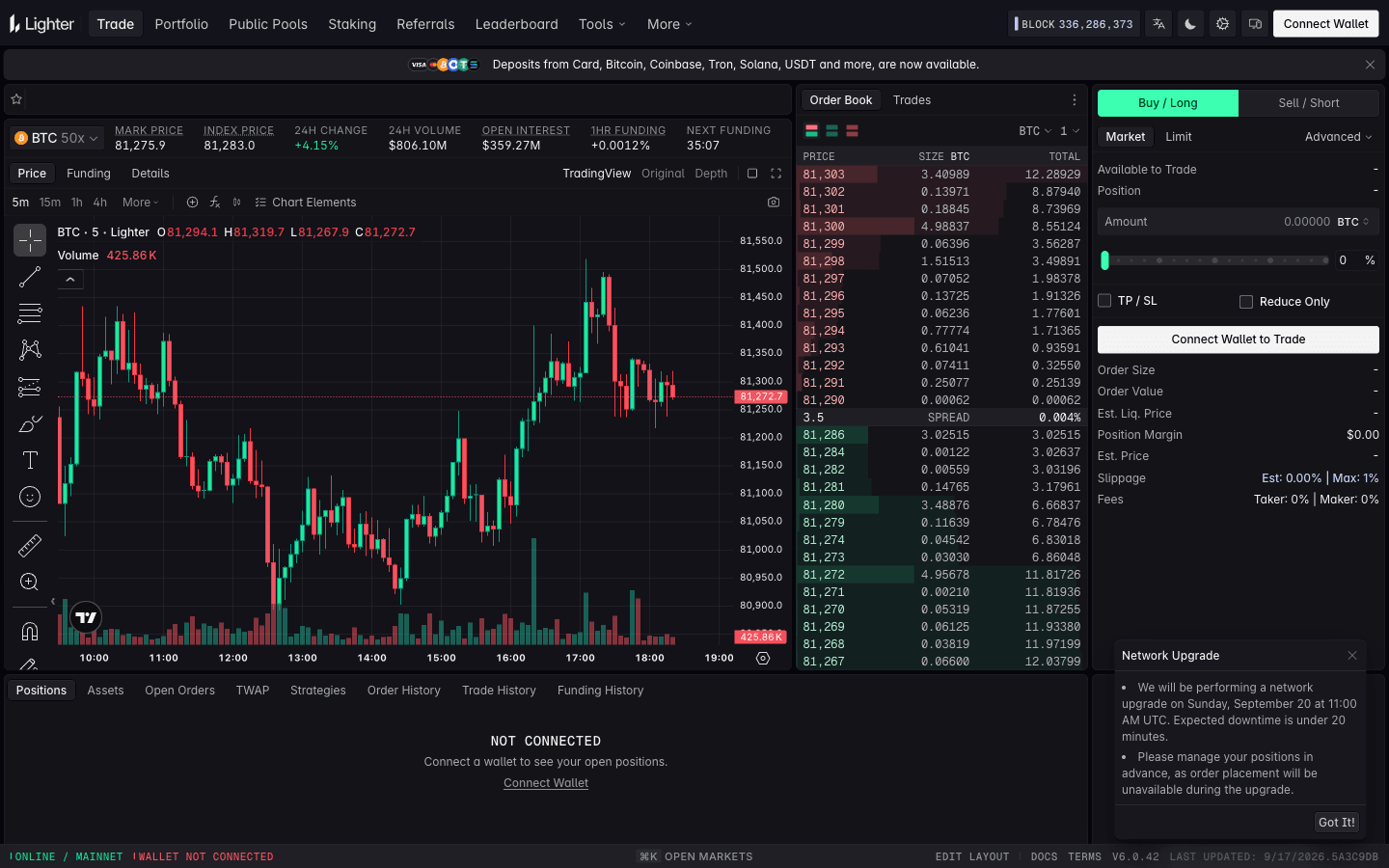
An order-book DEX: Lighter’s BTC perpetual screen, with bids and asks in the middle and “Taker: 0% | Maker: 0%” in the order form (September 2026).
Hybrid DEXs
Some venues match orders on a conventional server for speed but keep deposits, withdrawals and settlement on-chain. Pacifica (Solana) and Polymarket Perps (Polygon) describe themselves this way. You still sign with your own wallet, but during trading you rely on the operator’s engine more than on an on-chain one. That is a legitimate trade-off — just know which kind you are using.
Aggregators
An aggregator such as Jupiter (Solana), 1inch or CoW Swap is not a pool itself; it compares prices across many DEXs and splits your swap to get the best net rate. On September 25, 2026 DefiLlama counted about $430M of 24-hour volume routed through Jupiter. For swaps of more than a few hundred dollars, an aggregator usually beats going to a single pool.
A newer variant is the intent-based router (CoW Swap, UniswapX, 1inch Fusion). Instead of sending a swap transaction yourself, you sign an order that says what you want (“sell 1 ETH for at least this much USDC”), and competing third parties called solvers or fillers race to fill it from pools, private inventory or other users’ orders. You usually don’t pay gas directly (network costs are built into the quote), an order that doesn’t fill costs nothing, and because it never sits in the public mempool it is harder to sandwich.
A crypto wallet is a pair of keys. The public address is where funds are sent; the private key (usually backed up as a 12- or 24-word seed phrase) signs transactions. Whoever holds the seed phrase controls the funds. That is the core promise of a DEX — and its core responsibility: if you lose the phrase, nobody can reset it; if someone else gets it, they can empty the wallet and no support desk can reverse it.
Common wallets: Rabby and MetaMask for Ethereum-compatible chains (Arbitrum, Base, BNB Chain, HyperEVM), Phantom and Solflare for Solana, and hardware wallets (Ledger, Trezor) for larger balances. Some DEXs now let you start with an email: Hyperliquid, for example, accepts a 6-digit email code instead of a wallet and creates the key for you — convenient for a first try, but read how recovery works before depositing serious money.
Two kinds of signature you will meet:
Transactions move funds on a blockchain and cost gas — a swap on Uniswap, a deposit into Hyperliquid, a token approval.
Messages are free, off-chain signatures — logging in, or placing an order on Hyperliquid or Lighter after you have enabled trading.
A token approval gives a smart contract permission to move a token from your wallet. It is required for AMM swaps on EVM chains, and it is the permission scammers try to trick you into granting. Approve exact amounts where the wallet allows it, and revoke old approvals with a tool such as revoke.cash. Wallet setup for perps in detail: best wallet for Hyperliquid.
4. Spot DEXs vs perpetual DEXs
Spot DEXs swap one token for another. You own what you buy, there is no leverage, and nothing can be liquidated. Uniswap, PancakeSwap, Aerodrome, Raydium and Jupiter live here. Use them to buy a token, rebalance, or move between stablecoins.
Perpetual DEXs trade futures contracts with no expiry date. You post collateral (usually USDC), choose leverage and go long or short. Funding payments between longs and shorts — hourly on Hyperliquid — keep the contract near the spot price. If the market moves against you far enough, your position is liquidated and the margin is lost. Hyperliquid caps leverage at 40x on BTC and 25x on ETH (API, October 20, 2026); Lighter at 50x on BTC and ETH. Those are ceilings, not suggestions: at 20x, a 5% move against you wipes out the position. New to the product itself? Start with what are perpetual futures.
Perp DEXs are where most of the growth has been: on September 25, 2026 Hyperliquid alone traded more perp volume in a day ($8.25B) than DefiLlama recorded for the largest spot AMM, Uniswap, across all its versions and chains (about $3.3B). Live rankings: perp DEX ranking by volume. How the two compare in practice: perpetual vs spot trading on a DEX.
5. DEX vs CEX
DEX
CEX (Binance, Coinbase, Bybit…)
Who holds your funds
You (your wallet or a contract only you can move)
The exchange
Account and KYC
Wallet connect; usually no ID
Email, password, ID verification
Fiat deposits (USD, JPY, EUR)
No — crypto in, crypto out
Yes
Listings
AMMs: anyone can create a pool; perp DEXs list selectively
Exchange decides
Transparency
Trades and balances on-chain
Internal ledger
Main risks
Smart contracts, phishing, your own key management
Exchange failure, hacks, frozen withdrawals
Customer support
Community/Discord; no reversals
Support desk; can freeze or reverse internally
Lost password or keys
No recovery: the seed phrase is the only backup
Password reset and account recovery
Tax statements
None; you export your own history
Annual statements (in the US, Form 1099-DA)
Custody is the real difference. When FTX failed in November 2022, customers’ deposits were locked inside the company; in February 2025 attackers took about $1.5B of crypto from Bybit’s wallets (Bybit covered it). DEX users avoid that exposure, and take on their own instead. For fees, withdrawal costs and fills side by side, read our DEX vs CEX fee comparison.
6. Fees and gas: what a DEX trade really costs
A DEX trade can carry up to four costs. Which ones apply depends on the design:
Worked example. A $1,000 market order on Hyperliquid at the base tier costs $0.45 in fees ($0.43 with a referral code’s 4% discount), with no gas. The same $1,000 swap through a 0.30% Uniswap pool costs $3.00 in pool fees plus gas plus price impact. Front-ends and wallets can add their own fee on top of the pool fee; the confirmation screen shows the total before you sign, so read it.
Gas depends on the chain. Ethereum mainnet is the most expensive; Arbitrum, Base and Solana are usually a small fraction of that. On Hyperliquid you pay gas only on the chain you deposit from, and USDC withdrawals to Arbitrum carry a flat 0.2 USDC fee plus a tiny HyperEVM gas fee. All tiers and discounts: Hyperliquid fees explained.
7. KYC: why DEXs don’t ask for ID
Know-your-customer checks exist because a centralized exchange opens an account in your name and holds your money. A DEX does neither: you connect a wallet, sign, and the contract or chain executes. So Uniswap, Hyperliquid, Lighter and most other DEXs ask for no documents. What “no KYC” does not mean:
Not anonymous. Your address and every trade are public forever; analytics firms link addresses to exchanges and identities routinely.
Not unrestricted. Venues publish restricted jurisdictions. Hyperliquid’s Terms of Use (§1.6) exclude the United States, Ontario and sanctioned regions; respect those lists.
Not tax-free. Profits are taxable wherever you live (below).
Your on-ramp still verified you. The exchange where you bought USDC or ETH did KYC.
Trading on a DEX does not change what you owe; it changes who keeps the records. In the United States the IRS treats digital assets as property: selling a token, or exchanging one token for another, is a disposal that you report with its gain or loss, and Form 1040 asks every filer whether they did so during the year (IRS digital assets page, last reviewed September 2, 2026). The Form 1099-DA broker reporting that began with transactions on or after January 1, 2025 applies to brokers that take possession of customers’ assets, such as custodial exchanges and hosted wallets. A self-custodial DEX does not send you one, so export your trade, funding and transfer history yourself (how on Hyperliquid: trade history CSV export) and match it with the records of the exchange where you bought your crypto. More in our DEX tax reporting guide. Most other countries also tax crypto-to-crypto swaps. This is general information, not tax advice.
8. Advantages of a DEX
Self-custody. No exchange can lose, lend out or freeze your balance.
Open access. A wallet is enough; no approval process or waiting period.
Transparency. Reserves, trades, liquidations and fees are verifiable on-chain. On Hyperliquid you can inspect any wallet’s positions in an explorer.
Competitive fees on perps. Hyperliquid’s 0.045% base taker fee is below Binance Futures’ standard 0.05%, and Lighter’s default is 0%.
Earning, not just trading. Provide liquidity to an AMM pool or deposit into a vault (Hyperliquid’s HLP) and earn part of the fees — with real risk of loss.
New assets early. Tokens often trade on AMMs long before a CEX lists them — the flip side is that most of them fail.
9. Risks — and how to avoid them
Self-custody moves the risk from the exchange to the code and to you. These are the ones that actually cost people money:
Smart-contract and admin-key risk. Code can have bugs, and many protocols keep privileged keys for upgrades. In April 2026 attackers who had gained control of Drift’s admin permissions (Drift was then Solana’s largest perp DEX) listed a worthless token as collateral and withdrew roughly $285M, according to Elliptic, Chainalysis and TRM Labs. Prefer venues with a long track record, public audits and transparent governance, and don’t keep more on any single venue than you need.
Bridge risk. Moving assets between chains uses bridges, which have been among the most exploited contracts in crypto (Wormhole in 2022, for example). Use official or widely used routes and bridge only what you need.
Liquidation. On perp DEXs the most common loss is not a hack; it is leverage. Use 2–5x while learning, always set a stop-loss, and know your liquidation price. See how liquidation price works.
Fake front-ends and phishing. Clone sites, sponsored search ads and “support” DMs are the number-one way wallets get drained. Bookmark the official URL (app.hyperliquid.xyz, app.lighter.xyz, app.uniswap.org) and never type your seed phrase into a website.
Malicious approvals and address poisoning. A signature request that grants unlimited spending, or a look-alike address planted in your history, can empty a wallet. Read every prompt and copy addresses from a trusted source.
Scam tokens and rug pulls. Anyone can create a token called “USDC” or a copy of a trending coin. Check the contract address on the project’s official site or a reputable tracker before buying.
MEV and sandwich attacks. On public mempools, bots can front-run large AMM swaps. Set a sensible slippage limit and use an aggregator or MEV-protected route for size (sandwich attack protection).
DEX safety checklist: phishing, approvals and API keys
Phishing and fake front-ends. A clone looks exactly like the real app; only the transaction it asks you to sign differs. Hyperliquid's support guide cites “hyperliguid.xyz” (a g for the q) as a domain used to make people sign a malicious transaction, and lists an unknown multisig on your account as a sign of takeover. Open venues only from a bookmark you typed yourself:
Venue
Trading app
Official channels
Hyperliquid
app.hyperliquid.xyz
Support only via a Discord “open-ticket” or the Zendesk form; any DM is an impersonator
Lighter
app.lighter.xyz
Vulnerability reports to security@lighter.xyz
Aster
asterdex.com
Contract addresses on the docs “Smart Contracts” page
On Hyperliquid, “Enable Trading” is a gas-free signature and orders need no token approval; a “claim”, “verify” or “activate” prompt asking for an approval or a transfer is not Hyperliquid (its points programme ended in 2024). Referral codes go in the app or a /join/ link, never with a seed phrase. Even a real domain can be compromised (Matcha's front-end was, in January 2026), so your wallet's transaction preview is the last line of defence.
Token approvals. An ERC-20 approval lets a contract spend a token from your wallet until you revoke it. On a perp DEX they happen on the chain you deposit from, not on the trading side. Approve the exact deposit amount rather than “unlimited”, audit approvals monthly with Revoke.cash or Etherscan's Token Approval page (each revoke costs only gas), and treat permit-style signatures as seriously as transactions.
API and bot keys. Never put your main key in a script; each venue lets you create a narrower signer:
Venue
What you create
What it can do
Rules
Hyperliquid
API (agent) wallet approved by your main wallet
Trades for the account; cannot withdraw
1 unnamed + 3 named per account, +2 per sub-account; expiry up to 180 days
Lighter
API keys per account or sub-account
Signs requests for that account; read-only tokens exist
Keep bot keys on a sub-account holding only the bot’s capital
An IP whitelist is mandatory if withdraw is enabled; set a Valid Until date
Hyperliquid, Lighter and Aster API docs, checked September 25, 2026.
The printable checklist. Print this page or save the table as a PDF:
When
Do this
Before your first deposit
☐ Type the official URL once and bookmark it
☐ Use a dedicated trading wallet, backed by a hardware wallet
☐ Run the full loop with a small amount: deposit, open, close, withdraw
☐ Read the venue’s audits, bug bounty and incident history, and who can pause withdrawals or upgrade contracts
Every session
☐ Open the bookmark, never an ad, DM or reply link
☐ Read every wallet prompt; reject anything that moves tokens or sets an approval you did not expect
☐ Check leverage, size and liquidation price before you confirm
☐ Disconnect when done
Weekly
☐ Review connected sites in your wallet
☐ Delete unused API / agent wallets
☐ Sweep profits you do not need for margin to cold storage
Monthly
☐ Check approvals on every chain you deposit from (Revoke.cash or the explorer’s approval page) and revoke what you no longer use
☐ Update the browser, wallet extension and hardware-wallet firmware
If something looks wrong
☐ Stop using the address and treat it as burned
☐ Move what is left to a new wallet created on a clean device
☐ Revoke approvals and find out how you were compromised; ignore anyone offering “fund recovery”
If you are hacked: stop using the address, create a new wallet on a clean device, move what remains (on every chain and app), revoke approvals, then work out how it happened before funding the new wallet. No DEX can reverse a signed transaction. Wallet choice: best wallets for Hyperliquid.
10. Popular DEXs by category
24-hour volumes read on September 25, 2026 (~06:30 UTC): spot and aggregator figures from DefiLlama; Hyperliquid from its own API (core perps); Lighter, Aster and edgeX from CoinGecko (BTC-denominated, converted at BTC $84,041). Volumes swing with the market and the day of the week — treat them as a snapshot.
DEX
Type
Chain
24h volume
Uniswap
Spot AMM
Ethereum + 40-plus other chains
$3.3B (V2–V4 combined)
PancakeSwap
Spot AMM
BNB Chain first, multichain
$750M
Aerodrome
Spot AMM
Base
$504M
Raydium
Spot AMM
Solana
$341M
Jupiter
Aggregator
Solana
$430M routed
Hyperliquid
Perp + spot order book
Own L1 (HyperCore)
$8.25B perps (178 markets)
Lighter
Perp order book
Ethereum zk-rollup
$1.73B
Aster
Perp order book
Aster Chain
$1.69B
edgeX
Perp order book
StarkEx rollup on Ethereum
$1.13B
Uniswap (app.uniswap.org) — the reference AMM; DefiLlama tracks it on 49 chains and counted about $91.5B of volume over the last 30 days.
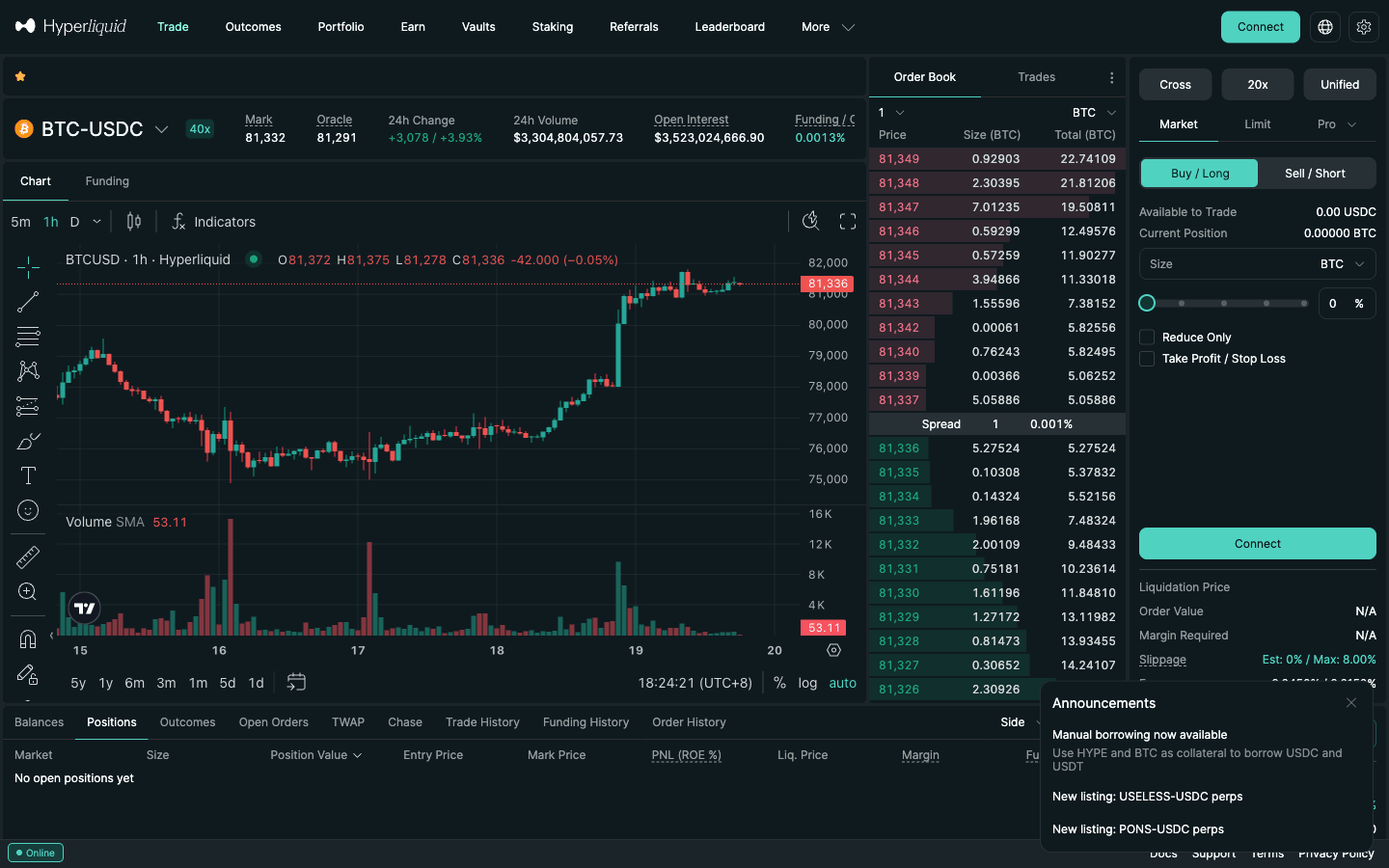
Hyperliquid’s BTC-USDC perpetual screen: chart on the left, on-chain order book in the middle, order form on the right (September 2026).
11. How to use a DEX, step by step
The flow is the same on almost every DEX. We use Hyperliquid as the example because it is the most common first perp DEX; for a token swap on Uniswap or Jupiter, steps 1–3 are identical and step 4 becomes “choose the two tokens and press Swap”.
Get a wallet (or use email). Install Rabby or MetaMask as a browser extension, write the seed phrase on paper, and store it offline. On Hyperliquid you can skip this and log in with an email code.
Buy USDC (and a little gas). Buy USDC on a regulated exchange you already use, plus a few dollars of the gas token for the network you will deposit from (ETH on Arbitrum is typical). Withdraw both to your wallet address, choosing a network the DEX supports — Hyperliquid accepts USDC on Arbitrum, Ethereum, Base and Polygon. Sending on the wrong network can lose funds.
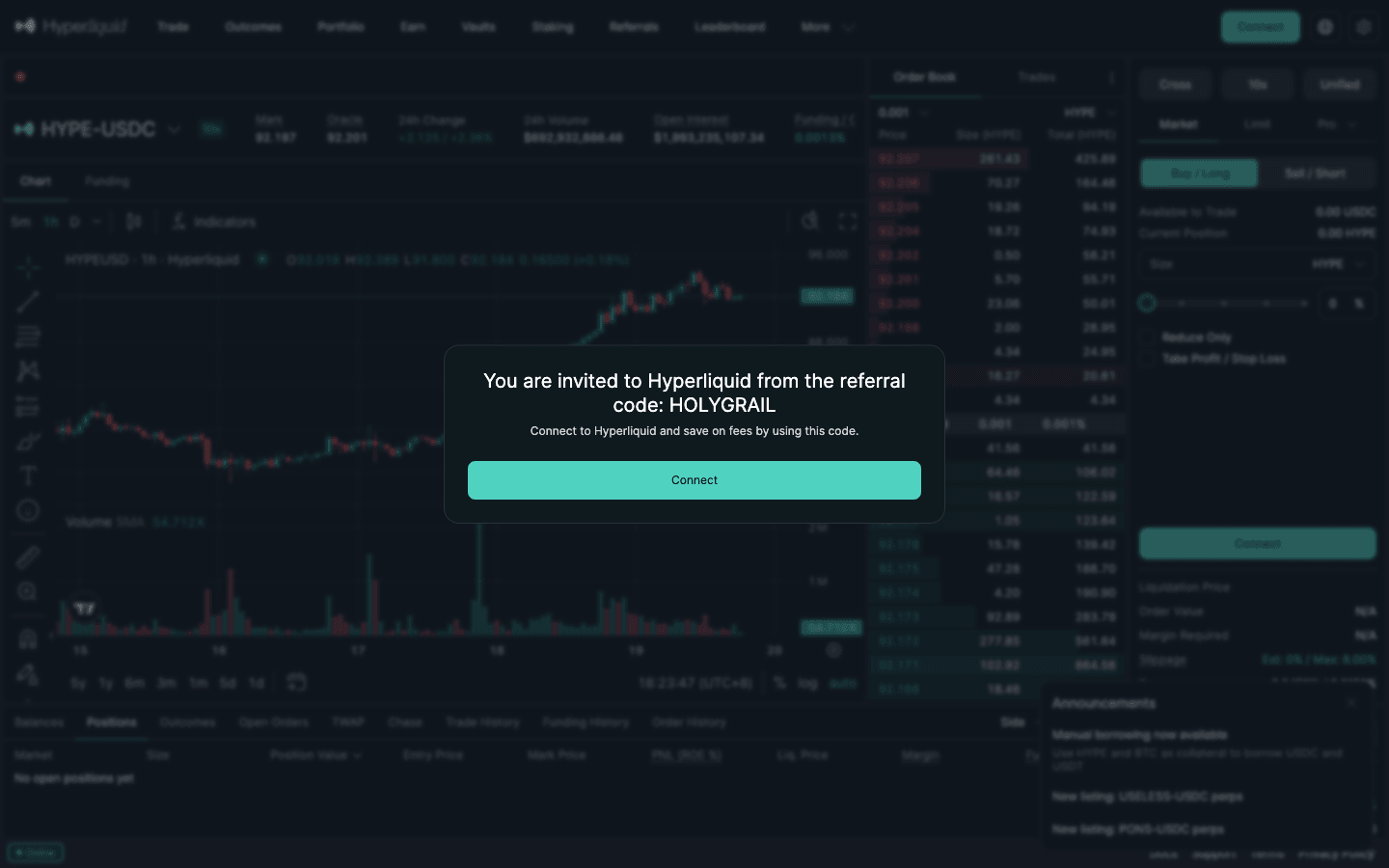
Open the DEX through the official link and connect. Use app.hyperliquid.xyz/join/HOLYGRAIL, click Connect, choose your wallet and sign. The referral prompt below confirms the 4% discount is attached; then click Enable Trading (a free signature).
Deposit. Click Deposit and send USDC. The minimum on Hyperliquid is 5 USDC; smaller deposits can be lost. Your balance appears in the account panel within minutes.
Place a small first trade. Pick BTC, set leverage to 2–5x, enter a size you can afford to lose, attach a stop-loss and take-profit, and press Long or Short. Close it and read the fill, fee and funding lines in your history.
Withdraw and keep records. Withdraw to your wallet when you’re done (0.2 USDC plus a tiny HyperEVM gas fee for USDC to Arbitrum), and export trade history for taxes.
What step 3 looks like: arriving through a referral link, Hyperliquid confirms the code before you connect (September 2026).
On a phone? The same steps work in a mobile wallet’s built-in browser or in Safari/Chrome: Hyperliquid’s web app runs on phones, and there is an official Android app (details in our Hyperliquid app guide). Native third-party apps such as Based (code HOLYGRAIL) trade on the same order book but add their own fee of 0.025% on perps. Even so, the referral discount also applies to orders placed through apps with a builder code: the 4% comes off Hyperliquid’s part of the fee, not the app’s. Order matters, though: apps such as Phantom often set their own Hyperliquid referral code on accounts that have none, so enter a code on Hyperliquid before you start using an app.
Cashing out is the reverse of step 2: withdraw USDC to your wallet, send it to an exchange that supports that network, sell it for dollars (or your currency) and withdraw to your bank. There is no way to go from a DEX straight to a bank account.
What the code changes: joining Hyperliquid with code HOLYGRAIL (the step 3 link above) takes 4% off fees on your first $25M of volume. No gas on orders, BTC up to 40x, email login. Prefer zero fees? Lighter (code 718610TD) charges 0% on Standard accounts. Or compare everything on our DEX picks page.
12. Glossary
AMM (automated market maker)
A DEX that prices trades with a formula against a liquidity pool instead of an order book.
Liquidity pool
A smart contract holding two (or more) tokens that traders swap against.
Liquidity provider (LP)
Someone who deposits tokens into a pool and earns a share of its fees.
Impermanent loss
What an LP gives up compared with simply holding the tokens, when prices move.
Order book
The list of open buy (bid) and sell (ask) orders at each price.
Maker / taker
A maker adds a resting limit order to the book; a taker fills against it. Makers usually pay less.
Slippage
The difference between the price you expected and the price you got. A “slippage tolerance” cancels the trade if it is exceeded.
Price impact
How much your own trade moves the price, based on pool or book depth.
Gas
The network fee for recording a transaction on a blockchain, paid in its native token (ETH, SOL, BNB…).
Perpetual future (perp)
A futures contract with no expiry that tracks an asset’s price, traded with leverage.
Funding rate
Periodic payment between longs and shorts that keeps a perp close to spot. See funding rates explained.
Liquidation
Forced closing of a leveraged position when its margin falls below the maintenance requirement.
Open interest
The total value of perp positions currently open.
Seed phrase
The 12 or 24 words that back up a wallet’s private key. Anyone with it controls the funds.
Token approval
Permission for a contract to move a specific token from your wallet.
Bridge
A protocol that moves assets from one blockchain to another.
MEV / sandwich attack
Bots reordering transactions around yours to profit from your price impact.
TVL
Total value locked: the assets deposited in a protocol’s contracts.
13. FAQ
What does DEX mean in crypto?
DEX stands for decentralized exchange: a peer-to-peer crypto market run by smart contracts or a blockchain instead of a company. You connect your own wallet, trade directly from it, and keep control of your funds; there is no account to open and, on most DEXs, no identity check. Uniswap (token swaps) and Hyperliquid (perpetual futures) are two of the largest.
What are examples of DEXs? Which are the top DEXs?
For token swaps: Uniswap (Ethereum and 40-plus other chains), PancakeSwap (BNB Chain), Aerodrome (Base), Raydium and Orca (Solana) and Curve (stablecoins), plus the Jupiter and 1inch aggregators. For perpetual futures: Hyperliquid, Lighter, Aster and edgeX. Our popular-DEXs table ranks them by 24-hour volume, and the perp DEX ranking updates every six hours.
Is Coinbase a DEX?
No. Coinbase is a centralized exchange (CEX): the company holds customer funds, verifies identity and handles dollar deposits and withdrawals, like Binance, Kraken and Bybit. Coinbase did incubate Base, a network on which DEXs such as Aerodrome and Uniswap run, and its separate self-custodial wallet can connect to them; trades made that way run from your own wallet.
How does a DEX work?
There are two main designs. An AMM such as Uniswap holds pools of two tokens and prices each trade with a formula, so you always trade against the pool. An order-book DEX such as Hyperliquid or Lighter matches buyers and sellers at the prices they choose, like a centralized exchange, but the matching and your balance live on a blockchain or rollup.
Is a DEX safe?
A DEX removes the risk of an exchange losing or freezing your deposit, but adds others: smart-contract and admin-key bugs (Drift, a Solana perp DEX, lost about $285M in April 2026), bridge exploits, phishing sites that copy real front-ends, and scam tokens. Use well-known venues, bookmark the official URL, never share your seed phrase and start with a small amount.
Are DEXs legal?
It depends on where you live, and we do not give legal verdicts. What you can check yourself: each DEX’s terms list the people it does not serve (Hyperliquid’s Terms of Use exclude the US, Ontario (Canada) and sanctioned jurisdictions (plus citizens of sanctioned jurisdictions)), some regulators publish rules or warnings about specific venues, and where crypto gains are taxed, DEX trades are usually taxed like any other crypto trade. For Hyperliquid, the country-by-country page collects each regulator’s official, dated statements. Hyperliquid availability by country.
Can I get back crypto I sent or swapped by mistake on a DEX?
No. A confirmed blockchain transaction is final, and a DEX has no support desk that can reverse it: a wrong address, a wrong network or a fake token with a familiar name cannot be refunded. (If you sent to your own address on another EVM network, add that network to your wallet: the funds are usually still there.) A token bought by mistake can only be sold again, if a pool or book still quotes it. Check the contract address, the network and the amount before you sign, send a small test first, and ignore anyone who offers “fund recovery” for a fee.
Do I need KYC to use a DEX? Is it anonymous?
Usually no ID, but not anonymous. Because you trade from a self-custodial wallet, the exchange never opens an account in your name, so Hyperliquid, Lighter, Uniswap and most other DEXs ask for no documents. Every swap, deposit and balance is public on-chain and tied to your address, analytics firms routinely link addresses to the exchange accounts that funded them, and the exchange you bought your crypto on did verify you. Each DEX also lists people it does not serve (Hyperliquid: the US, Ontario (Canada) and sanctioned jurisdictions (plus citizens of sanctioned jurisdictions)).
What is the difference between a DEX and a CEX?
On a CEX (Binance, Coinbase, Bybit) the company holds your funds, runs the order book, verifies your identity and lets you deposit fiat money. On a DEX you hold your own keys, trades settle on a blockchain, and there is usually no KYC and no fiat. See our full DEX vs CEX fee comparison for the numbers.
How do DEXs make money?
From trading fees. On an AMM the swap fee (0.30% on Uniswap v2 pools; 0.05%, 0.30% or 1% on standard v3 pools) goes to liquidity providers, and some protocols take a share. On Hyperliquid, fees (0.045% taker / 0.015% maker at the base tier) go to its community-owned HLP vault and an assistance fund that buys HYPE, not to a company treasury.
What are gas fees on a DEX?
Gas is the network fee for writing a transaction to a blockchain. On an AMM every swap is a transaction, so you pay gas each time (cheap on Solana, Base or Arbitrum, more on Ethereum mainnet). Order-book perp DEXs such as Hyperliquid and Lighter charge no gas to place or cancel orders; you pay gas only when you deposit, and a small fee (0.2 USDC plus a tiny HyperEVM gas fee for USDC to Arbitrum on Hyperliquid) when you withdraw.
What is a perpetual DEX?
A DEX for perpetual futures: contracts that track a coin’s price with no expiry, so you can go long or short with leverage. Hourly or 8-hourly funding payments between longs and shorts keep the price close to spot. Hyperliquid is the largest, with 179 perp markets and about $6.15B of 24-hour volume (as of November 3, 2026).
Which DEX should a beginner use?
For swapping tokens, a large AMM on a cheap chain (Uniswap on Base or Arbitrum, Jupiter on Solana). For trading with leverage, Hyperliquid: it has the deepest perp order book, no gas on orders, email login, and 4% off fees on your first $25M with a referral code. Our DEX picks page compares the alternatives.
Can I buy crypto with a card on a DEX?
Most DEXs only trade crypto against crypto, so you first buy USDC or ETH on a regulated exchange or through an on-ramp, then send it to your wallet. Some front-ends embed third-party card on-ramps (Lighter’s app advertised card deposits in September 2026); those providers run their own identity checks.
Can I cash out to dollars from a DEX?
Not directly. A DEX has no bank connection, so cashing out is the on-ramp in reverse: swap or withdraw to a stablecoin such as USDC, send it to a centralized exchange (or an off-ramp service) on a network it supports, sell it there and withdraw to your bank. The exchange or off-ramp will apply its own identity checks and fees. Send a small test amount first; a transfer on the wrong network can be lost.
Can I use a DEX on my phone?
Yes. Most DEXs work in a phone browser or inside a mobile wallet’s built-in browser (MetaMask, Phantom, Rabby). Hyperliquid’s official web app runs in Safari or Chrome, and Hyperliquid also publishes an Android app on Google Play. Native third-party apps such as Based trade on Hyperliquid’s order book but add their own fee (0.025% on Based perps) on top of Hyperliquid’s. Only install apps from links on a project’s official site.
Do I pay taxes on DEX trades? Do DEXs report to the IRS?
Using a DEX does not change your taxes. In the US the IRS treats digital assets as property, so selling or exchanging one token for another is a reportable disposal, and your Form 1040 asks whether you did either during the year. The Form 1099-DA broker reporting that started with 2025 transactions covers brokers that take possession of customers’ assets, such as custodial exchanges; a self-custodial DEX does not send you one, so keep your own records. Other countries have their own rules. This is not tax advice.
How do perpetual DEXs prevent oracle manipulation and frontrunning?
Against oracle manipulation they never trust a single price: the index is a median of several exchanges or oracles, sources that deviate or go stale are dropped (Aster gives zero weight to a source more than 5% from the median; Lighter caps the book premium in its mark price at 0.5%), and open-interest caps limit positions on thin markets. Against frontrunning, an order book has no pool to sandwich, and orders are sequenced under published rules (Hyperliquid processes cancels before new GTC and IOC orders in each block; Lighter orders transactions first-in-first-out and proves matching). Use limit orders and lower leverage on small coins.
Can a Hyperliquid API wallet withdraw my funds?
No. Hyperliquid's API docs say API (agent) wallets act for an account without withdrawal permission. A leaked agent key can still place bad trades, so give each bot its own agent, set an expiry (180 days at most) and never reuse a deregistered agent address.
Make your first DEX trade
Hyperliquid is where most on-chain perp volume trades. Sign up with HOLYGRAIL and your first $25M of volume is 4% cheaper.
Disclosure: HOLYGRAIL (Hyperliquid), HOLYGRAIL (Based’s own program) and 718610TD (Lighter) are our referral codes; we earn a share of referred accounts’ fees, and it never raises yours. We have no referral relationship with Uniswap, PancakeSwap, Aerodrome, Raydium, Orca, Curve or Jupiter. Figures were read from official documentation, Hyperliquid’s public API, DefiLlama and CoinGecko on September 25, 2026; the tax section from the IRS digital assets page on September 27, 2026. Nothing here is financial, legal or tax advice.