
Short version. Hyperliquid funding is paid every hour, on the hour, at one eighth of the 8-hour rate, peer-to-peer with no exchange cut. Positive = longs pay shorts. Baseline 0.00125%/h (0.01% per 8 hours, 10.95% a year); cap 4% per hour on every asset; payment = size × oracle price × rate. Rates now (November 3, 2026, 12:27 UTC):
| Market | Hourly | 8h equiv. | APR | $10k long / day |
|---|---|---|---|---|
| BTC | 0.00125% | 0.0100% | 10.95% | $3.00 |
| ETH | 0.00125% | 0.0100% | 10.95% | $3.00 |
| HYPE | 0.00125% | 0.0100% | 10.95% | $3.00 |
| INIT (lowest, 24h vol. > $1M) | −0.00412% | −0.0330% | −36.13% | −$9.90 |
api.hyperliquid.xyz metaAndAssetCtxs at build time (the site rebuilds about every 6 hours). Every perp: live table; what the last 720 hours cost: 30-day history. Cross-exchange basics: what a funding rate is.
To hold a position that pays or earns this funding you need a Hyperliquid account. Join with code HOLYGRAIL first: 0.045% taker becomes 0.0432% for your first $25M of volume, and funding itself stays peer-to-peer.
We earn a commission when you sign up through our links; it never raises your fees.
1. What is the Hyperliquid funding rate right now?
Rates below come from Hyperliquid’s public API when this page was built (November 3, 2026, 12:27 UTC). The site rebuilds about every 6 hours. Of 179 perps, 161 were positive, 18 negative and 150 exactly at the 0.00125% baseline. APR is the simple annualised rate (hourly × 8,760); “per day” is the cost for a $10,000 long (a short receives the same).
| Market | Hourly | 8h | APR | vs baseline | Who pays | $10k long / day | Open interest | 24h volume |
|---|---|---|---|---|---|---|---|---|
| Majors | ||||||||
| BTC 40x | 0.00125% | 0.0100% | 10.95% | at baseline | Longs pay shorts | $3.00 | $3.09B | $2.86B |
| ETH 25x | 0.00125% | 0.0100% | 10.95% | at baseline | Longs pay shorts | $3.00 | $2.26B | $976.8M |
| SOL 20x | −0.00017% | −0.0014% | −1.49% | below zero | Shorts pay longs | −$0.41 | $528.6M | $287.7M |
| HYPE 10x | 0.00125% | 0.0100% | 10.95% | at baseline | Longs pay shorts | $3.00 | $1.91B | $668.7M |
| Highest funding (24h volume over $1M) | ||||||||
| ZEC 10x | 0.00125% | 0.0100% | 10.95% | at baseline | Longs pay shorts | $3.00 | $529.1M | $598.2M |
| NEAR 10x | 0.00125% | 0.0100% | 10.95% | at baseline | Longs pay shorts | $3.00 | $183.7M | $135.9M |
| XRP 20x | 0.00125% | 0.0100% | 10.95% | at baseline | Longs pay shorts | $3.00 | $208.8M | $82.3M |
| XMR 5x | 0.00125% | 0.0100% | 10.95% | at baseline | Longs pay shorts | $3.00 | $151.2M | $68.4M |
| PUMP 10x | 0.00125% | 0.0100% | 10.95% | at baseline | Longs pay shorts | $3.00 | $96.9M | $39.9M |
| Lowest funding (24h volume over $1M) | ||||||||
| INIT 3x | −0.00412% | −0.0330% | −36.13% | below zero | Shorts pay longs | −$9.90 | $1.6M | $1.8M |
| MEGA 3x | −0.00411% | −0.0329% | −35.99% | below zero | Shorts pay longs | −$9.86 | $8.8M | $4.4M |
| GRAM 5x | −0.00283% | −0.0227% | −24.82% | below zero | Shorts pay longs | −$6.80 | $22.3M | $2.4M |
| MON 5x | −0.00131% | −0.0105% | −11.50% | below zero | Shorts pay longs | −$3.15 | $25.5M | $2.6M |
| AVAX 10x | −0.00102% | −0.0082% | −8.97% | below zero | Shorts pay longs | −$2.46 | $17.3M | $6.7M |
Source: api.hyperliquid.xyz/info metaAndAssetCtxs, November 3, 2026, 12:27 UTC. 66 of 179 perps had more than $1M of 24-hour volume. The hourly figure is the rate for the current hour; the app header rounds it to four decimals.
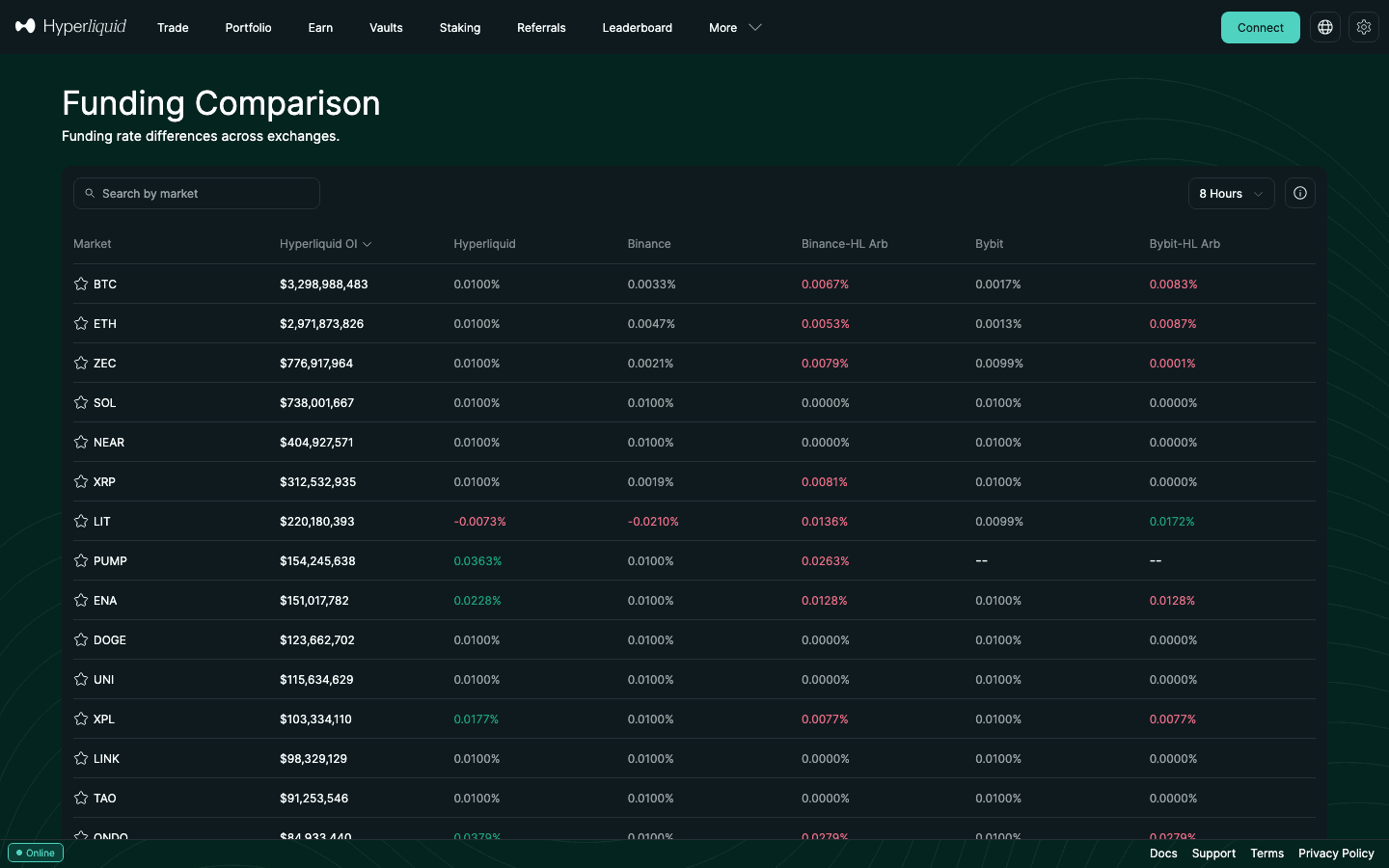
The usual shape: the majors sit at or near the baseline most hours, while one-sided 3x and 5x books escape it in both directions. A rate far from baseline on a thin market is a cost warning, not a free yield: at ten times the baseline, a $10,000 long pays $30.00 a day. Every market’s current and predicted rate, with the Binance and Bybit spread, sorted and refreshed in your browser: Hyperliquid funding rates today. Volume and open interest per market are on the Hyperliquid market data page; inside the app, the Funding Comparison page (More menu) is the official tool.
HIP-3 extremes. Builder-deployed HIP-3 markets (stocks, commodities, pre-IPO) fund on their own settings and produce the most extreme annualised rates. At November 3, 2026, 12:27 UTC, across 167 HIP-3 markets, the most extreme was xyz:CAMBRICON at −0.16234%/h (−1422.13% APR) on $19K of 24-hour volume. Among HIP-3 markets with more than $1M of volume: xyz:JIO −0.01703%/h (−149.22% APR), io:PRL 0.01065%/h (93.26% APR), xyz:PALLADIUM 0.01050%/h (91.94% APR). Details in section 15.
2. How to convert a Hyperliquid funding rate: hourly, 8h, daily, APR
Hyperliquid shows an hourly number; Binance and Bybit show a per-interval number (usually 8 hours). Multiply before you compare. Hyperliquid: ×8 for the 8-hour equivalent, ×24 for a day, ×8,760 for a simple APR. A venue paying every 8 hours: ×3 a day, ×1,095 a year.
| Hourly rate | Per 8 hours (×8) | Per day (×24) | APR (×8,760) | $10k long per day |
|---|---|---|---|---|
| 0.00125% Baseline (interest only) | 0.0100% | 0.0300% | 10.95% | $3.00 |
| 0.00500% 4× baseline | 0.0400% | 0.1200% | 43.80% | $12.00 |
| 0.0100% 0.01% an hour | 0.0800% | 0.2400% | 87.60% | $24.00 |
| 0.0500% 0.05% an hour | 0.4000% | 1.20% | 438% | $120.00 |
| 4.00% Cap | 32.00% | 96.00% | 35,040% | $9,600.00 |
The baseline row is the one to remember: 0.00125% an hour is 0.01% per 8 hours, exactly the default on Binance and Bybit, and 10.95% a year. (Hyperliquid’s docs quote 11.6% APR, the compounded figure.) The cap row is theoretical: no liquid market comes close, but it shows how little the rule itself limits.
| Venue | Pays every | Payments a day | Cap |
|---|---|---|---|
| Hyperliquid | 1 hour | 24 | 4% per hour |
| dYdX v4 | 1 hour | 24 | 12% per 8h (BTC) |
| Lighter | 1 hour | 24 | 4% per 8h (0.5% per hour) |
| Binance (BTCUSDT) | 8 hours | 3 | ±0.3% per 8h |
| Bybit (BTCUSDT) | 8 hours | 3 | ±0.333% per 8h |
| Aster (BTCUSDT) | 8 hours | 3 | ±0.3% per 8h |
Intervals and caps from each venue’s docs or API (Binance, Bybit and Aster move some symbols to 4-hour or 1-hour funding). dYdX v4 uses a 0% interest component on cross markets, so its calm-market rate is near zero rather than 0.00125%.
3. How often is funding paid on Hyperliquid?
Every hour. Hyperliquid designed funding “to closely match the process used by centralized perpetual exchanges”: the formula produces an 8-hour rate, but “funding is paid every hour at one eighth of the computed rate for each hour.” Three consequences:
- The number you see is hourly. The market header and the API show the hourly rate. Hyperliquid’s “0.00125%” and Binance’s “0.01%” (per 8 hours) are the same baseline. The header rounds it: BTC showed “0.0013%” on September 25, 2026.
- Open and close within the hour, pay nothing. Only positions held at the hour mark are charged, with no pro-rating. A scalp opened at :05 and closed at :55 pays no funding; a position held across the mark pays the full hour.
- No big payment to dodge. You are charged 24 times a day, so each payment is 1/24 of a day’s funding. Closing at :59 and reopening at :01 saves one small payment and costs a fee round trip.
The interval and the cap “do not depend on the asset”: BTC and a 3x memecoin both settle hourly with the same 4% ceiling.
4. How is the Hyperliquid funding rate calculated?
Funding exists because a perpetual contract has no expiry to pull its price back to spot (the basics: what are perpetual futures). From the docs:
Funding Rate (F) = Average Premium Index (P) + clamp(interest rate − P, −0.0005, 0.0005)
- Every 5 seconds, the premium is measured: how far the perp’s impact bid or ask sits from the oracle, as a fraction of the oracle.
- Over the hour, those samples are averaged into P.
- The clamp pulls F toward the interest rate (0.01% per 8 hours) by up to ±0.05%. So F equals exactly 0.01% whenever P is between −0.04% and +0.06% on an 8-hour basis. That band is why most markets print the baseline most hours.
- Paid hourly at F ÷ 8. Positive F: longs pay shorts. Negative F: shorts pay longs.
The docs’ worked example. Impact bid $10,100 against a $10,000 oracle: premium 1%. Clamp(0.01% − 1%) = −0.05%. F = 1% − 0.05% = 0.95% per 8 hours, which is paid as 0.11875% an hour. A 10 BTC long at $10,000 would pay 10 × $10,000 × 0.11875% = $118.75 that hour.
5. Impact prices, with the live BTC numbers
The premium does not use the last trade or the mid price. It uses impact prices: the average price you would get by trading a fixed notional through the book, 20,000 USDC on BTC and ETH and 6,000 USDC on every other asset.
premium = [max(impact bid − oracle, 0) − max(oracle − impact ask, 0)] / oracle
If the impact spread straddles the oracle (impact bid below, impact ask above), both terms are zero and the premium is zero. Only when buyers push even the impact bid above the oracle (or sellers push the impact ask below it) does a premium appear.
BTC at November 3, 2026, 12:27 UTC (metaAndAssetCtxs):
- Oracle 77,395; impact bid 77,377; impact ask 77,383.9. The impact prices were below the oracle, so premium = −0.0143% (the API’s live
premiumfield: −0.0143%). - Clamp(0.01% − (−0.0143%)) = 0.0243%, inside ±0.05%.
- F = −0.0143% + 0.0243% = 0.0100% per 8 hours → 0.00125% per hour if that premium held all hour, exactly the baseline. The API’s current-hour rate, which averages every 5-second sample so far, was 0.00125%.
The 6,000 USDC impact notional on alts is small, which is why thin markets leave the baseline easily: a few aggressive orders move the impact price of a small book. The live premium field is the early warning: when it stays above +0.06% (or below −0.04%) for much of the hour, the hourly average escapes the clamp and the rate leaves the baseline.
6. Why is the baseline 0.00125%?
The interest component is fixed at 0.01% per 8 hours, which is 0.00125% per hour. The docs describe it as “11.6% APR paid to short” and as “the difference in cost to borrow USD versus spot crypto.” Two practical points:
- Longs pay it by default. In a calm market longs pay shorts about 0.03% a day: $3.00 per day on a $10,000 position, $21.00 a week, about $90 a month.
- Shorts earn it by default. A delta-neutral trader who is short the perp and long spot collects the baseline without taking a view (earning funding below).
7. The 4% cap, the oracle and your margin
- Cap: 4% per hour, the same for every asset, described by the docs as “much less aggressive capping than CEX counterparts.” For comparison, Binance and Aster cap BTCUSDT at ±0.3% per 8 hours and Lighter caps at 4% per 8 hours (0.5% per hour).
- Payment = position size × oracle price × funding rate. The docs stress “the spot oracle price is used to convert the position size to notional value, not the mark price.” The oracle is each validator’s liquidity-weighted median of CEX spot prices.
- Leverage does not change the rate. Funding is charged on notional, not margin. What leverage changes is the payment relative to your margin: the 0.03% daily baseline is 0.3% of margin a day at 10x.
- Funding moves your liquidation price. It is added to or subtracted from your balance at each hour mark. In cross margin it changes account value; in isolated margin it changes that position’s margin, so a long paying heavy funding sees its liquidation price creep toward the market (liquidation price calculator).
8. Hyperliquid funding rate spread vs Binance and Bybit
The predictedFundings request returns the next funding rate on Hyperliquid, Binance and Bybit for each coin, with each venue’s interval. The table below puts every rate on Hyperliquid’s own per-hour basis (a CEX rate ÷ its interval: 0.01% per 8 hours is 0.00125% an hour), and the gap is Hyperliquid minus the CEX. A positive gap means a long costs more on Hyperliquid, so a short there, hedged with a long on the CEX, collects the difference. It refreshes in your browser while you read.
Biggest funding gaps right now: Hyperliquid vs Binance and Bybit
Build data · 12:27 UTC
| Coin | Hyperliquidnext, per hour | Binanceper hour | Bybitper hour | GapHL − CEX, per hour | Next CEX paymentUTC |
|---|---|---|---|---|---|
| BTCestimate → | +0.00125%+10.95% /yr | +0.00125%8h | +0.00125%8h | 0.00000%0.00% /yr | 16:00 UTCBinance |
| ETHestimate → | +0.00125%+10.95% /yr | +0.00111%8h | +0.00079%8h | +0.00046%+4.07% /yr | 16:00 UTCBybit |
| SOLestimate → | −0.00018%−1.54% /yr | +0.00125%8h | +0.00075%8h | −0.00143%−12.49% /yr | 16:00 UTCBinance |
| HYPEestimate → | +0.00125%+10.95% /yr | – | – | – | – |
| LITestimate → | +0.00125%+10.95% /yr | +0.00125%4h | −0.00455%4h | +0.00580%+50.85% /yr | 16:00 UTCBybit |
| XPLestimate → | +0.00125%+10.95% /yr | +0.00125%4h | −0.00237%4h | +0.00362%+31.72% /yr | 16:00 UTCBybit |
| FARTCOINestimate → | +0.00125%+10.95% /yr | +0.00125%4h | +0.00445%4h | −0.00320%−28.02% /yr | 16:00 UTCBybit |
| AVAXestimate → | −0.00105%−9.21% /yr | +0.00004%8h | +0.00096%8h | −0.00201%−17.61% /yr | 16:00 UTCBybit |
| WLDestimate → | +0.00125%+10.95% /yr | −0.00024%8h | +0.00125%8h | +0.00149%+13.02% /yr | 16:00 UTCBinance |
| LINKestimate → | +0.00125%+10.95% /yr | +0.00111%8h | −0.00021%8h | +0.00146%+12.78% /yr | 16:00 UTCBybit |
Hyperliquid API, 2026-11-03 12:27 UTC. Binance and Bybit: their own predicted rates as Hyperliquid’s predictedFundings reports them (reference values; no Binance or Bybit API is called), per hour (the small 4h or 8h is how often they settle). Gap = Hyperliquid minus the highlighted CEX, whichever is wider; positive means a Hyperliquid short hedged with a long there collects it, before fees. Rows: BTC, ETH, SOL, HYPE, then the 6 widest of 32 crypto perps with over $5M of 24h volume (HIP-3 markets have no CEX rate in this feed). Refreshes about once a minute while this tab is open; tap a coin to estimate its funding.
Every coin, sortable, with current and predicted rates: Hyperliquid vs Binance and Bybit funding rates, live
Capturing a gap needs a Hyperliquid account. Every pair in this table has a Hyperliquid leg, so the account comes first: join with code HOLYGRAIL before your first trade. It takes 4% off your fees on the first $25M of volume and cannot be added after $10,000 of volume.
Join Hyperliquid with HOLYGRAIL →We earn a commission when you sign up through our link; it never raises your fees. A gap is not a profit: fees on four fills, rate changes and price moves come first.
Reading it (build time, November 3, 2026, 12:27 UTC): on BTC, Hyperliquid’s predicted rate was +0.00125% per hour against +0.00125% on Binance and +0.00125% on Bybit, so the cheapest place to hold a BTC long was Hyperliquid. The widest gap among liquid coins was LIT at +0.0058% per hour against Bybit, about +50.85% a year before fees. A spread that large rarely lasts: it is the market pricing a crowded side on one venue. HYPE has no Binance or Bybit rate in the feed, although both exchanges list a HYPEUSDT perp.
A positive spread is what a delta-neutral trader collects by shorting here and holding the long on the cheaper venue, but it is set hour by hour and can flip within a day (even BTC spent 6% of the last 720 hours at zero or below), and the four taker fills of a two-venue hedge add up fast: a taker round trip on Hyperliquid alone is $9.00 per $10,000 ($8.64 with a referral code). The Hyperliquid vs Lighter vs Aster mechanics are compared in crypto funding rates explained.
9. Earning funding instead of paying it
Holding the receiving side (usually the short) and hedging the price with spot or a perp elsewhere turns hourly funding into income: the 0.00125% baseline alone is 10.95% a year to shorts, and a position opened and closed inside one hour pays nothing. Live spreads on Hyperliquid, Lighter, Aster, edgeX and Binance, a worked example after fees and the risks are in our Hyperliquid funding rate arbitrage guide.
10. Hyperliquid funding history: 30 days of BTC, ETH, SOL and HYPE
Headline rates tell you the next payment; history tells you what holding costs. From fundingHistory: the last 720 hourly payments per coin, Oct 4, 13:00 UTC to Nov 3, 12:00 UTC, refreshed with every build. “Typical range” is the 10th to 90th percentile of the hourly rate: 80% of hours fell inside it.
| Coin | 30-day sum | $10k long paid | Typical hourly range | Median hour | Hours at baseline | Hours positive | Highest hour | Lowest hour |
|---|---|---|---|---|---|---|---|---|
| BTC | 0.7351% | $73.51 | 0.00033% to 0.00125% | 0.00125% | 71% | 94% | 0.00125%Oct 4, 13:00 UTC | −0.00140%Oct 11, 11:00 UTC |
| ETH | 0.5431% | $54.31 | −0.00015% to 0.00125% | 0.00125% | 51% | 88% | 0.00125%Oct 4, 13:00 UTC | −0.00767%Oct 30, 01:00 UTC |
| SOL | 0.6017% | $60.17 | −0.00011% to 0.00125% | 0.00125% | 56% | 88% | 0.00125%Oct 4, 19:00 UTC | −0.00350%Oct 16, 20:00 UTC |
| HYPE | 0.9859% | $98.59 | 0.00047% to 0.00125% | 0.00125% | 74% | 92% | 0.02174%Oct 30, 02:00 UTC | −0.00454%Oct 7, 18:00 UTC |
Typical ranges, from our own data. For 4 of the 4 coins the median hour was exactly the baseline (0.00125%), and for 4 of 4 the 90th percentile was the baseline too: on majors, above-baseline hours are the exception, not the rule. The low end is where coins differ: ETH and SOL spent at least 10% of hours below zero. Summed over 720 hours, the baseline alone would be 0.90%; the coins landed on both sides of it. Over a month funding costs far more than trading: $73.51 of BTC funding on $10,000 against $9.00 for a taker round trip.
How to get the full funding history
- Per market: the Funding tab next to the chart plots the hourly and cumulative rate.
- Your own payments: the Funding History tab under the chart, with an Export as CSV button (columns Time, Market, Size, Side, Payment, Rate). Anyone’s list is public at app.hyperliquid.xyz/fundingHistory/ followed by an address.
- Lighter instead: Lighter’s hourly funding history (its public
fundingsendpoint and 30 days per market) is in Lighter funding rate history. - Any range, any coin: the API’s
fundingHistory(example in section 12). Each call returns up to 500 hourly rows, about 20 days, so request again with the last timestamp + 1 to page through months.
Holding perps for weeks? Funding goes between traders; the fee goes to the exchange. Code HOLYGRAIL takes 4% off every fill for your first $25M (how the code works).
11. Where to see funding in the app
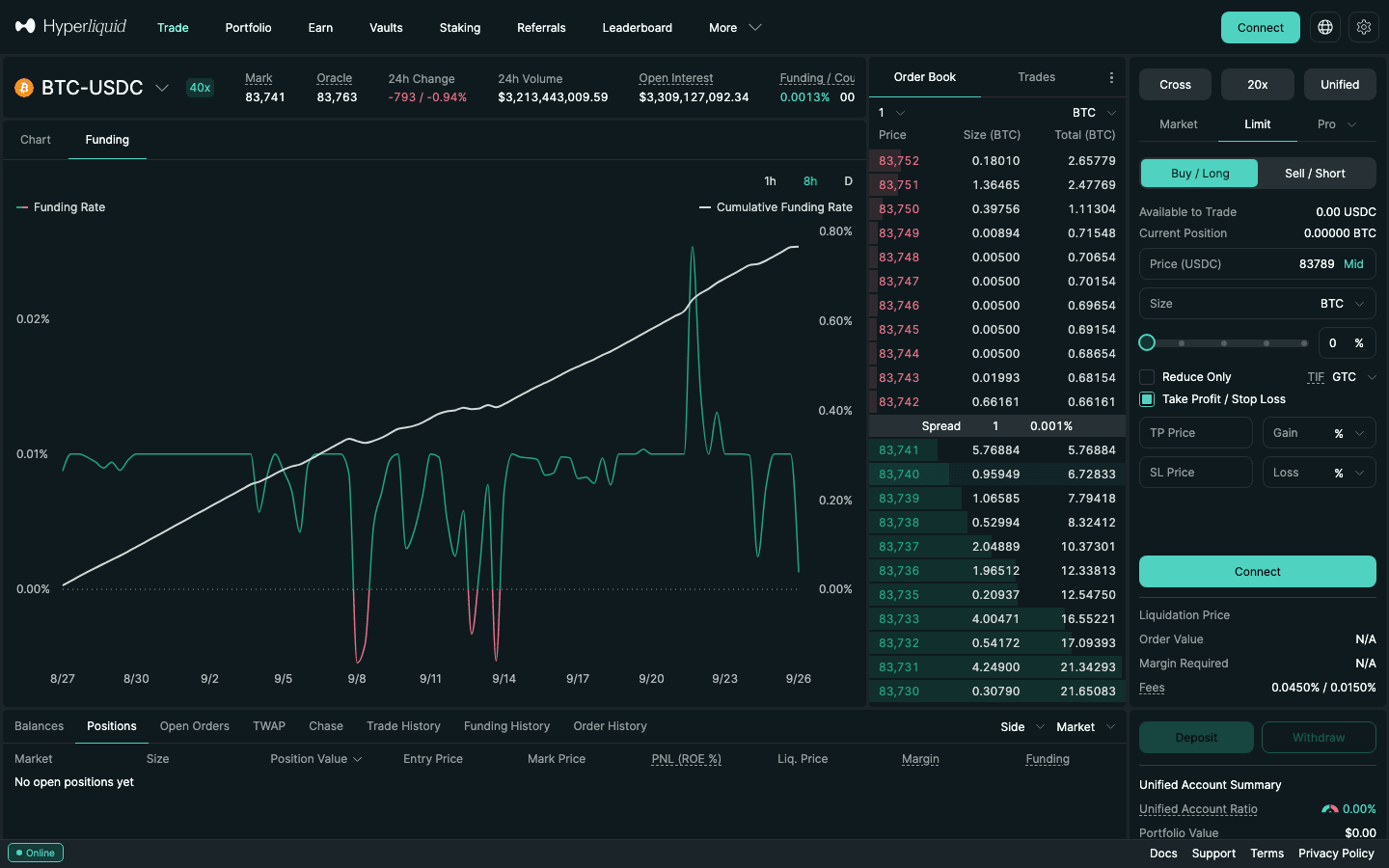
- Market header: “Funding / Countdown” shows the current hourly rate and the time to the next payment (for example “0.0013% 00:57:42” on BTC).
- Funding tab: next to the Chart tab; plots the hourly and cumulative rate for the market.
- Positions: the Funding column shows net funding paid or received since the position was opened; hover for all-time and since-changed values.
- Funding History tab: under the chart, one row per payment, with Export as CSV.
- Funding Comparison: in the More menu, Hyperliquid against Binance and Bybit on one basis.
For taxes and records, export Funding History with Trade History (CSV export guide).
12. Funding in the API (with requests)
All four are POST requests to https://api.hyperliquid.xyz/info with a JSON body; no key needed. The funding and fundingRate values are already hourly fractions (0.0000125 = 0.00125%); multiply by 8 to compare with an 8-hour CEX rate.
| type | Parameters | Returns |
|---|---|---|
metaAndAssetCtxs | optional dex (HIP-3) | Per market: current hourly funding, premium, oraclePx, markPx, impactPxs, open interest |
fundingHistory | coin, startTime (ms), optional endTime | Hourly fundingRate and premium, up to 500 rows per call |
predictedFundings | — | Next rate on HlPerp, BinPerp and BybitPerp with fundingIntervalHours and next funding time (main dex only) |
userFunding | user, startTime, optional endTime | Your own hourly payments (coin, size, rate, USDC), up to 500 per call |
Current rates for every market:
curl -s https://api.hyperliquid.xyz/info \
  -H 'Content-Type: application/json' \
  -d '{"type":"metaAndAssetCtxs"}'

# response: [meta, assetCtxs]; BTC's context when this page was built:
{ "funding": "0.0000125", "premium": "-0.0001434201",
  "oraclePx": "77395", "impactPxs": ["77377", "77383.9"], ... }
Funding history for one coin (the call behind the 30-day table above):
curl -s https://api.hyperliquid.xyz/info \
  -H 'Content-Type: application/json' \
  -d '{"type":"fundingHistory","coin":"BTC","startTime":1791115201000}'

# up to 500 rows per call; request again with startTime = last "time" + 1
[ { "coin": "BTC", "fundingRate": "0.0000125", "premium": "...", "time": ... }, ... ]
Bots should subscribe over WebSocket instead of polling (API guide); userEvents includes funding events.
13. Worked example: a leveraged HYPE long for a month
You open a $10,000 HYPE long at 5x ($2,000 margin, cross) with a market order and hold it through the same 720 hours as the history table.
- Funding: 0.9859% of notional = $98.59 (the baseline alone would be $90.00).
- Fees: 0.045% × 2 = $9.00 taker round trip, or $8.64 with a referral code.
- Total carry: about $107.59, or 5.4% of your $2,000 margin, before any price move.
- At 10x ($1,000 margin) the same position costs 10.8% of margin a month. At the peak hour (0.02174%, Oct 30, 02:00 UTC) HYPE was costing $2.17 an hour on $10,000.
That is why the funding column matters more than the fee on long holds. Ways to cut it: hold long-term exposure as spot (no funding), hold the long where funding is lowest (spread table), or take the receiving side with a hedge.
14. Reading funding with open interest
Funding tells you which side is paying; open interest (OI) tells you whether that side is still adding positions. Read together (OI per market is in the live table and the open interest guide):
| OI rising | OI falling | |
|---|---|---|
| Funding high (longs crowded) | New leveraged longs still piling in; they keep paying and a sharp drop can cascade into long liquidations. | Crowded longs taking profit or being liquidated; funding usually drifts back toward the baseline as they leave. |
| Funding negative (shorts crowded) | New shorts still piling in; they keep paying and a sharp rally can force a short squeeze. | Shorts covering or being liquidated; funding usually returns toward the baseline once they are out. |
These are tendencies, not signals: combine them with price and liquidation data before trading on them.
15. HIP-3 markets and Hyperps fund differently
HIP-3. Builder-deployed perps (stocks, indices, commodities on trade.xyz and other dexes) use a more responsive premium, premium = 0.5 × (impact bid + impact ask) / oracle − 1, and the deployer can set a funding multiplier and interest rate. trade.xyz multiplies the whole formula by a scaling factor of 0.5, so its baseline is 0.000625% an hour, 5.47% a year. Weekend price discovery on stock markets and thin pre-IPO books are where the most extreme annualised rates in the callout above tend to come from. Check the market before assuming crypto numbers apply (trade.xyz guide, all Hyperliquid markets).
Hyperps (Hyperliquid-only pre-launch perps) have no external spot price. Their “oracle” is an 8-hour exponential moving average of the market’s own mark price, and funding premium samples are computed at 1% of the usual formula. The docs warn that after strong momentum, funding “will heavily incentivize positions in the opposite direction for the next eight hours”. Shortly after the token lists on Binance, OKX or Bybit spot, the hyperp converts to a normal perp.
New to perps? Start with how to use Hyperliquid, what is a DEX and the best DEX comparison.
16. FAQ
What is the Hyperliquid funding rate?
It is the hourly payment between longs and shorts that keeps each Hyperliquid perp close to its spot oracle price. Positive means longs pay shorts; negative means shorts pay longs. Hyperliquid computes an 8-hour rate and pays one eighth of it every hour; the baseline is 0.00125% per hour (0.01% per 8 hours), and funding is peer-to-peer with no exchange fee.
What does a positive funding rate mean on Hyperliquid?
The perp is trading above the spot oracle (or sitting at the positive baseline), so every long pays every short at the next hour mark. At the 0.00125% baseline a $10,000 long pays about $3.00 a day. A negative rate reverses the direction: shorts pay longs.
How often is funding paid on Hyperliquid?
Every hour, on the hour, to whoever holds a position at that moment. There is no pro-rating, so a position opened and closed within the same hour pays or receives no funding at all. Binance and Bybit pay most majors every 8 hours, so multiply a Hyperliquid hourly rate by 8 before comparing.
What is the normal Hyperliquid funding rate?
0.00125% per hour, which is 0.01% per 8 hours, 0.03% a day and 10.95% a year (simple). The rate stays exactly there whenever the premium is small enough for the ±0.05% clamp to absorb it. At the November 3, 2026, 12:27 UTC build, 150 of 179 perps were at the baseline, 161 were positive and 18 negative.
Which coin has the highest funding rate on Hyperliquid right now?
At the November 3, 2026, 12:27 UTC build, no perp with more than $1M of 24-hour volume had funding above the 0.00125% baseline, so no single coin stood out; the lowest was INIT at −0.00412%. The live table on this page updates with every rebuild (about every 6 hours); the app’s Funding Comparison page updates continuously.
What is the maximum funding rate on Hyperliquid?
4% per hour, the same for every asset. The docs call it much less aggressive capping than CEXs: Binance caps BTCUSDT at ±0.3% per 8 hours. Majors rarely leave the baseline for long, but on a crowded small-cap there is little ceiling protecting the paying side.
How is the Hyperliquid funding payment calculated?
Payment = position size × oracle price × hourly funding rate. The oracle (a liquidity-weighted median of CEX spot prices computed by validators) converts your position to notional, not the mark price. A 1 BTC long with the oracle at $77,395 pays $0.97 for one hour at the 0.00125% baseline.
Does leverage change the funding I pay?
Not the rate and not the dollar amount for the same position size: funding is charged on notional (size × oracle price), not on your margin. Leverage changes how big that payment is relative to your margin. At 10x, the 0.03% daily baseline is 0.3% of your margin a day; at 3x it is 0.09%.
Can funding push my position toward liquidation?
Yes. Funding is added to or subtracted from your balance every hour. In cross margin it lowers account value; in isolated margin it comes out of that position’s margin, so a long paying high funding sees its liquidation price creep toward the market price even if the price does not move.
How do I avoid paying funding on Hyperliquid?
Take the receiving side (short when funding is positive), close before the hour mark if you only need the position for minutes, hold long-term exposure as spot (spot has no funding), hold the long where funding is lowest (compare Binance and Bybit in the spread table), or hedge: short the perp against a spot long to collect funding instead of paying it.
Where can I find Hyperliquid funding rate history?
In the app, the Funding tab next to the chart plots hourly and cumulative funding for each market, and the Funding History tab under the chart lists your own payments with an Export as CSV button. Through the API, fundingHistory returns hourly rates for any coin (500 rows per call; paginate with the last timestamp) and userFunding returns your own payments.
What is funding rate arbitrage on Hyperliquid?
Holding the side of a Hyperliquid perp that receives funding (usually the short) and hedging the price on spot or another venue, so you keep the hourly funding minus fees. Live spreads, break-even after fees and the risks are in our Hyperliquid funding rate arbitrage guide.
Does Hyperliquid take a cut of funding?
No. Funding is purely peer-to-peer: every dollar debited from one side is credited to the other, and no fee is collected. Trading fees (0.045% taker / 0.015% maker at tier 0) are separate.
Trade Hyperliquid with 4% lower fees
Your next step, whether you pay funding or collect it, is a Hyperliquid account. Sign up with code HOLYGRAIL: 4% off trading fees on your first $25M of volume. Funding is peer-to-peer either way.
Disclosure: HOLYGRAIL is our referral code; we earn a share of referred accounts’ trading fees at no cost to you. Funding mechanics are from Hyperliquid’s official docs (re-read October 27, 2026); live tables are rebuilt from api.hyperliquid.xyz about every 6 hours and show the fetch time. Not investment advice.