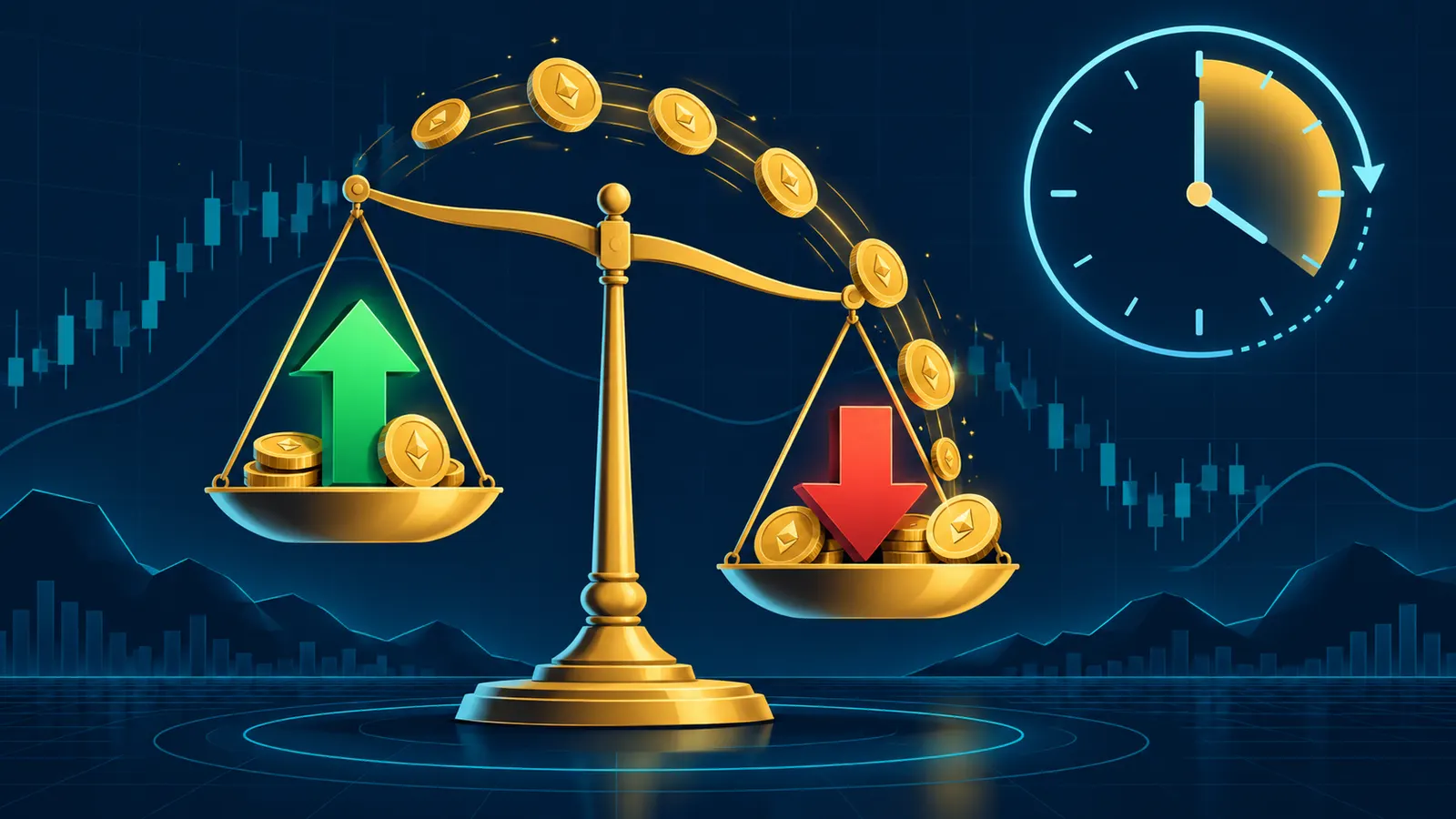
Short version. Funding is paid between traders on the full position size, not on your margin. The neutral rate is 0.01% per 8 hours (0.00125% an hour, ~11% a year) and the rate only leaves that level when the perp trades more than about 0.05% away from spot. Hyperliquid and Lighter pay every hour; Aster, Binance and Bybit every 8 hours on BTC and ETH and often every 4 hours on alts. In the week to October 21, 2026 00:00 UTC a $10,000 BTC long paid $10.79–$18.99 depending on the venue, and the most crowded liquid altcoin on Hyperliquid $33.86.
| BTC funding now | Hyperliquid | Lighter | Aster | Binance | Bybit |
|---|---|---|---|---|---|
| Per 8 hours | 0.0100% | 0.0096% | 0.0100% | 0.0100% | 0.0100% |
| Annualised | 11.0% | 10.5% | 11.0% | 11.0% | 11.0% |
| Paid every | 1 hour | 1 hour | 8 hours | 8 hours | 8 hours |
As of Tue, 03 Nov 2026 12:27 UTC (Hyperliquid Tue, 03 Nov 2026 12:27 UTC). Positive = longs pay. All six coins: live table.
Hourly funding, no gas, 4% off fees
Hyperliquid pays funding peer-to-peer every hour, so a position opened and closed between two hourly settlements pays none. To trade there you need an account: join with code HOLYGRAIL first for 4% off trading fees on your first $25M of volume.
We earn a commission when you sign up through our links; it never raises your fees.
1. What is a funding rate in crypto? Positive vs negative funding
A perpetual contract never expires, so there is no settlement date to pull its price back to the underlying asset. Funding is the substitute. Every interval, the side of the market that is paying a premium hands a small percentage of its position value to the other side. If the perp trades above spot the rate is positive and longs pay; if below, shorts pay. Traders arbitrage the payment away, and the perp price converges on spot without anyone forcing it. (New to perps? Read what are perpetual futures first, and how to short on Hyperliquid for the side that collects positive funding.)
| Positive funding | Negative funding | |
|---|---|---|
| Perp price vs spot | Above spot (premium) | Below spot (discount) |
| Who pays | Longs pay shorts | Shorts pay longs |
| What it says about positioning | More demand for leveraged longs | More demand for leveraged shorts |
| Typical setting | Rallies, new listings, meme coins | Sharp sell-offs, crowded hedges |
| Futures-curve term | Contango | Backwardation |
Three things it is not. It is not a fee the exchange collects: Binance's documentation states it "only helps facilitate the exchange of funding amounts" and charges no service fee, Hyperliquid's says funding is "purely peer-to-peer and no fees are collected on the payments", and Lighter's says the same. It is not part of your trading fee, which is charged separately on each fill. And it is not an interest rate on your margin: it is charged on the full notional of the position, so a 10x-leveraged $1,000 margin position pays funding on $10,000.
| Funding | Trading fee | Margin interest | |
|---|---|---|---|
| Paid to | The other side of the market | The exchange | The lender |
| Charged on | Full position value, at each funding time | Each fill (open and close) | The borrowed amount, over time |
| Can you receive it? | Yes, when your side is not paying | Only as a maker rebate | No |
| Applies to | Perpetual futures | Every trade | Spot margin trading |
2. The funding rate formula
Almost every crypto exchange, centralised or decentralised, uses the same formula; Binance's funding-rate FAQ (first published in 2019) is the reference most people quote. Hyperliquid, Lighter and Aster use the same structure, with their own sampling and caps. The 8-hour rate is:
F = P + clamp(I − P, −0.05%, +0.05%)
- I, the interest rate — fixed at 0.01% per 8 hours (0.03% per day). It represents the cost of holding dollars instead of the coin. Binance sets it to 0% on a few pairs such as ETHBTC; Aster sets 0% on BNBUSDT and some others.
- P, the premium index — how far the perp's order book sits from the spot index:
P = [max(0, impact bid − index) − max(0, index − impact ask)] / index. Impact bid and ask are the average prices you would get trading a fixed "impact notional" through the book; each venue sets its own size and sampling (Binance and Aster every 5 seconds, weighting later samples more; Lighter once a minute at a random second). The Hyperliquid version, with its impact sizes and live BTC numbers, is in our Hyperliquid funding rate guide. - The clamp — pulls the rate back to I whenever P is within ±0.05% of it. Binance spells out the consequence: as long as the premium is between −0.04% and +0.06%, the funding rate is exactly 0.01%. That is why liquid coins print the same number for days.
Worked example (Binance's own). Average premium index 0.0429%. Clamp(0.01% − 0.0429%) = −0.0329%, inside the ±0.05% band. F = 0.0429% − 0.0329% = 0.0100%. The perp was trading four basis points rich and the rate still landed on the baseline. Now push the premium to 1% (Hyperliquid's documentation uses the same example): the clamp saturates at −0.05% and F = 0.95% per 8 hours — a long pays $95 per $10,000 every 8 hours until the premium collapses, unless the venue’s cap bites first (Binance and Aster cap BTCUSDT at 0.3% per 8 hours, so $30).
Interval scaling. The formula gives an 8-hour rate. Hyperliquid and Lighter pay one eighth of it every hour; Aster and Binance divide it by 8/N for an N-hour interval, so a 4-hour market pays half the 8-hour rate twice as often. Same cost per day, different number on the screen.
Caps. Binance caps USDⓈ-M funding at ±0.3% per interval on BTCUSDT and ETHUSDT and at ±2% on most other contracts (713 of the 808 listed in its fundingInfo on October 21, 2026), with tighter caps on some, such as ±0.375% on SOL and XRP; Aster uses the same levels on BTC and ETH (±0.3%), and Bybit's BTCUSDT cap is ±0.333%. Hyperliquid caps at 4% per hour for every asset — far looser, deliberately. Lighter caps at 4% per 8 hours (0.5% an hour) and scales the premium by 1/2 on RWA markets and 1/100 on pre-IPO markets.
3. Intervals, caps and what price is used
| Venue | Interval | Interest rate | Cap | Notional priced at |
|---|---|---|---|---|
| Hyperliquid | Every hour (1/8 of the 8h rate), every asset | 0.01% per 8h = 0.00125%/h | 4% per hour, every asset | Oracle (spot) price |
| Lighter | Every hour | 0.01% per 8h on crypto (lower on RWA, 0 on FX) | 4% per 8h (0.5%/h); premium × 1/2 on RWA, 1/100 on pre-IPO | Index price |
| Aster | 8 hours on BTC/ETH; 4h, 2h or 1h on other markets (of 789 symbols on October 21, 2026: 325 every 8h, 363 every 4h, 3 every 2h, 98 every hour) | 0.01% per 8h, scaled to the interval (0% on BNBUSDT and some others) | ±0.3% BTC/ETH, ±0.375% SOL/XRP, ±2% on many alts | Mark price |
| Binance USDⓈ-M | 8 hours on majors, 4h on most alts (HYPEUSDT 4h) | 0.01% per 8h on BTC/ETH | ±0.3% BTC/ETH; ±2% on many alts (e.g. HYPEUSDT) | Mark price |
| Bybit | 8 hours on BTC, ETH, SOL, HYPE; shorter on some alts | 0.01% per 8h | ±0.333% on BTCUSDT; per symbol | Mark price |
Hyperliquid, Lighter and Aster docs re-read October 21, 2026; Binance and Aster intervals and caps from their public fundingInfo endpoints the same day, Bybit's from its instruments endpoint.
Two details trip people up. First, the payment goes to whoever holds a position at the settlement timestamp: on Binance that is 00:00, 08:00 and 16:00 UTC for 8-hour markets (plus 04:00, 12:00, 20:00 for 4-hour ones); on Hyperliquid it is every hour on the hour. There is no pro-rating — hold for 59 minutes and close, and you pay nothing. Second, the notional is priced differently: Binance and Aster use the mark price, Hyperliquid the oracle (a weighted median of CEX spot prices), Lighter the index. On a liquid major the difference is noise; on a thin market where mark and index diverge it is not. The Hyperliquid funding rate mechanics in full (formula, hourly cap, oracle pricing) have their own guide, and the three DEXs are compared line by line in section 9.
4. Reading the number: hourly, 8-hour and annualised
The single biggest source of confusion is that venues display the rate on different bases. Hyperliquid shows an hourly rate; Binance and Bybit show a per-interval rate that is usually 8-hourly. A Hyperliquid "0.00125%" and a Binance "0.01%" are the same thing. To compare, multiply Hyperliquid's number by 8 — or use Hyperliquid's own Funding Comparison page, which does it for you.
| 8-hour rate | Hourly | Daily | Annualised (simple) |
|---|---|---|---|
| 0.01% / 8h (the baseline) | 0.00125% | 0.03% | 10.95% |
| 0.05% / 8h | 0.00625% | 0.15% | 54.75% |
| 0.10% / 8h | 0.0125% | 0.30% | 109.5% |
| 0.30% / 8h (Binance / Aster BTC cap) | 0.0375% | 0.90% | 328.5% |
| 1.00% / 8h | 0.125% | 3.00% | 1,095% |
Annualised = 8-hour rate × 3 × 365. Hyperliquid's docs quote 11.6% APR for the baseline (compounded); simple arithmetic gives 10.95%. Aggregators such as CoinGlass show an "OI-weighted" or "volume-weighted" rate across exchanges — useful for sentiment, useless for working out what your position on your exchange will pay.
5. What funding costs, and how to estimate it
Cost of holding a $10,000 long — notional, not margin — at various rates. A short at the same rate receives the same amounts.
| Rate | Per 8h | Per day | Per week | Per month (30d) |
|---|---|---|---|---|
| Baseline 0.01% / 8h | $1.00 | $3.00 | $21.00 | $90.00 |
| 0.05% / 8h | $5.00 | $15.00 | $105.00 | $450.00 |
| 0.10% / 8h | $10.00 | $30.00 | $210.00 | $900.00 |
| 0.30% / 8h | $30.00 | $90.00 | $630.00 | $2,700.00 |
| −0.05% / 8h (you receive) | +$5.00 | +$15.00 | +$105.00 | +$450.00 |
Put that next to trading fees. A $10,000 round trip at Hyperliquid's base taker rate (0.045%) costs $9.00. At baseline funding, that is about three days of holding; at 0.1% per 8h it is about seven hours. Leverage is what turns funding from a rounding error into the main cost: with 20x leverage, $500 of margin controls the $10,000 above, so the $90 baseline month is 18% of your margin, and the 0.3%-per-8h row would burn several times your margin in a month — the position would be liquidated long before the month was out.
Estimate your funding cost
Enter your position and the rate your exchange shows. The buttons load the live BTC rate from the table below in each venue's own interval.
Funding is charged only to positions open at each payment time, so a hold that is not a whole number of intervals shows a range (a 7-hour hold on an 8-hour venue: 0–1 payments). A venue button also applies that venue's BTC funding cap.
For trading fees and funding together across venues, use the DEX fee calculator.
6. Live funding rates across exchanges
The same six coins on five venues, converted to an 8-hour basis so they can be compared directly (hourly rates × 8, 4-hour rates × 2), with the simple annualised rate underneath. Positive = longs pay. The cheapest venue for a long in each row is highlighted.
| Coin | Hyperliquid | Lighter | Aster | Binance | Bybit |
|---|---|---|---|---|---|
| BTC | 0.0100%11.0%/yr | 0.0096%10.5%/yr | 0.0100%11.0%/yr | 0.0100%11.0%/yr | 0.0100%11.0%/yr |
| ETH | 0.0100%11.0%/yr | 0.0096%10.5%/yr | 0.0100%11.0%/yr | 0.0089%9.7%/yr | 0.0063%6.9%/yr |
| SOL | −0.0014%−1.5%/yr | 0.0096%10.5%/yr | 0.0100%11.0%/yr | 0.0100%11.0%/yr | 0.0060%6.6%/yr |
| XRP | 0.0100%11.0%/yr | 0.0096%10.5%/yr | 0.0100%11.0%/yr | 0.0100%11.0%/yr | 0.0094%10.2%/yr |
| DOGE | 0.0100%11.0%/yr | −0.0016%−1.8%/yr | 0.0095%10.4%/yr | 0.0084%9.2%/yr | −0.0005%−0.5%/yr |
| HYPE | 0.0100%11.0%/yr | 0.0096%10.5%/yr | 0.0100%11.0%/yr | 0.0100%11.0%/yr | 0.0100%11.0%/yr |
Build-time data: Hyperliquid metaAndAssetCtxs (Tue, 03 Nov 2026 12:27 UTC); Lighter, Binance and Bybit from Lighter’s public funding-rates feed, which normalises all three to 8 hours (Tue, 03 Nov 2026 12:27 UTC); Aster premiumIndex and fundingInfo (Tue, 03 Nov 2026 12:27 UTC). Binance and Aster pay HYPE every 4 hours; Aster and the CEXs show the rate for the next payment.
The usual pattern: most hours, Hyperliquid and Lighter sit at their baselines on the majors (Lighter records its default as 0.0012% an hour, 0.0096% per 8 hours), while the CEXs and Aster often print below baseline on BTC, so a BTC long is frequently cheaper to hold there. HYPE is where venues disagree most, sometimes with opposite signs. Rates move every interval, so treat any single reading as a snapshot and check the history below before choosing where to hold for days.
Which Hyperliquid perps pay the most right now, hour by hour, with open interest and volume: the live table in our Hyperliquid funding rate guide (161 of 179 Hyperliquid perps positive and 18 negative at this build). Every Hyperliquid market’s current and predicted rate next to Binance’s and Bybit’s, sortable and refreshed in your browser: Hyperliquid funding rates today. Volume and open interest per market: the Hyperliquid market data page.
7. Funding rate history: what a position paid over 7 and 30 days
Headline rates tell you the next payment; history tells you what a position costs. Total funding paid by a long, summed from each venue’s history endpoint, for the 7 days and the 30 days to October 21, 2026 00:00 UTC. Multiply by 100 for dollars per $10,000 (0.1750% = $17.50).
| Coin, period | Hyperliquid | Lighter | Aster | Binance | Bybit |
|---|---|---|---|---|---|
| BTC, 7 days | 0.1750% | 0.1899% | 0.1265% | 0.1099% | 0.1079% |
| BTC, 30 days | 0.7093% | 0.5808% | 0.3824% | 0.2905% | 0.3039% |
| ETH, 7 days | 0.1260% | 0.1474% | 0.1450% | 0.0914% | 0.0925% |
| ETH, 30 days | 0.7236% | 0.5048% | 0.5231% | 0.3379% | 0.3037% |
| SOL, 7 days | 0.0454% | 0.1034% | 0.0881% | 0.0633% | 0.0285% |
| SOL, 30 days | 0.6011% | 0.1251% | 0.3106% | 0.2695% | 0.1786% |
| HYPE, 7 days | 0.1838% | 0.1408% | 0.1854% | 0.1540% | 0.0995% |
| HYPE, 30 days | 0.7975% | 0.6466% | 0.3339% | 0.3938% | 0.0748% |
Payments after 2026-10-14 00:00 UTC (7 days) and 2026-09-21 00:00 UTC (30 days), up to and including 2026-10-21 00:00 UTC. Hyperliquid and Lighter pay hourly (168 / 720 payments); Aster, Binance and Bybit every 8 hours (21 / 90), except HYPE on Aster and Binance every 4 hours (42 / 180). Read from each venue's history endpoint on October 21, 2026.
Over 30 days a BTC long paid 0.71% on Hyperliquid, 0.58% on Lighter and 0.29–0.38% on Aster, Binance and Bybit: $70.93 against $29.05–$38.24 per $10,000. Hyperliquid's BTC rate sat exactly on its baseline in 59% of those hours and was positive in 92%, while the CEX rates dip below theirs often enough to add up. The cheapest BTC long was Bybit over 7 days and Binance over 30; on SOL, Hyperliquid was the cheapest DEX over the week but the dearest over the month. There is no permanently cheapest venue, which is why the table is worth checking before a multi-week hold. For Hyperliquid’s own 30-day hour-by-hour data, see the Hyperliquid funding rate guide.
Worked example: a $10,000 BTC long held for one week at 5x leverage ($2,000 of margin), opened and closed with market orders:
| Venue | Funding (7 days) | Taker fees, open + close | Total | As % of $2,000 margin |
|---|---|---|---|---|
| Hyperliquid | $17.50 | $9.00 (0.045% × 2) | $26.50 | 1.32% |
| Lighter (Standard) | $18.99 | $0.00 (0% × 2) | $18.99 | 0.95% |
| Aster | $12.65 | $8.00 (0.04% × 2) | $20.65 | 1.03% |
| Binance | $10.99 | $10.00 (0.05% × 2) | $20.99 | 1.05% |
| Bybit | $10.79 | $11.00 (0.055% × 2) | $21.79 | 1.09% |
On BTC, funding and fees were the same order of magnitude, and on the hourly DEXs a week of funding cost more than a round-trip fee. Funding is a subscription; the fee is paid once. At 20x the same $10,000 needs only $500 of margin, and Hyperliquid’s $26.50 becomes 5.3% of it in a week.
Crowded coins are where funding bleeds. The same week on Hyperliquid, per $10,000 long, among the 35 perps with more than $5M of daily volume:
| Market | 7-day funding | Long paid on $10,000 | Negative hours (of 168) | Max leverage |
|---|---|---|---|---|
| CASHCAT | 0.3386% | $33.86 | 0 | 3x |
| STRK | 0.2589% | $25.89 | 0 | 5x |
| COMP | 0.2116% | $21.16 | 0 | 5x |
| ZEC | 0.2087% | $20.87 | 1 | 10x |
| CRV | 0.2025% | $20.25 | 3 | 10x |
| BTC (reference) | 0.1750% | $17.50 | 4 | 40x |
| JUP (lowest of the 35) | -0.2391% | $-23.91 | 104 | 10x |
Hyperliquid fundingHistory, 168 hourly payments to October 21, 2026 00:00 UTC; max leverage from the API on October 21, 2026.
It was a calm week, and the bleed still shows. A CASHCAT long at 3x (at least $3,334 of margin for $10,000) paid $33.86 in a week, 1.0% of its margin, before any price move; at the same rate a month costs about 4% of margin. A trade that never hits its stop can still lose money. The other side also exists: on JUP shorts paid longs in 104 of 168 hours.
Hold where your side pays least
Routing a position to the cheaper funding only works if the account already exists when the gap opens. Set up the venues first: Hyperliquid (code HOLYGRAIL, 4% off fees on your first $25M), Lighter (0% taker on Standard accounts, code 718610TD) and Aster (8-hourly on BTC and ETH, code DTLpLc).
8. How to check the funding rate
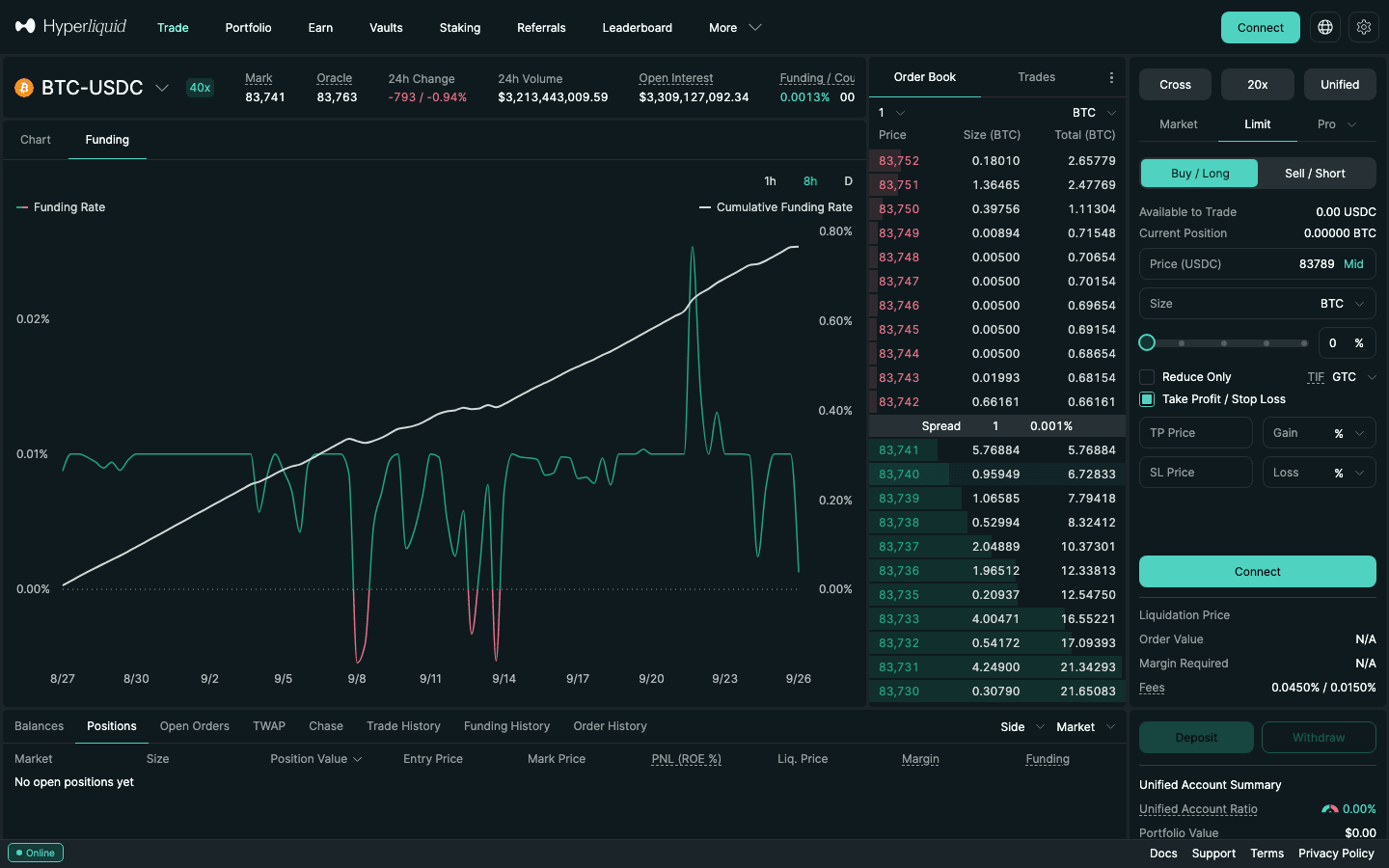
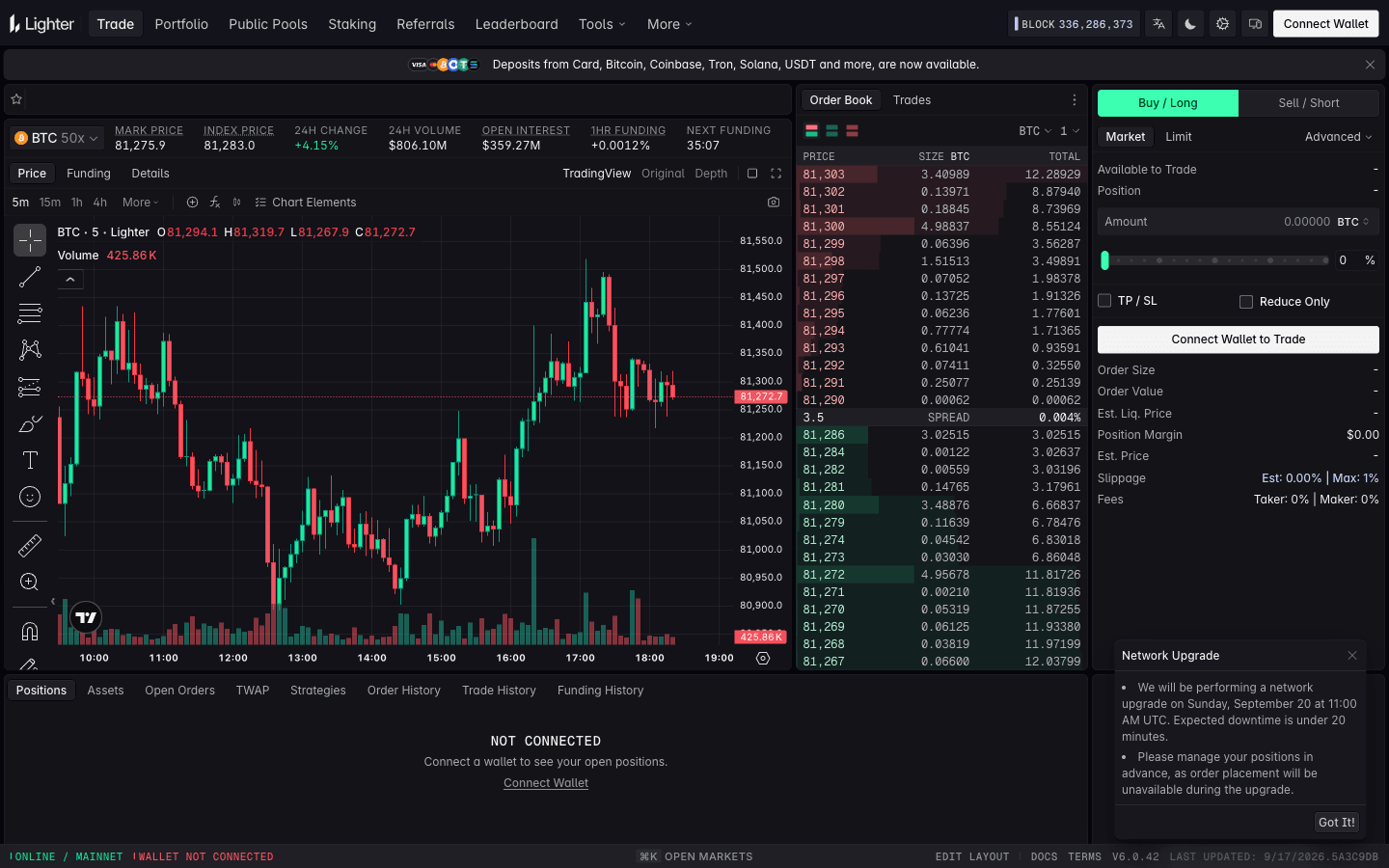
On the exchange. Every perp exchange shows the current rate next to the price, with a countdown to the next payment. On Hyperliquid the market header reads Funding / Countdown (hourly rate), the Funding tab beside the chart plots the rate over time, and the Funding History tab under the chart lists every payment you made or received, with Export as CSV. Lighter has a Funding tab on each market and a Funding History tab in the account panel. Aster shows the rate and countdown on the trade page and lists every symbol with its interval on its real-time funding page.
Across exchanges. Trackers put many exchanges on one screen:
- CoinGlass — a coin-by-exchange table, OI- and volume-weighted averages, a heatmap and accumulated funding.
- CoinMarketCap — average, highest and lowest rates with a table by coin.
- Coinalyze — current and predicted rates by exchange, with charts.
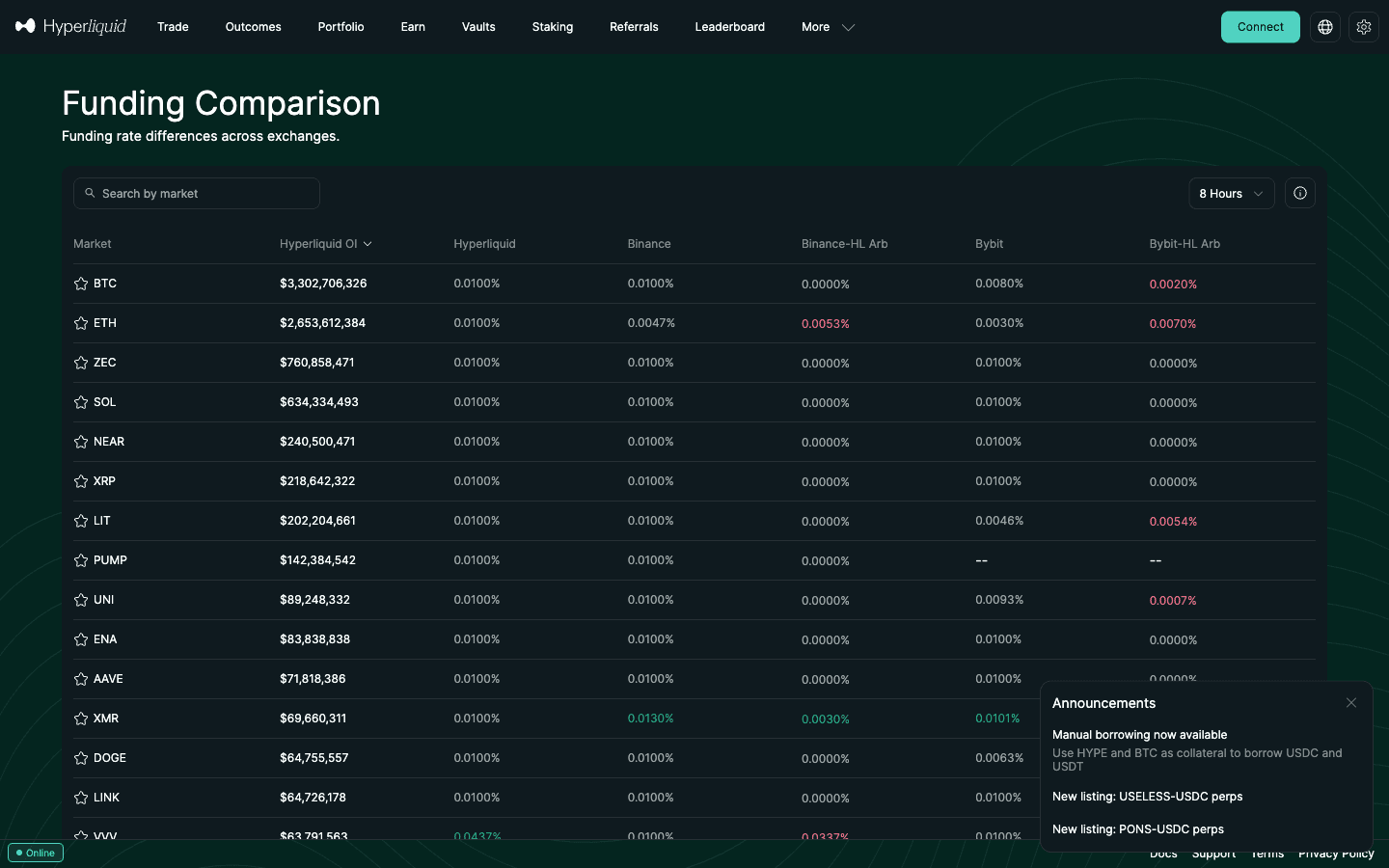
- Hyperliquid Funding Comparison — Hyperliquid next to Binance and Bybit on one basis, free and without login.
- Exchange pages: Binance's real-time funding rate page and Aster's real-time and history pages list every contract with its interval.
Coverage of Lighter and Aster on third-party trackers varies, and aggregated averages are not what your position pays, so confirm on the venue (or with the endpoints below) before acting. The live table in section 6 covers the three DEXs we track next to Binance and Bybit.
Funding rate APIs (Hyperliquid, Lighter, Aster)
All three DEXs publish funding through public endpoints that need no API key; this page is built from them. Endpoint names below were checked against each venue's API docs on October 4, 2026 and called again on October 21, 2026.
| Venue | Base URL | Current rate | History | Your own payments |
|---|---|---|---|---|
| Hyperliquid | POST api.hyperliquid.xyz/info | metaAndAssetCtxs (hourly funding, premium, oraclePx, markPx, openInterest); predictedFundings (next rate on Hyperliquid, Binance and Bybit with each venue's interval) | fundingHistory (coin, startTime, optional endTime; up to 500 rows per response, paginate from the last timestamp) | userFunding (user, startTime) |
| Lighter | GET mainnet.zklighter.elliot.ai/api/v1/ | funding-rates (Lighter, Hyperliquid, Binance and Bybit on an 8-hour basis in one call); real-time via the market_stats WebSocket channel | fundings (market_id, resolution = 1h or 1d, start_timestamp, end_timestamp, count_back) | positionFunding |
| Aster | GET fapi.asterdex.com/fapi/v1/ (the v3 docs use /fapi/v3/; both return the same data) | premiumIndex (lastFundingRate, nextFundingTime, mark and index price); fundingInfo (interval, cap and floor per symbol) | fundingRate (symbol, startTime, endTime, limit default 100, max 1,000) | income with incomeType=FUNDING_FEE (signed, needs an API key) |
Lighter funding rate API in one call. curl https://mainnet.zklighter.elliot.ai/api/v1/funding-rates returns an array of {market_id, exchange, symbol, rate} rows for lighter, hyperliquid, binance and bybit; rate is a fraction per 8 hours (0.000096 = 0.0096%). For history, /api/v1/fundings?market_id=1&resolution=1h&start_timestamp=…&end_timestamp=…&count_back=168 gives hourly rows with rate in percent and a direction field (long = longs paid). Market ids come from /api/v1/orderBooks (BTC is 1, ETH is 0).
Hyperliquid. curl -X POST https://api.hyperliquid.xyz/info -H 'Content-Type: application/json' -d '{"type":"fundingHistory","coin":"BTC","startTime":1790000000000}' returns {coin, fundingRate, premium, time} per hour; fundingRate is a fraction per hour. Open interest, mark and oracle price for every market come from the same metaAndAssetCtxs call: see the open interest request in our Hyperliquid API guide. Why the payment uses the oracle while liquidations use the mark: mark price vs index price.
Aster. curl 'https://fapi.asterdex.com/fapi/v1/fundingRate?symbol=BTCUSDT&limit=21' returns the last 21 payments (one week on an 8-hour market) in ascending order; read the interval from fundingInfo before you sum.
A simple hourly poller: fetch the three current-rate calls, convert to 8 hours (× 8 for Hyperliquid, × 8 / N for Aster using fundingInfo; Lighter's feed is already on 8 hours), and flag coins where the gap between venues exceeds your round-trip fee hurdle (Hyperliquid 0.045% taker, Lighter 0% on Standard, Aster 0.04% taker; see DEX vs CEX fees). What a flagged spread actually earned over a week on five venues, after fees: funding rate arbitrage worked example.
9. Hyperliquid vs Lighter vs Aster: the mechanics side by side
The three DEXs use the same skeleton (interest 0.01% per 8 hours plus a premium clamped to ±0.05%), which is why liquid majors print the same baseline on all three most of the time. What differs is how the premium is sampled, how hard the rate is capped and which price the payment uses.
| Hyperliquid | Lighter | Aster | |
|---|---|---|---|
| Payment interval | Every hour | Every hour | Per market: 8 hours on BTC/ETH, 4h, 2h or 1h elsewhere |
| Rate shown | Hourly (1/8 of the 8h formula) | Hourly (1/8 of the 8h formula) | Per interval: F ÷ (8 / N), N = interval in hours |
| Premium sampling | Every 5 s, averaged over the hour | Once a minute at a random second, time-weighted average of 60 samples | Every 5 s; later samples weighted more on intervals longer than 1h |
| Interest rate | 0.01% / 8h (0.00125%/h) | 0.01% / 8h on crypto; lower on RWA, 0 on FX | 0.01% / 8h; 0% on BNBUSDT and some others |
| Cap | 4% per hour, every asset | 4% per 8h (0.5%/h); premium × 1/2 on RWA, × 1/100 on pre-IPO | Per symbol: ±0.3% BTC/ETH, ±0.375% SOL/XRP, ±2% on many alts, per interval |
| Payment priced at | Oracle (spot) price | Index price | Mark price |
| Impact notional for the premium | 20,000 USDC on BTC/ETH, 6,000 USDC on others | 500 USDC ÷ initial margin fraction | Impact Margin Amount ÷ initial margin rate at max leverage (configurable) |
| Exchange cut | None | None | None |
Official docs (Hyperliquid funding and contract specifications, Lighter trading/funding, Aster funding-rate) and Aster’s fundingInfo endpoint, re-read October 21, 2026.
- Caps decide how bad a squeeze can get. Hyperliquid’s 4%-per-hour cap is loose by design, so a crowded small-cap can charge the paying side far more per hour there than on Lighter (0.5% an hour) or on Aster (±2% per 4–8h interval on most alts). If you are on the paying side of a crowded trade, the tighter cap is the safer venue.
- Aster can change the rules in volatile markets. Its docs reserve the right to adjust the funding interval, cap and floor in extreme volatility. Read the interval from the
fundingInfoendpoint or Aster’s real-time funding page before you hold, not from memory. - Timing matters only on longer intervals. On Hyperliquid and Lighter each payment is 1/24 of a day’s funding, not worth dodging. On an 8-hour Aster market a full interval lands at once, and Aster’s docs add a 15-second deviation: a position opened at 16:00:05 UTC may still be charged for the 16:00 interval.
- Margin can pay the bill. On Aster, funding comes out of the Perps balance and, if that is short, out of position margin, which moves your liquidation price.
- Mid-caps are where spreads live. On BTC, ETH and SOL the three usually sit within a few ten-thousandths of a percent of each other on an 8-hour basis. Wider spreads appear on mid-caps and new listings, which is what cross-venue funding arbitrage trades.
Lighter funding in detail: hourly formula, market types and holding cost
Lighter is the venue where funding is closest to a fixed fee, and on its default Standard account (0% taker, 0% maker) funding is the only cost of holding a position: the docs list no overnight, rollover or borrow fee on perps. How the hourly rate is built, step by step:
- A premium sample every minute. At a random second in each minute Lighter measures how far the impact bid sits above the index, or the impact ask below it. The impact size is 500 USDC divided by the market's initial margin fraction ($5,000 on a 10x market), so one small order cannot move funding.
- An hourly average. The 60 samples are averaged and multiplied by the market's premium multiplier (1 on crypto, 1/2 on RWA, 1/100 on pre-IPO).
- The small clamp. Lighter adds clamp(interest − premium, ±0.05%). Any premium within 0.05% of the 0.01% interest rate (8-hour basis) lands exactly on the interest rate.
- The cap, then ÷ 8. The result is capped at ±4% per 8 hours and paid hourly as one eighth: at most 0.5% an hour. On October 21, 2026 the API still showed a looser cap on two markets (RIVER 16% and ARC 20% per 8 hours).
So on a quiet crypto market a long pays 0.00125% an hour, which Lighter's records show as 0.0012% because its API keeps four decimals. Worked examples on the 8-hour basis: a +0.03% average premium still pays the default; the docs' own +0.10% example clamps to 0.05% and pays 0.00625% an hour ($0.63 per hour on $10,000); a −0.20% discount becomes −0.15% and a long receives 0.01875% an hour. The payment is size × index price × rate, peer-to-peer.
| Market type | Premium multiplier | Small clamp (scaled) | Interest rate | Default funding |
|---|---|---|---|---|
| Crypto perps | 1 | 0.05% | 0.01% per 8h | 0.0012% per hour, longs pay shorts |
| Stocks, indices, commodities (RWA) | 1/2 | 0.025% | 0.0032% per 8h | 0.0004% per hour |
| Forex (and US10Y) | 1/2 | 0.025% | 0 | 0% |
| Pre-IPO and pre-market | 1/100 | 0.0005% | 0.0032% per 8h (pre-IPO) | 0.0004% per hour |
docs.lighter.xyz “Funding” (multipliers) and the public API orderBookDetails (interest rate, multiplier, caps per market), re-read October 21, 2026.
What 30 days actually cost on Lighter. Every hourly payment from the public fundings endpoint for the 720 hours to October 21, 2026 00:00 UTC (positive = longs paid):
| Market | 30-day total | On a $10,000 long | Last 7 days | Hours positive | Highest hour | Lowest hour |
|---|---|---|---|---|---|---|
| BTC | 0.5808% | $58.08 | 0.1899% | 85.3% | 0.0012% | −0.0019% |
| ETH | 0.5048% | $50.48 | 0.1474% | 81.4% | 0.0012% | −0.0036% |
| SOL | 0.1251% | $12.51 | 0.1034% | 74.6% | 0.0012% | −0.0237% |
| HYPE | 0.6466% | $64.66 | 0.1408% | 88.9% | 0.0025% | −0.0028% |
| ZEC | 1.0728% | $107.28 | 0.1908% | 99.6% | 0.0088% | −0.0039% |
| XAU (gold) | 0.7827% | $78.27 | 0.1606% | 99.9% | 0.0056% | −0.0014% |
| US500 | 0.2473% | $24.73 | 0.0569% | 94.7% | 0.0004% | −0.0038% |
| EUR/USD | 0.2082% | $20.82 | 0.0053% | 38.1% | 0.0047% | 0.0000% |
| OPENAI (pre-IPO) | 0.2210% | $22.10 | 0.1032% | 36.1% | 0.0045% | −0.0014% |
Lighter public API /api/v1/fundings (resolution 1h), read October 21, 2026. Totals are simple sums of hourly rates.
- BTC and ETH funding was close to a fixed fee with a cap on top. BTC paid exactly the default in 59% of hours and never more; in the other hours it dipped below, as low as −0.0019%.
- Crowded alts cost more. ZEC cost longs 1.07% over the month, with a peak hour about seven times the default.
- RWA and FX are cheaper at the default, not always in practice. Gold's default is 0.0004% an hour, but its measured month was 0.78% because the premium sat above the clamp in almost every hour; EUR/USD paid nothing in 62% of hours; US500 longs paid in 95% of hours, but at most 0.0004% an hour.
Holding cost of a $10,000 BTC long on Lighter Standard (no trading fee, so funding is the whole bill):
| Holding period | Hourly payments | At the default (0.0012%/h) | Measured (to October 21, 2026) |
|---|---|---|---|
| Overnight (8 hours) | 8 | 0.0096% = $0.96 | about the same |
| 1 day | 24 | 0.0288% = $2.88 | the default in the last 24 hours |
| 1 week | 168 | 0.2016% = $20.16 | $18.99 |
| 30 days | 720 | 0.864% = $86.40 | $58.08 |
Funding is charged on notional, so leverage multiplies it against your margin: the same day costs 0.29% of $1,000 of margin at 10x, and a month at 50x would eat over a third of the margin. A short receives what the long pays, and Lighter's multi-asset margin lets you post ETH against an ETH short for a basis trade. A position opened and closed inside the same hour never touches a payment. On a Premium account add 0.028% taker on the way in and out.
Lighter against Hyperliquid over the same 720 hours: a BTC long paid 0.5808% on Lighter against 0.7093% on Hyperliquid (about 18% less), ETH 0.5048% against 0.7236%, and Lighter never printed Hyperliquid's short spikes (BTC's highest hour was 0.0012% against 0.00898% on September 21) because of its tighter cap. Hyperliquid's answer is depth, which matters more than a few dollars of funding once orders are large.
Hold positions where trading is free
Lighter's Standard account pays 0% trading fees, so hourly funding is your only holding cost. Referral code 718610TD: 10% of your trading fees rebated every Monday if you move to Premium.
Venue reviews: Hyperliquid, Lighter, Aster, or all of them compared on the best DEXs page.
10. Funding as sentiment: high, negative, contango
Because the clamp pins the rate at baseline until the premium moves more than about 0.05% away from it, any sustained move off baseline on a liquid coin is information: the market is paying to be positioned that way.
What is a high funding rate? On an 8-hour basis: 0.01% is neutral (about 11% a year); 0.03–0.05% is elevated (33–55% a year); 0.1% or more is extreme (about 110% a year) and usually means a crowded, leveraged long; anything near the cap (0.3% per 8h on Binance BTC) is a squeeze. On Hyperliquid, divide by 8 to compare with the hourly number on screen.
Is negative funding bullish? Negative funding says shorts are crowded and paying. After a sharp drop that is a common setting for short-covering bounces, but funding can stay negative for days in a downtrend, and it is not a buy signal on its own. What it does guarantee is that a long position gets paid while it lasts.
Contango and backwardation. On dated futures, a contract priced above spot is in contango and one below spot is in backwardation; the gap shrinks to zero at expiry. A perpetual never expires, so the same premium or discount is paid out continuously through funding instead: positive funding is the perp's contango, negative funding its backwardation.
- High positive funding plus rising open interest: longs are crowding in with leverage. On September 21, 2026, as BTC rallied from 81,221 to 87,471, Hyperliquid’s hourly BTC rate hit 0.00898% at 10:00 UTC, about seven times the baseline; BTC then traded down to 82,835 over the following three days. That is one example, not a rule.
- Negative funding with rising open interest and a falling price: new shorts are piling in. Negative funding as open interest falls usually means shorts are closing. How to read open interest itself: open interest on perp DEXs.
- Funding diverging between venues: one exchange’s users are more one-sided than another’s (HYPE in the live table often shows it). Hold your position where your side pays least.
- What it is not: a timing tool. Crowded markets stay crowded, and Hyperliquid’s 4%-per-hour cap means the paying side can bleed for a long time before anything reverses. For a fuller sentiment toolkit (OI, long/short ratios, liquidation maps), see the Hyperliquid whale tracker.
11. How to stop funding bleed
Funding bleed is the slow equity drain of paying funding on a position you did not plan to pay for. Five habits fix most of it.
- Measure before you hold. Note the rate and the interval, then compute
rate × notional × number of paymentsfor your planned hold (the estimate above does it; the funding rate calculator adds each venue's interval and cap). If expected funding is more than about a quarter of the profit you are aiming for, shorten the hold or skip the trade. Log funding paid next to fees and slippage in your journal. - Shorten the hold when you are the payer. In a positive-funding market, every extra hour is a cost. Enter closer to your catalyst and do not leave crowded altcoin longs running for days. When you receive funding, a longer hold is fine only if the liquidation risk still is.
- Choose the venue with the better all-in rate. Over the 30 days in section 7, a BTC long cost $70.93 per $10,000 in funding on Hyperliquid and $38.24 on Aster. Compare on one basis first; a slightly higher trading fee can be cheaper than several days of higher funding.
- Cap leverage and hold time together. Funding scales with notional, so the same rate drains a 20x account four times faster than a 5x one in percentage terms. Set a maximum hold (for example 48 hours unless you re-approve the thesis) and keep enough margin for an adverse move plus the next several payments.
- Use spot for multi-week longs. Spot never pays funding. If you want exposure for weeks in a positive-funding market, hold spot and use a smaller perp for the leveraged part, or hedge with a short perp where funding is high (section 12).
Two timing details: on 8-hour venues, opening at 07:59 UTC means paying a full interval a minute later, so check the countdown; on hourly venues, each payment is one eighth as large and not worth dodging. And watch the premium field on Hyperliquid’s API: when it climbs past about 0.05% on an 8-hour basis, the next print leaves baseline.
12. Funding rate arbitrage in brief
Hold the side that receives funding and hedge the price. Cash-and-carry: buy the coin on spot, short the same number of coins on the perp, collect funding with no price exposure. Cross-venue: short the perp where funding is high, long it where it is low, keep the spread. At the baseline the gross yield is about 11% a year before fees, so it only earns its keep when a market is well above baseline. In the week above, shorting CASHCAT on Hyperliquid would have received 0.34% before fees and hedging costs, while a BTC short received 0.17%. The risks that actually lose money are liquidation of the short leg, funding flips, basis moves and fees on both legs. Live spreads on Hyperliquid, Lighter, Aster, edgeX and Binance, a 7-day worked example after fees and a calculator are in our funding rate arbitrage guide.
13. FAQ
What is a funding rate in crypto?
A periodic payment between the holders of long and short positions in a perpetual futures contract. When the rate is positive, longs pay shorts; when it is negative, shorts pay longs. The exchange keeps nothing. It exists to pull the perp price toward spot, because a perpetual contract has no expiry date that would do it. The neutral rate is 0.01% per 8 hours: $3.00 a day on a $10,000 position.
How much is the funding rate right now?
As of Tue, 03 Nov 2026 12:27 UTC, BTC funding per 8 hours was 0.0100% on Hyperliquid, 0.0096% on Lighter, 0.0100% on Aster, 0.0100% on Binance, 0.0100% on Bybit. The neutral level is 0.01% per 8 hours (0.00125% an hour). Rates change every interval; the live table on this page refreshes every 6 hours and each exchange shows its own rate with a countdown on the trading screen.
Is a negative funding rate bullish?
Not by itself. Negative funding means the perp trades below spot and shorts are paying longs, so the short side is crowded. That can set up a short squeeze, but funding can also stay negative through a downtrend. Read it together with open interest and price: negative funding with rising open interest and a falling price is a crowded short; negative funding as open interest drops usually means shorts are closing. A long position receives funding while it is negative.
What is a high funding rate?
Anything well above the 0.01%-per-8-hour baseline (about 11% a year). From 0.03% to 0.05% per 8 hours (roughly 33–55% a year) longs are paying a real premium; 0.1% per 8 hours is about 110% a year and is usually a crowded, leveraged market. Caps set the ceiling: 0.3% per 8 hours on Binance and Aster BTC, 4% per 8 hours on Lighter and 4% per hour on Hyperliquid.
How do I check the funding rate?
On the exchange, the trading screen shows the current rate and a countdown to the next payment next to the price (Hyperliquid labels it Funding / Countdown; its Funding History tab exports what you paid as CSV). Across exchanges, use a tracker such as CoinGlass, CoinMarketCap, Coinalyze or Hyperliquid's free Funding Comparison page, or the live table on this page. Always check the interval: an hourly rate and an 8-hour rate are not comparable until converted.
How often is crypto funding paid?
Hyperliquid and Lighter pay every hour. Binance, Bybit and Aster pay every 8 hours on BTC and ETH (00:00, 08:00, 16:00 UTC) and every 4 hours (sometimes 1 or 2) on many other markets. An hourly 0.00125% equals an 8-hour 0.01%.
Do I pay funding if I close before the funding time?
No. Funding is charged to positions open at the settlement timestamp, with no pro-rating. On 8-hour venues, closing a minute before 08:00 UTC skips that payment (Aster's docs warn of a 15-second deviation around the timestamp); on hourly venues each payment is one eighth as large, so timing matters much less.
How much does funding cost per week?
At the baseline, $21.00 per $10,000 of position held for 7 days. In the 7 days to October 21, 2026 00:00 UTC, a $10,000 BTC long actually paid $17.50 on Hyperliquid, $18.99 on Lighter, $12.65 on Aster, $10.99 on Binance, $10.79 on Bybit. Crowded altcoins cost more: CASHCAT longs on Hyperliquid paid $33.86 per $10,000 that week, while JUP longs were paid $23.91.
What is the difference between funding, trading fees and margin interest?
Funding is paid between traders on the full position value at each funding time and can be received as well as paid. A trading fee is paid to the exchange once per fill (open and close). Margin interest is paid to a lender on the amount you borrow for spot margin trading and accrues over time. A perp position pays trading fees plus funding; it pays no borrowing interest.
Why is the funding rate different on each exchange?
Each exchange has its own traders and its own order book, so one venue can be more crowded on one side than another. The mechanics also differ: how often the premium is sampled, how much depth the impact price uses, the payment interval, the cap and whether the interest component is 0.01% or 0%. That is why the same coin can pay longs on one exchange and shorts on another, and why cross-venue funding arbitrage exists.
Which DEX has the lowest funding rates: Hyperliquid, Lighter or Aster?
None consistently. In the 7 days to October 21, 2026 00:00 UTC, a BTC long paid 0.1750% on Hyperliquid, 0.1899% on Lighter and 0.1265% on Aster; over 30 days it was 0.71%, 0.58% and 0.38%. On SOL the 7-day order was reversed, with Hyperliquid cheapest of the three. The order changes by coin and by week. They differ more in caps (Hyperliquid 4% per hour, Lighter 0.5% per hour, Aster ±0.3% per 8h on BTC) and in the interval (hourly on Hyperliquid and Lighter, 1–8 hours per market on Aster).
Is crypto bullish or bearish right now, according to funding?
Funding shows positioning, not direction. As of Tue, 03 Nov 2026 12:27 UTC, 161 of 179 Hyperliquid perps had positive funding and 18 negative, and BTC averaged 0.0099% per 8 hours across the five exchanges in our table (baseline 0.01%). Rates near baseline mean leverage is balanced; a market-wide jump well above it means longs are crowded, which has preceded sharp pullbacks but is not a timing signal.
Can you make money from funding rates?
Yes, by holding the side that receives funding and hedging the price with spot or a perp on another venue (funding rate arbitrage). At the baseline that is about 11% a year before fees; it only becomes attractive when a market is well above baseline, and it carries liquidation, basis and exchange risk. See our funding rate arbitrage guide for the full maths.
Trade perps with hourly funding and no gas
Hyperliquid pays funding every hour, peer-to-peer, on 179 markets. Your first position there needs an account: join with code HOLYGRAIL first for 4% off trading fees on your first $25M of volume (how the referral code works).
Disclosure: HOLYGRAIL, 718610TD and DTLpLc are our referral codes; we earn a share of referred accounts' trading fees at no cost to you. The formula and caps are from the exchanges' official documentation and APIs; the live tables refresh at build time (every 6 hours) and the 7- and 30-day history was read from public APIs on October 21, 2026. Not investment advice.