
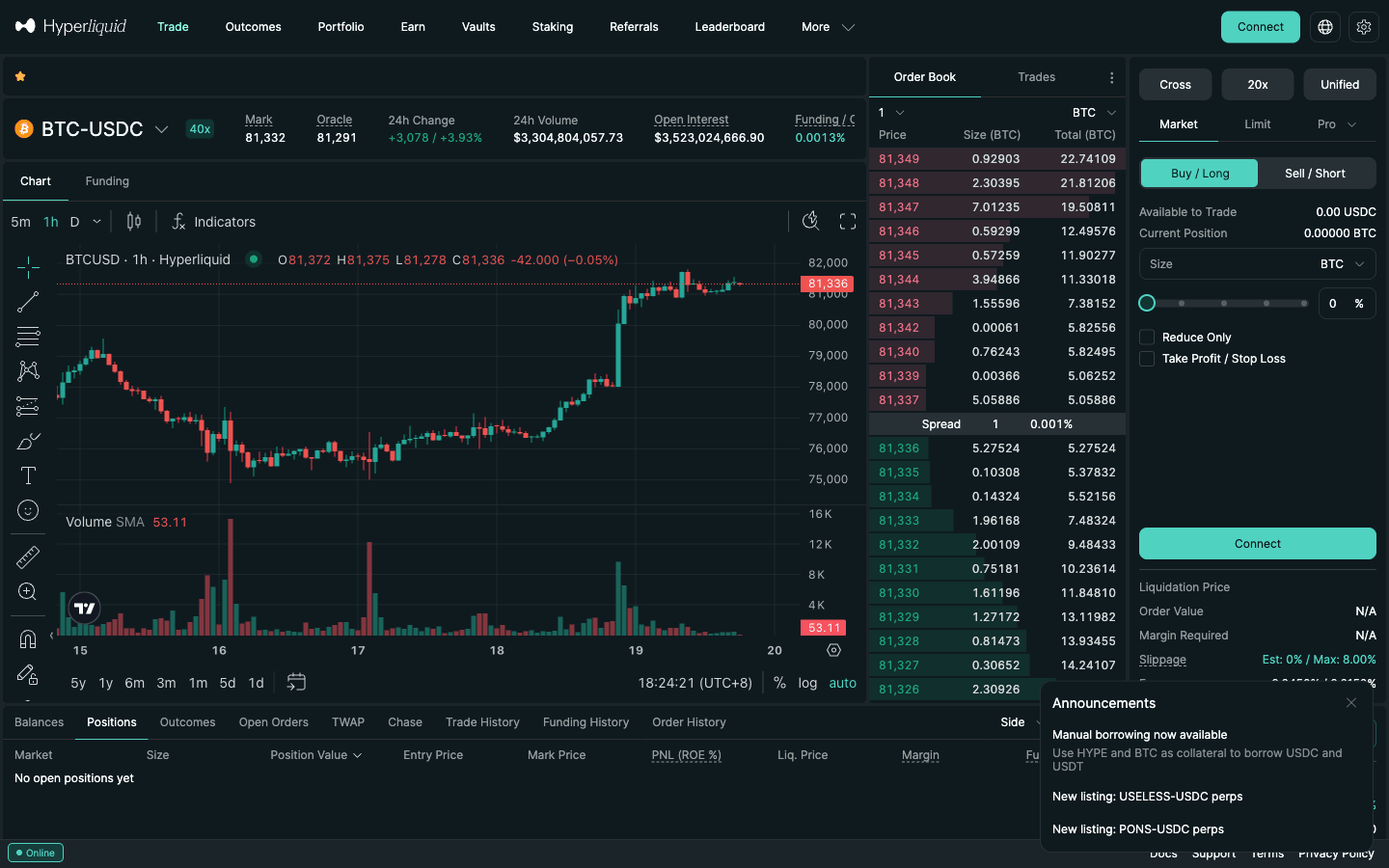
Short version (September 25, 2026). Hyperliquid: 0.045% taker / 0.015% maker, $7.63B 24h perp volume, $13.09B open interest, 178 perps, BTC 40x. Lighter: 0% / 0% on Standard (300 ms taker delay), $1.62B volume, 210 perps, BTC 50x. Aster: 0.04% taker / 0% maker, $1.54B volume, 584 symbols, 200x on the first BTC bracket. None needs KYC, none charges gas on orders. Our default for most readers: Hyperliquid with code HOLYGRAIL (4% off).
Pros and cons of each
Hyperliquid
Best for: size, multi-day holds, liquid altcoins, stocks in the same account.
Pros
- Deepest books: the most volume and more open interest than Lighter and Aster combined.
- Every order, cancel, trade and liquidation happens on its own chain, in public.
- 179 perps (as of November 3, 2026) plus HIP-3 stock and commodity markets.
- Hourly funding, HLP and user vaults, mature API and CCXT support.
- The only guaranteed referral discount: 4% off your first $25M.
Cons
- Highest entry taker fee of the three (0.045%).
- No Japanese interface; iPhone users trade in Safari.
- HLP has absorbed manipulation losses, and validators once delisted a market (JELLY, 2025).
- Stake is concentrated: Foundation validators hold 47.3%.
Lighter
Best for: frequent small market orders on BTC, ETH, FX and indices.
Pros
- 0% maker and 0% taker on the default Standard account.
- Matching is proven with ZK proofs verified on Ethereum, with an Escape Hatch exit.
- Native iOS and Android apps; Japanese language setting on the web.
- Wide real-world-asset list: US and Asian stocks, FX, metals, pre-IPO.
Cons
- Standard adds 300 ms to taker orders and cancels; maker orders are not delayed.
- Thin beyond BTC and ETH: most of its 210 perps trade under $1M a day.
- Highest volume-to-open-interest ratio of the three; DefiLlama normalizes only part of its volume.
- The referral perk only helps if you use Premium.
Aster
Best for: limit-order flow, long-tail symbols, private positions, stock perps.
Pros
- 0% maker fees at every VIP level; stock perps at 1.25 bps taker.
- The most symbols: 584 trading perps.
- Account Privacy and hidden orders keep positions out of public view.
- Japanese interface and a Binance-style API that makes bots easy to port.
Cons
- The 200x headline only applies up to $400 of BTC notional.
- Aster Chain has no external validators yet, and its core contracts are closed-source.
- Its volume history was questioned: in October 2025 DefiLlama began recording days above $25B as zero.
- Four trading modes with different fee models; no referral discount is guaranteed.
Lighter
Code 718610TD: 10% of your trading fees rebated every Monday on fees you pay on Premium, Plus or advanced orders.
We earn a commission when you sign up through our links; it never raises your fees.
The side-by-side table
Every cell below was read from the exchange's own documentation or public API on September 25, 2026 (rows added on September 27, 2026: stocks, funding interval, architecture, vaults, best for). Live values (volume, open interest, market count) move daily; Hyperliquid's weekday volume typically sits in the $4–8B range.
| September 25, 2026 | Hyperliquid | Lighter | Aster |
|---|---|---|---|
| Best for | Size, long holds, the most liquid alts, stocks and commodities (HIP-3) in one account | Small, frequent market orders on BTC, ETH, FX and indices at zero fees | Limit-order (maker) flow, long-tail symbols, private positions, cheap stock perps |
| Taker / maker fee (entry tier) | 0.045% / 0.015% | Standard 0% / 0% · Premium 0.028% / 0.004% | 0.04% / 0% (USDT perps) |
| With our referral code | 0.0432% / 0.0144% (4% off, first $25M) | 10% of fees rebated weekly (Standard stays free) | DTLpLc: 5% of your fees back as a rebate (each referrer sets its own share) |
| Other discounts | Volume tiers to 0.024% / 0%; HYPE staking 5–40% | Premium: staked LIT 2.5–30% | VIP tiers to 0.016% taker (volume + ASTER balance); ASTER-payment 5% off is spot only |
| Max leverage BTC / ETH / SOL | 40x / 25x / 20x | 50x / 50x / 25x | 200x / 200x / 100x (first bracket only: ≤ $400 BTC notional) |
| Live perp markets | 178 (plus HIP-3 stocks and commodities) | 210 perps + 10 spot | 584 trading symbols |
| Stocks / RWA perps | Via HIP-3 markets such as trade.xyz (US stocks, indices, commodities) from the same account | 56 US stock, ETF and index perps + 17 Asian stock and ETF perps, FX, metals, pre-IPO | US, Hong Kong and Korean stock perps up to 50x; RWA taker 1.25 bps |
| 24h perp volume | $7.63B | $1.62B | $1.54B |
| Open interest | $13.09B | $0.62B | ~$1.42B (DefiLlama) |
| Volume ÷ open interest | 0.58× | 2.63× | 1.08× |
| Funding interval | Every hour | Every hour (peer-to-peer) | 8 hours on BTC/ETH; 1–8 hours by symbol |
| Order latency (published) | Median 0.2 s, p99 0.9 s end-to-end (co-located) | Standard: 300 ms taker and 300 ms cancel delay, maker not delayed; 140 ms taker on Premium | No order latency published; Aster Chain 50 ms blocks |
| Architecture | Order book fully on its own L1 (HyperBFT consensus); HLP backstops liquidations | Off-chain sequencer; ZK proofs verified on Ethereum; Escape Hatch exit to Ethereum | Own L1 (Aster Chain, Proof-of-Staked-Authority) + validator-signed bridges |
| Vaults / copy trading | HLP protocol vault (lock-up 4 days) + user vaults (leader keeps 10% of profits, lock-up 1 day); copy trading through third-party apps | LLP protocol vault (open to LIT stakers, up to 10 USDC per LIT staked) + public pools run by whitelisted operators, no lock-up | AOS3 vaults: a manager locks 100 ASTER, sets a 0–100% profit share; default lock-up 1 day |
| Deposits | USDC (Arbitrum; email login also Base, Ethereum, Polygon); native BTC/ETH/SOL via Unit; 5 USDC minimum | Universal addresses on 12 networks incl. Bitcoin, Solana, Tron, BNB Chain; $5 minimum for a new account | BNB Chain, Ethereum, Arbitrum, Solana; no minimum set in the API |
| USDC withdrawal | 0.2 USDC plus a tiny HyperEVM gas fee, within 5 minutes to Arbitrum | Secure to Ethereum (queue ~24 min that day) or fast via Arbitrum (4 USDC min) | Destination gas deducted; docs quote ~30 s |
| Japanese UI | No (EN, ES, FR, KO, ZH) | Yes (language setting in the web app) | Yes (asterdex.com/ja) |
| Mobile | Official Android app; iPhone via Safari | Native iOS + Android (Lighter Mobile) | Android app; iOS only in some storefronts |
| API | REST + WebSocket, official Python SDK, CCXT | REST + WebSocket, SDK; Standard 60 req/min | Binance-style REST/WS (2,400 weight/min) |
| Token / points | HYPE; points program ended 2024 | LIT; no points page on the main exchange (404) | ASTER; Stardust points paused Aug 30, 2026 |
Sources: Hyperliquid API metaAndAssetCtxs and docs; Lighter API exchangeStats / orderBooks / orderBookDetails and docs.lighter.xyz; Aster fapi exchangeInfo / ticker and docs.asterdex.com; Aster open interest from DefiLlama's perps table (same day). Leverage is the maximum for the smallest position size.
What a trade actually costs (with referral codes)
Fees are where the three differ most, and the ranking flips depending on whether you take liquidity or provide it. Here is a $10,000 BTC position opened and closed (a round trip) at each venue's entry tier:
| Round trip on $10,000 | Market orders (taker × 2) | Limit orders (maker × 2) |
|---|---|---|
| Hyperliquid | $9.00 | $3.00 |
Hyperliquid with HOLYGRAIL | $8.64 | $2.88 |
| Lighter Standard | $0.00 | $0.00 |
| Lighter Premium (0 LIT staked) | $5.60 | $0.80 |
| Aster (USDT perps, VIP 1) | $8.00 | $0.00 |
Three things the headline rates hide:
- Lighter's free tier is paid for in time. Standard accounts get 300 ms added to taker orders and cancels, and maker orders are not delayed (docs, October 6, 2026). For a swing trader that is invisible; for a scalper racing other bots it matters. Premium removes most of that delay for 0.028% taker. Our Lighter referral code guide explains the first-week Premium rebate.
- Aster's 0.04% applies to its "General" group. 21 thinly traded "Group B" pairs cost 0.1% taker and RWA perps (gold, stocks) 0.0125%. Maker is 0% on all of them. Full ladder in Aster fees.
- Hyperliquid gets cheaper faster with size. Above $5M of 14-day volume taker drops to 0.040%, and HYPE staking takes another 5–40% off. Details in Hyperliquid fees, and you can model your own mix with the DEX fee calculator.
Your monthly fee bill. If all your volume is market orders, this is what each venue charges per month at the entry tier. All three volumes stay on it: Hyperliquid's first volume discount starts at $5M of 14-day volume.
| Monthly taker volume | $100,000 | $1,000,000 | $10,000,000 |
|---|---|---|---|
| Hyperliquid (0.045%) | $45 | $450 | $4,500 |
Hyperliquid with HOLYGRAIL | $43.20 | $432 | $4,320 |
| Lighter Standard (0%) | $0 | $0 | $0 |
| Lighter Premium (0.028%) | $28 | $280 | $2,800 |
| Aster VIP 1 (0.04%) | $40 | $400 | $4,000 |
Registry rates as of September 27, 2026. Makers pay less everywhere: 0.015% on Hyperliquid, 0% on Lighter Standard, 0% on Aster.
Fees are not the whole cost. Funding on a multi-day hold usually outweighs them: in the seven days to September 25, 2026 a BTC long paid 0.2233% in funding on Hyperliquid, 0.2011% on Lighter and 0.0924% on Aster, which is $22.33, $20.11 and $9.24 on $10,000. Funding flows between traders, not to the exchange, and changes every hour; see funding rates explained.
Liquidity: volume, open interest and depth
Liquidity decides your slippage, and slippage on a large order can dwarf any fee difference. On September 25, 2026:
- Hyperliquid cleared $7.63B of perp volume in 24 hours with $13.09B of open interest. BTC alone traded $3.20B, ETH $955M, then ZEC, HYPE and SOL. That is more open interest than Lighter and Aster combined, many times over.
- Lighter traded $1.62B with about $0.62B of open interest across its active perps. Activity is concentrated: BTC ($767M) and ETH made up roughly two thirds of volume in our earlier check the same day, and most of the 210 perps trade under $1M a day.
- Aster traded $1.54B across 584 symbols; BTCUSDT was $476M and ETHUSDT $292M. DefiLlama showed about $1.42B of open interest.
For BTC and ETH all three books are tight. Our Lighter order-book simulation earlier that day found a $100,000 BTC market buy would move about 0.5 bp and a $1M buy about 1.3 bp. Beyond the top pairs, Hyperliquid's depth advantage grows quickly, which is why larger traders default to it. How to measure it yourself: price impact and slippage. The live cross-venue volume table is in our perp DEX ranking.
Is the volume real? Volume vs open interest
The top search result for this comparison is a data dashboard asking one question: is the volume on these venues real, or farmed? A quick check is to divide 24-hour volume by open interest. Positions that are genuinely held show up as open interest; volume far above open interest means the same money turns over many times a day, which is what fee-free scalping, points farming or wash trading produce. Here are two same-moment snapshots we took from the exchanges' own APIs:
| Venue | Thu September 25, 2026, 17:00 UTC volume / OI | Ratio | Sun September 27, 2026, 02:05 UTC volume / OI | Ratio |
|---|---|---|---|---|
| Hyperliquid | $7.63B / $13.09B | 0.58× | $2.93B / $13.10B | 0.22× |
| Lighter | $1.62B / $0.62B | 2.63× | $0.65B / $0.62B | 1.04× |
| Aster | $1.54B / $1.42B | 1.08× | $0.78B / $1.43B | 0.54× |
Volume: Hyperliquid metaAndAssetCtxs, Lighter exchangeStats, Aster ticker/24hr (trading perps). Open interest: one side, from each API; Aster's from DefiLlama's open-interest endpoint. Sunday's 24 hours cover a weekend, when volume falls and open interest does not.
How to read it:
- Hyperliquid has the lowest ratio: traders hold large positions and turn them over less than once a day. DefiLlama counts its full reported volume as normalized volume.
- Lighter turns over fastest on weekdays (2.63×), which fits zero taker fees: scalpers and bots can trade in and out for free. DefiLlama's normalized figure for Lighter was $2.21B of $2.99B reported (74.1%) on October 21, 2026, so it discounts part of that flow. That is not proof of wash trading; Lighter's points rules say self-trading earns nothing.
- Aster is the one with a history. On October 15, 2025, during its points campaigns, DefiLlama changed its Aster adapter so that any day above $25B of volume is recorded as zero, "until we figure out the farming volume methodology with orderbook data" (DefiLlama's commit). A year later its volume sits close to or below its open interest, a normal-looking ratio, and the Stardust points program has been paused since August 30, 2026.
Over 30 days DefiLlama counted $212B of perp volume on Hyperliquid, $49.3B on Aster, $66B on Lighter and $25.7B on edgeX, another venue we cover (read September 26, 2026). A community Dune dashboard charts the same three venues, though its author marks it as outdated. For the full method (reported vs normalized volume, trade sampling, liquidations), read how to spot wash trading on a DEX; for what open interest tells you, see the open interest guide.
Architecture and safety: how each could fail
All three are self-custodial: you sign every order, and no company holds your balance. What differs is who runs the matching engine, what checks it, and how you get your money out if something breaks.
- Hyperliquid: an order book on its own chain. HyperCore runs the order books "fully onchain": every order, cancel, trade and liquidation is a transaction on Hyperliquid's L1, finalised by HyperBFT consensus. The trade-off is who secures that chain: 27 active validators; the five Hyper Foundation validators hold 47.3% of stake (API, September 26, 2026). Liquidations that the book cannot absorb are taken over by the liquidator vault inside HLP, so HLP depositors carry that risk. USDC deposits now route through Circle's CCTP; the legacy Arbitrum bridge, audited by Zellic, holds less than 10% of HyperCore's USDC per the docs.
- Lighter: matching proven on Ethereum. A sequencer matches orders off-chain at exchange speed, and each batch of matching and liquidations is proven with zero-knowledge proofs that Ethereum verifies before the state updates. The data to rebuild every account is posted to Ethereum. If the sequencer ignores exit requests sent through Ethereum's priority queue, the contract enters Escape Hatch mode and users withdraw directly on Ethereum. The docs publish 9 audit files for the contracts and circuits. This is the strongest exit guarantee of the three; the remaining risks are market ones (leverage, the LLP insurance vault, a single sequencer for live trading).
- Aster: its own young L1 plus bridges. Aster Chain uses Proof-of-Staked-Authority with 50 ms blocks. In Phase 1 there are no external validators, and Aster says its core chain contracts and RPC infrastructure "will not be open-sourced at the moment" to protect its matching engine. Funds arrive through validator-signed bridges from BNB Chain, Ethereum, Arbitrum, Solana and other chains. Privacy is the upside: with Account Privacy on, orders are ZK-verified and balances and positions are hidden. Aster's audits cover its vault and yield contracts rather than the order-book engine.
Incident history (public record, as of September 27, 2026):
| Date | Venue | What happened | Source |
|---|---|---|---|
| Mar 12, 2025 | Hyperliquid | A 50x ETH whale withdrew margin and was liquidated; HLP lost about $4M. "No protocol exploit or hack." Max leverage was cut to 40x BTC / 25x ETH. | @HyperliquidX |
| Mar 26, 2025 | Hyperliquid | JELLY squeeze: validators voted to delist the market; users other than flagged addresses were made whole by the Hyper Foundation. | @HyperliquidX |
| Jul 29, 2025 | Hyperliquid | API outage of about 37 minutes; the chain kept producing blocks and affected traders were refunded (about $1.99M). | Hyperliquid announcements |
| Sep 2025 | Aster | A misconfigured index price on the newly listed XPL perp spiked its price and liquidated traders. Not a hack; Aster reimbursed affected users, fees included. | News reports |
| Oct 10–11, 2025 | Hyperliquid | Market-wide crash: auto-deleveraging closed some profitable positions; Hyperliquid reported no downtime and no bad debt. | Hyperliquid announcements |
| Oct 15, 2025 | Aster | DefiLlama stopped counting Aster volume on days above $25B over farming concerns. | DefiLlama GitHub |
| Nov 12, 2025 | Hyperliquid | POPCAT manipulation across 19 wallets left HLP with bad debt; the Arbitrum bridge was paused temporarily. | Halborn post-mortem |
Lighter does not publish an incident log, and we have not verified any Lighter incident from an official source, so we list none rather than repeat unverified reports. A longer, labelled timeline for Hyperliquid (including a user's leaked private key, which was not a protocol breach) is in our Hyperliquid review; Aster's audits and risks are in the Aster review and Lighter's Escape Hatch in the Lighter review. The checks that apply to any venue are in our DEX security checklist.
Leverage, markets and stocks
Maximum leverage on these venues depends on position size, so the headline figure only applies to small positions.
- Hyperliquid: BTC 40x (up to $150M notional), ETH 25x, SOL and XRP 20x, 30 markets at 10x and the remaining 144 at 5x or 3x. Its HIP-3 markets add stocks, indices and commodities (trade.xyz alone lists over 100), traded from the same account. See trade.xyz stocks on Hyperliquid.
- Lighter: 50x on BTC, ETH, SPY, US500 and major FX pairs; 25x on SOL, gold and silver; 20x on XRP, HYPE and large US stocks. Its real-world-asset list includes 56 US stock, ETF and index perps and 17 Asian stock and ETF perps, plus pre-IPO markets.
- Aster: the order book shows 200x on BTC and ETH, but only up to $400 of notional; 150x up to $300,000 and 100x up to $800,000 on BTC. 317 of its 584 symbols start at 5x (September 25, 2026). Its stock perps (US, Hong Kong and Korean shares) go up to 50x and cost 1.25 bps taker, the cheapest stock perps of the three. The separate 1001x mode is pool-based, with a profit cap and a fee on profit at 500x and above. See leverage tiers across DEXs.
High leverage mostly buys you a liquidation price closer to entry. At 40x a 2.5% move against you wipes the margin; at 200x it is 0.5%. If you are new to this, read risk management for perps before choosing a venue on leverage.
Ready to pick? Start where the liquidity is
For most traders, Hyperliquid is the safest default: the deepest books, 179 perps (as of November 3, 2026) and hourly funding. Code HOLYGRAIL takes 4% off your fees for the first $25M.
Speed and execution
What the exchanges publish:
- Hyperliquid: end-to-end order latency of 0.2 s median and 0.9 s at the 99th percentile for a co-located client (HyperCore overview). Cancels and post-only (ALO) orders are processed before market orders sent at the same time, which protects makers. Latency-sensitive traders can pay an IOC priority fee: about 45 ms faster per 1 bp paid, up to 8 bp, and the fee is burned.
- Lighter: Standard accounts carry an added 300 ms on taker orders and 300 ms on cancels; maker orders are not delayed. Premium is 140 ms taker, with no added delay on cancels and post-only orders.
- Aster: Aster Chain produces 50 ms blocks and claims up to 100,000 TPS. Aster does not publish an order round-trip figure, so we do not quote one.
From a connection in Tokyo, our warm HTTPS requests to each exchange's public order-book endpoint (30 requests each, September 25, 2026) came back in a median 98 ms from Hyperliquid, 116 ms from Lighter and 101 ms from Aster (Binance: 95 ms). That measures the network path to the API, not how fast an order is matched, but it shows none of the three is slow to reach from Japan. The full breakdown, including queue position and slippage caps, is in our execution speed and fill quality comparison.
Deposits, withdrawals and chains
Hyperliquid runs on its own L1. With a wallet you deposit USDC on Arbitrum (5 USDC minimum, anything smaller is lost); email accounts can also deposit from Base, Ethereum and Polygon. Native BTC, ETH and SOL arrive through Unit. Withdrawing USDC costs 0.2 USDC plus a tiny HyperEVM gas fee in HYPE and arrives on Arbitrum within 5 minutes through Circle CCTP; you need no ETH on Arbitrum.
Lighter is a zk-rollup whose funds sit in contracts on Ethereum. Its universal deposit addresses accept assets from 12 networks, including Bitcoin, Solana, Tron, BNB Chain, Base and Arbitrum ($5 minimum for a new account). Withdrawals are either secure (to Ethereum, through a queue whose public estimate read 1,412 s, about 24 minutes, on September 25, 2026) or fast (USDC via Arbitrum, 4 USDC minimum).
Aster runs its order book on Aster Chain and bridges to BNB Chain, Ethereum, Arbitrum and Solana. Deposit fees are zero; withdrawals deduct the destination chain's gas, and the docs quote about 30 seconds. Email-login accounts only accept USDT on Arbitrum One.
Side-by-side minimums, fees and times: DEX withdrawal fees compared.
Japanese UI, mobile, API, vaults, tokens and points
- Japanese interface: Lighter (language setting in the web app) and Aster (asterdex.com/ja) have one; Hyperliquid's web app ships English, Spanish, French, Korean and Chinese only.
- Mobile: Lighter has native iOS and Android apps. Hyperliquid Corp publishes an Android app, and iPhone users run the web app in Safari. Aster's Android app is on Google Play; its iOS app was not listed in the US or Japanese App Store. Comparison: best DEX apps.
- API: Hyperliquid has REST and WebSocket APIs, an official Python SDK and certified CCXT support. Lighter's API needs an API key per account index and limits Standard accounts to 60 requests a minute. Aster copies Binance's futures API, which makes bots easy to port. Guides: Hyperliquid API, Lighter API, Aster API.
- Vaults and copy trading: none of the three has a built-in copy-trade button, but all three let you put money behind someone else's strategy. Hyperliquid has the HLP protocol vault (lock-up 4 days) and user vaults, where the leader keeps 10% of profits; apps such as Hyperdash add copy trading on top for a builder fee. Lighter has the LLP, open to LIT stakers, and public pools run by whitelisted operators with no lock-up. Aster's AOS3 vaults let a manager who locks 100 ASTER take a 0–100% share of realized profits, with a default lock-up of 1 day. Guides: Hyperliquid vaults, Hyperliquid copy trading, Lighter LLP and pools.
- Tokens: HYPE ($80.66), LIT ($3.83) and ASTER ($0.7180) on CoinGecko on October 22, 2026. HYPE staking cuts Hyperliquid fees by 5–40%; staked LIT cuts Lighter Premium fees by 2.5–30%; holding ASTER is required for Aster's higher VIP tiers. Comparison: HYPE vs LIT vs ASTER.
- Points: none are running on the main exchanges. Hyperliquid's program ended in 2024, Lighter's /points page returns 404, and Aster's Stardust page reads "Paused on 2026/8/30". Choose a venue on cost and liquidity, not on airdrop hopes.
Who should pick which
Choose Hyperliquid if you trade more than a few thousand dollars per order, hold positions for days, want the most liquid altcoin perps, or want stocks and commodities (HIP-3) in the same account. It also has the only referral discount you are guaranteed: 4% off your first $25M with HOLYGRAIL. Start with how to use Hyperliquid.
Choose Lighter if you place many small market orders on BTC, ETH or the big FX and index perps, and 300 ms does not matter to you. Zero fees on Standard mean 100 round trips a day cost nothing in commissions. If you later need speed, switch to Premium with the first week rebated through 718610TD. Guide: Lighter sign-up.
Choose Aster if you mostly post limit orders (0% maker), want a long-tail symbol the others do not list, prefer a Japanese interface, or already hold BNB-Chain assets. Account Privacy and hidden orders appeal to traders who do not want their positions visible. Code DTLpLc; see Aster for beginners.
A common set-up among active traders: Hyperliquid as the main account, Lighter for fee-free BTC/ETH scalps, Aster for a few symbols it alone lists. For the wider field (edgeX, dYdX, Pacifica and others), see the best DEXs in 2026; if the concept is new, start with what is a DEX.
Head-to-head comparisons
This page compares the three at a glance. For the details of any one pairing:
- Hyperliquid vs Lighter: order-book depth, zk-proofs vs an L1, and when free fees beat liquidity.
- Aster vs Hyperliquid: privacy features, leverage brackets and fee tiers.
- Lighter vs Aster: fees, depth and which of the two newer venues suits scalping.
- DEX vs CEX fees: all three against Binance and Bybit.
- Hyperliquid alternatives: eight perp DEXs sorted by the reason you would leave Hyperliquid, from fees and leverage to Solana and US access.
FAQ
Which is better: Hyperliquid, Lighter or Aster?
It depends on what you trade. Hyperliquid has the most liquidity by a wide margin ($7.63B of 24h perp volume and $13.09B of open interest on September 25, 2026) and is the best default for size, market coverage and reliability. Lighter is the cheapest: Standard accounts pay 0% maker and 0% taker, in exchange for 300 ms of added taker latency. Aster offers the most symbols (584), 0% maker fees and the highest headline leverage, plus a Japanese interface.
Which perp DEX has the most volume and open interest?
Hyperliquid, on every measure we checked. On September 25, 2026 it traded $7.63B in 24 hours against $1.62B on Lighter and $1.54B on Aster, and held $13.09B of open interest against about $0.62B and $1.42B. Over 30 days DefiLlama counted $212B for Hyperliquid, $49.3B for Aster and $66B for Lighter (read September 26, 2026). Hyperliquid alone holds more open interest than the other two combined, many times over.
Is Aster's or Lighter's volume real?
Nobody can prove it from the outside, but the usual test, volume divided by open interest, looked normal for Aster in September 2026 and high for Lighter, which fits its zero fees. In October 2025 DefiLlama changed its Aster adapter so that any day above $25B of reported volume counts as zero, "until we figure out the farming volume methodology"; that was the period of Aster's points campaigns. In September 2026 Aster's volume was close to or below its open interest (1.08× on Thursday, September 25, 0.54× on Sunday, September 27). Lighter's volume ran at 2.63× its open interest on a weekday, the highest turnover of the three, and DefiLlama counted 74.1% of its reported 24h volume as normalized. Zero taker fees make volume cheap to produce, so weigh open interest and depth more than raw volume.
Is Lighter really zero fees?
Yes on its default Standard account: 0% maker and 0% taker. The cost is time: Standard taker orders and cancels get 300 ms of added latency; maker orders are not delayed. Premium accounts pay 0.028% taker and 0.004% maker for 140 ms taker latency. Everyone still pays funding (to other traders) and a liquidation fee if liquidated.
Is Hyperliquid, Lighter or Aster safe?
All three are self-custodial, and we found no report of a protocol hack that drained user balances on any of them as of September 27, 2026; the risks differ. Hyperliquid runs its whole order book on its own chain, but its HLP vault has absorbed manipulation losses (March and November 2025), and stake is concentrated: 27 active validators; the five Hyper Foundation validators hold 47.3% of stake. Lighter has the strongest exit guarantee: proofs are verified on Ethereum and an Escape Hatch lets you withdraw on Ethereum if the operator stops. Aster Chain is the youngest: no external validators in Phase 1 and closed-source core contracts, and a misconfigured XPL market in September 2025 liquidated traders before Aster reimbursed them.
Which has the lowest fees?
Lighter, on its default Standard account: 0% maker and 0% taker on perps and spot. A $10,000 market order costs $0 there, $4.00 on Aster (0.04%) and $4.50 on Hyperliquid (0.045%), or $4.32 with the HOLYGRAIL referral code. For resting limit orders Aster is also free (0% maker) and Hyperliquid charges 0.015%.
Which has the highest leverage?
On paper Aster: BTCUSDT and ETHUSDT show 200x, but only for the first bracket, up to $400 of notional; from $400 to $300,000 BTC drops to 150x and to 100x up to $800,000. Lighter offers 50x on BTC and ETH, Hyperliquid 40x on BTC and 25x on ETH. Aster also has a separate pool-based 1001x mode, which is a different product with a profit cap.
Which is best for tokenized stocks?
All three list stock perps that trade around the clock. Aster is the cheapest to trade them (1.25 bps taker, 0% maker, up to 50x on US, Hong Kong and Korean stocks). Lighter has the widest list: 56 US stock, ETF and index perps and 17 Asian ones, plus FX and pre-IPO markets. Hyperliquid's stock markets are HIP-3 perps deployed by builders such as trade.xyz, traded from the same account as your crypto positions.
Can I copy trade or use vaults on all three?
None of the three has a one-click copy-trading button of its own, but each has vaults that do the same job. Hyperliquid has the HLP protocol vault and user vaults (the leader keeps 10% of profits), and third-party apps offer copy trading on top. Lighter has the LLP (for LIT stakers) and public pools run by whitelisted operators. Aster has manager-run vaults under its AOS3 standard, with a profit share of 0–100% set by the manager.
Which is fastest?
On published numbers, Lighter Premium (140 ms of taker latency) and Hyperliquid (0.2 s median end-to-end for a co-located client) are in the same range; Lighter Standard adds 300 ms to taker orders. Aster publishes a 50 ms block time but no order end-to-end figure. From a connection in Tokyo, our warm HTTPS round-trip to each public order-book endpoint had medians of 98 ms (Hyperliquid), 116 ms (Lighter) and 101 ms (Aster) on September 25, 2026 — network time, not matching time.
Do I need KYC, and can I use them from the US or Japan?
No KYC at sign-up on any of them: all three are self-custodial, and you connect a wallet (or log in with email) without submitting ID. None is available in the United States: Hyperliquid's terms exclude the US and Ontario, and Lighter's and Aster's terms both exclude the US, Canada and the UK, among others. Japan is not on any of the three lists as of September 2026. Never use a VPN to get around a venue's restrictions.
Can I use a referral code on all three?
Yes, but the benefit differs. Hyperliquid gives referred users 4% off fees for the first $25M of volume (code HOLYGRAIL). With Lighter code 718610TD you get 10% of your trading fees rebated every Monday from sign-up; Standard accounts are free anyway. Aster code DTLpLc gives you 5% of your Aster Perps fees back as a next-day rebate (Aster lets each referrer decide how much of its 10% commission to pass on). Enter each code before you trade: Hyperliquid refuses codes after $10,000 of volume.
Should I split my trading across all three?
Many active traders do: Hyperliquid for large orders and the widest range of liquid markets, Lighter for fee-free scalping on BTC and ETH, Aster for long-tail symbols or 0% maker flow. Keep in mind that collateral on each venue is separate, so splitting capital raises your liquidation risk on each account.
Disclosure: HOLYGRAIL (Hyperliquid), 718610TD (Lighter) and DTLpLc (Aster) are our referral codes; we earn a share of referred accounts' fees at no cost to you. All figures come from each exchange's documentation and public API, and CoinGecko for token prices, read between September 25, 2026 and September 27, 2026. Not investment advice.